China's successful blending of Marxism with its national realities has been pivotal in driving the country's rapid development and modernization while keeping people's well-being centerstage, said global scholars.
In the late 19th century, China began absorbing Western knowledge, including Marxism. Over a century later, Marxism continues to play an important role in the country's development and modernization.
In a recent China Global Television Network (CGTN) program, international experts discussed how Marxist principles have become an integral part of the unique Chinese path. "Since the late 19th century, China has absorbed various Western knowledge, including Marxism, the theory of evolution, liberalism, and classical economics, among others. After more than a century of exploration, China chose what was most necessary for its development, integrating these ideas with its unique circumstances," said A. V. Lomanov, a professor at the Russian Academy of Sciences.
Stephan Ossenkopp, a senior researcher at the German think tank Schiller Institute, expressed admiration for China's rapid development, noting that it has been fueled by trade rather than the colonialism practiced by Western countries.
"The pace of its (China's) progress is really breath-taking, if you think that Western countries have, first of all, relied on colonialism, getting the raw materials in illegal way elsewhere. China has not done that. China's always been involved in trade and deals. And on the other hand, the West has taken so much time to industrialize and modernize. China is doing this on a scale at the pace that's unprecedented," said Ossenkopp.
As for the practice of Marxism in China, Lomanov highlighted the importance of innovation and integration with local realities, which he believes is key to the long-term existence of Marxism and can offer significant inspiration to the global theoretical cycle.
"The vital source of Marxism's resilience lies in its ability to progress and adapt to local conditions. The Communist Party of China, along with scholars, has begun advancing the 'second combination'," said Lomanov, referring to the synthesis of Marxist principles with the finer parts of Chinese traditional culture.
"If successful, it could provide significant inspiration for theories and thinkers worldwide," he added.
Xin Xiangyang, president and Party deputy secretary of the Academy of Marxism at the Chinese Academy of Social Sciences, stated that Marxism continues to play a crucial role in helping China address challenges during the modernization process.
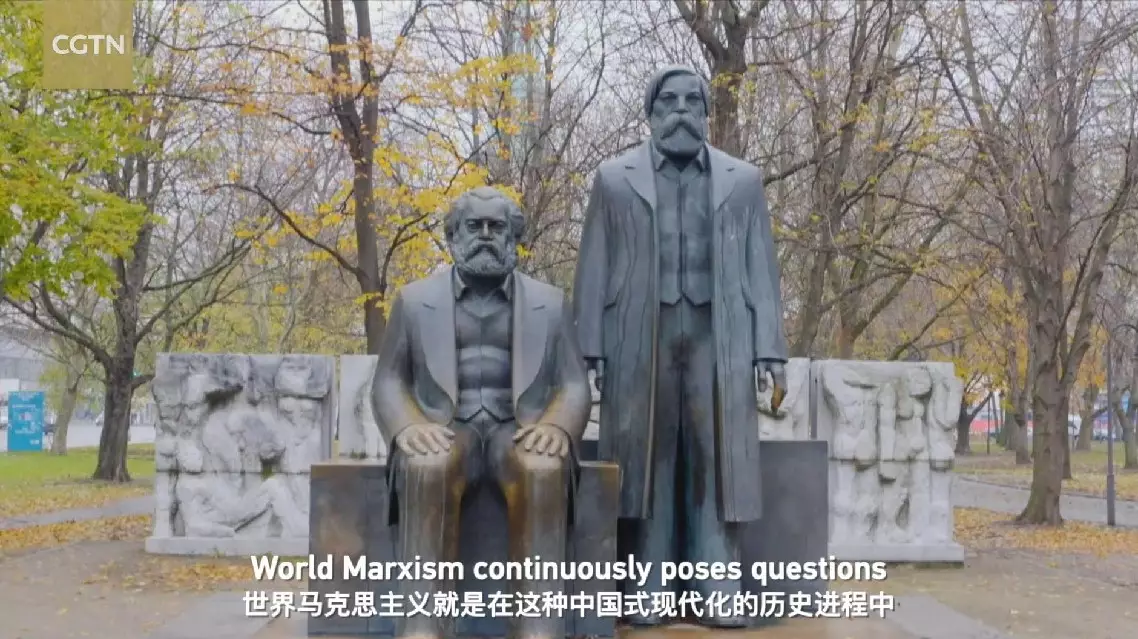
"World Marxism continuously poses questions within the historical process of Chinese modernization, with contemporary Marxism addressing these issues and systematically clarifying them theoretically," said Xin.
Integration of Marxism with China's national realities key to rapid development: scholars