DUBLIN (AP) — Ireland’s two long-dominant center-right parties looked likely to form a new government as results came in Sunday from a fractured national election, though with a reduced vote share and complex coalition negotiations ahead.
In an exception to the global anti-incumbent mood, outgoing governing parties Fianna Fail and Fine Gael took the two largest shares of the vote, narrowly ahead of left-of-center opposition Sinn Fein.
Click to Gallery
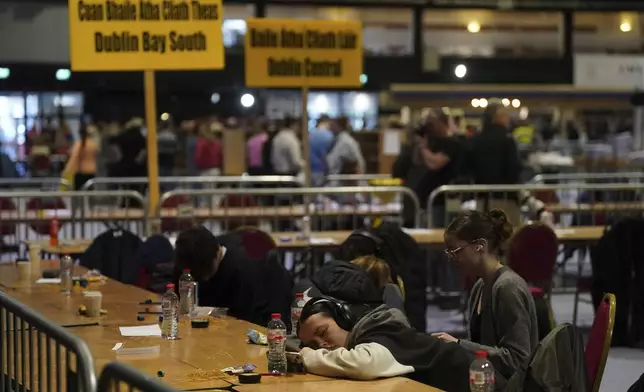
People take a break as the election count continues at RDS Simmonscourt after voters went to the polls during Ireland's election, in Dublin, Sunday, Dec. 1, 2024. (Brian Lawless/PA via AP)
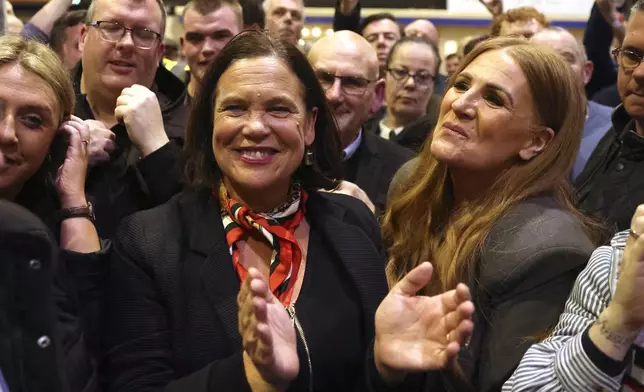
Sinn Fein president Mary Lou McDonald celebrates with supporters after arriving at the count at the Royal Dublin Society in Dublin, Saturday, Nov. 30, 2024.(AP Photo/Peter Morrison)
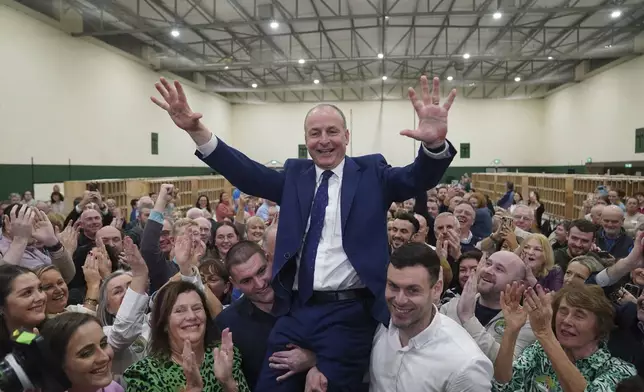
Fianna Fail leader Micheal Martin is hoisted up by his sons Cillian and Micheal Aodh, after he was deemed elected in the Cork South Central constituency at the election count centre at Nemo Rangers GAA Club in Cork, after the General Election, Saturday Nov. 30, 2024. (Jacob King/PA via AP)
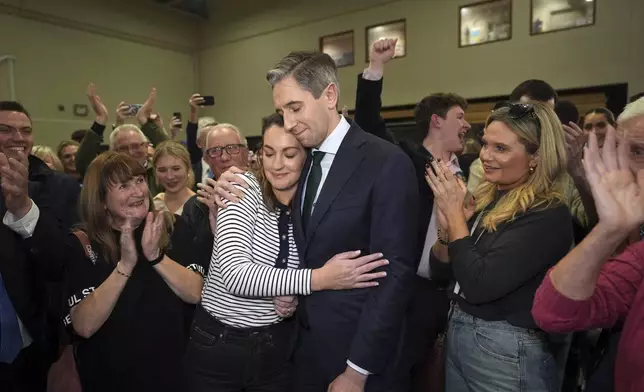
Irish premier Simon Harris is hugged by his wife Caoimhe after being re-elected to the Dail parliament as a TD for Wicklow on the first count at the election count centre at Shoreline Leisure Greystones in County Wicklow, south of Dublin, Ireland, after the General Election, Saturday, Nov. 30, 2024. (Niall Carson/PA via AP)
Under Ireland's system of proportional representation, vote share does not translate neatly into seats in parliament. With about two-thirds of results declared, Fianna Fail was on course to be the biggest party in the 174-seat Dáil, the lower house of parliament, with Fine Gael and Sinn Fein battling for second place.
It's certain that no party will have enough seats to govern on its own, and the most likely outcome is a coalition between Fianna Fail, led by Micheál Martin, and Fine Gael under outgoing Prime Minister Simon Harris. In that case either Harris or Martin — or possibly both, if they strike a job-sharing deal — will become Ireland's next premier, known as the taoiseach.
Sinn Fein, which aims to reunify the Republic of Ireland with the U.K. territory of Northern Ireland, lacks a clear path to power because the other two parties say they won’t work with it, partly because of its historic ties with the Irish Republican Army during three decades of violence in Northern Ireland.
Ireland uses a complex system of proportional representation in which each of the country’s 43 constituencies elects several lawmakers and voters rank candidates in order of preference. As a result, it can take days for full results to be known.
“The people of Ireland have now spoken,” Harris said. “We now have to work out exactly what they have said, and that is going to take a little bit of time.”
The cost of living — especially Ireland’s acute housing crisis — was a dominant topic in the three-week campaign, alongside immigration, which has become an emotive and challenging issue in a country of 5.4 million people long defined by emigration.
The results of Friday's election mean Ireland has partly bucked the global trend of incumbents being rejected by disgruntled voters after years of pandemic, international instability and cost-of-living pressures.
The next government, like the last, will likely be led by two parties that have dominated Irish politics for the past century. Fine Gael and Fianna Fail have similar policies, but are longtime rivals with origins on opposing sides of Ireland’s 1920s civil war. After the 2020 election ended in a virtual dead heat, they formed a coalition, propped up by the Green Party.
The Greens had a devastating result, losing all but one of their 12 seats. This time, the winning parties may turn to left-leaning Labour or the Social Democrats, or to independent lawmakers, for support.
For all the focus on migration, anti-immigration independents made few breakthroughs. Ireland does not have a significant far-right party to capitalize on the issue.
Reelected Fine Gael lawmaker Paschal Donohoe said the main theme of the election was “the center holding.”
Nonetheless, the new government will face huge pressure to ease rising homelessness, driven by soaring rents and property prices, and to better absorb a growing number of asylum-seekers. The big parties' share of the vote continues to decline, and voter disaffection expressed itself in support for small parties and independent candidates.
One of the more unorthodox independents was reputed organized crime boss Gerry “the Monk” Hutch, who saw a groundswell of support after he was bailed on money-laundering charges in Spain in November in order to run for election.
Hutch, who last year was acquitted of killing a gangland rival, came within a whisker of winning a seat in Dublin.
Lawless reported from London.

People take a break as the election count continues at RDS Simmonscourt after voters went to the polls during Ireland's election, in Dublin, Sunday, Dec. 1, 2024. (Brian Lawless/PA via AP)

Sinn Fein president Mary Lou McDonald celebrates with supporters after arriving at the count at the Royal Dublin Society in Dublin, Saturday, Nov. 30, 2024.(AP Photo/Peter Morrison)

Fianna Fail leader Micheal Martin is hoisted up by his sons Cillian and Micheal Aodh, after he was deemed elected in the Cork South Central constituency at the election count centre at Nemo Rangers GAA Club in Cork, after the General Election, Saturday Nov. 30, 2024. (Jacob King/PA via AP)

Irish premier Simon Harris is hugged by his wife Caoimhe after being re-elected to the Dail parliament as a TD for Wicklow on the first count at the election count centre at Shoreline Leisure Greystones in County Wicklow, south of Dublin, Ireland, after the General Election, Saturday, Nov. 30, 2024. (Niall Carson/PA via AP)
Protesters confronted federal officers in Minneapolis on Thursday, a day after a woman was fatally shot by an Immigration and Customs Enforcement officer.
The demonstrations came amid heightened tensions after President Donald Trump's administration dispatched 2,000 officers and agents to Minnesota for its latest immigration crackdown.
Across the country, another city was reeling after federal immigration officers shot and wounded two people in a vehicle outside a hospital in Portland, Oregon.
The killing of 37-year-old Renee Good in Minneapolis on Wednesday set off a clash between federal and state officials over whether the shooting appeared justified and whether a Minnesota law enforcement agency had jurisdiction to investigate.
Here's what is known about the shooting:
The woman was shot in her SUV in a residential neighborhood south of downtown Minneapolis, about a mile (1.6 kilometers) from where police killed George Floyd in 2020. Videos taken by bystanders and posted online show an officer approaching a vehicle stopped in the middle of the road, demanding the driver open the door and grabbing the handle.
The Honda Pilot begins to pull forward and a different ICE officer standing in front of the vehicle draws his gun and immediately fires at least two shots at close range, jumping back as the vehicle moves toward him.
It is not clear from the videos if the officer gets struck by the SUV, which speeds into two cars parked on a curb before stopping.
It’s also not clear what happened in the lead-up to the shooting.
Homeland Security Secretary Kristi Noem said the SUV was part of a group of protesters that had been harassing agents and “impeding operations” that morning. She said agents had freed one of their vehicles that was stuck in snow and were leaving the area when the confrontation and shooting occurred.
No video has emerged to corroborate Noem’s account. Bystander video from the shooting scene shows a sobbing woman who says the person shot was her wife. That woman hasn’t spoken publicly to give her version of events.
Good died of gunshot wounds to the head.
A U.S. citizen born in Colorado, Good described herself on social media as a “poet and writer and wife and mom." Her ex-husband said Good had just dropped off her 6-year-old son at school Wednesday and was driving home when she encountered ICE agents on a residential street.
He said Good and her current partner moved to Minneapolis last year from Kansas City, Missouri.
Good's killing is at least the fifth death to result from the aggressive U.S. immigration crackdown the Trump administration launched last year.
Noem said Thursday that there would be a federal investigation into the shooting, though she again called the woman’s actions “domestic terrorism.”
“This vehicle was used to hit this officer,” Noem said. “It was used as a weapon, and the officer feels as though his life was in jeopardy.”
Vice President JD Vance said the shooting was justified and referred to Good's death as “a tragedy of her own making.”
Minneapolis Police Chief Brian O’Hara gave no indication that the driver was trying to harm anyone when he described the shooting to reporters Wednesday. Minneapolis Mayor Jacob Frey said he had watched videos of the shooting that show it was avoidable.
The agent who shot Good is an Iraq War veteran who has served for nearly two decades in the Border Patrol and U.S. Immigration and Customs Enforcement, according to records obtained by The Associated Press.
Jonathan Ross has been a deportation officer with ICE since 2015, records show. He was seriously injured this summer when he was dragged by the vehicle of a fleeing suspect whom he shot with a stun gun.
Federal officials have not named the officer. But Noem said he was dragged by a vehicle in June, and a department spokesperson confirmed Noem was referring to the Bloomington, Minnesota, case in which documents identified the injured officer as Ross.
Court documents say Ross got his arm stuck in the window as a driver fled arrest in that incident. Ross was dragged 100 yards (91 meters), and cuts to his arm required 50 stitches.
According to police, officers initially responded to a report of a shooting outside a hospital Thursday afternoon.
Minutes later police heard that a man who had been shot was asking for help in a residential area a couple of miles away. Officers went there and found a man and a woman with gunshot wounds. Officers determined they were wounded in a shooting with federal agents.
Police Chief Bob Day said the FBI was leading the investigation and he had no details about events that led to the shooting.
The Department of Homeland Security said the vehicle’s passenger was “a Venezuelan illegal alien affiliated with the transnational Tren de Aragua prostitution ring” who was involved in a recent shooting. When agents identified themselves to the occupants during a “targeted vehicle stop,” the driver tried to run them over, the department said. An agent fired in self-defense, it said.
There was no immediate independent corroboration of that account or of any gang affiliation of the vehicle’s occupants.
Trump and his allies have consistently blamed Tren de Aragua for being at the root of violence and illicit drug dealing in some U.S. cities.
Drew Evans, head of Minnesota Bureau of Criminal Apprehension, said Thursday that federal authorities have denied the state agency access to evidence in the Good case, barring the state from investigating the shooting alongside the FBI.
Minnesota Gov. Tim Walz demanded that state investigators be given a role, telling reporters that residents would otherwise have a difficulty accepting the findings of federal law enforcement.
“And I say that only because people in positions of power have already passed judgment from the president to the vice president to Kristi Noem,” Walz said.
Noem denied that Minnesota authorities were being shut out, saying: “They don’t have any jurisdiction in this investigation.”
Dozens of protesters gathered Thursday morning outside a Minneapolis federal building being used as a base for the immigration crackdown. Border Patrol officers fired tear gas and doused demonstrators with pepper spray to push them back from the gate.
Area schools were closed as a safety precaution.
Protests were also planned across the U.S. in cities including New York, New Orleans and Seattle.
Associated Press writer Audrey McAvoy contributed.
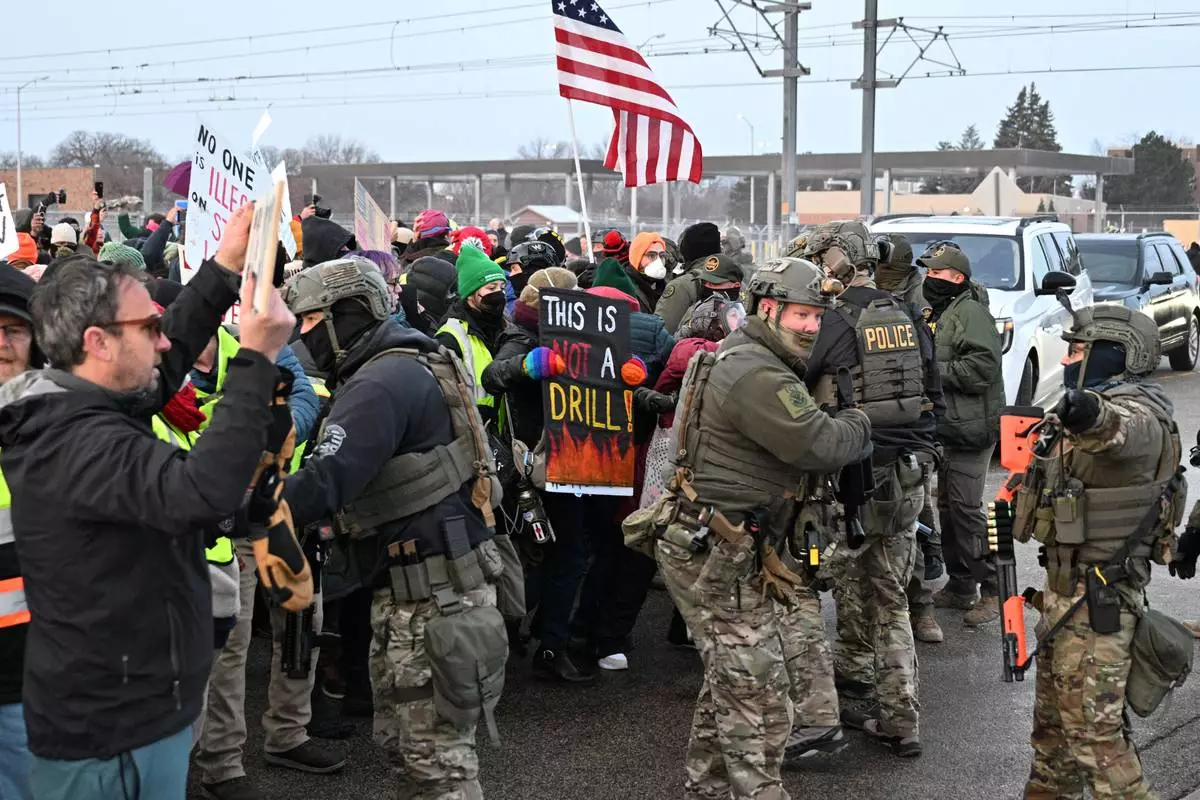
Protesters confront federal agents outside the Bishop Henry Whipple Federal Building, Thursday, Jan. 8, 2026, in Minneapolis, Minn. (AP Photo/Tom Baker)
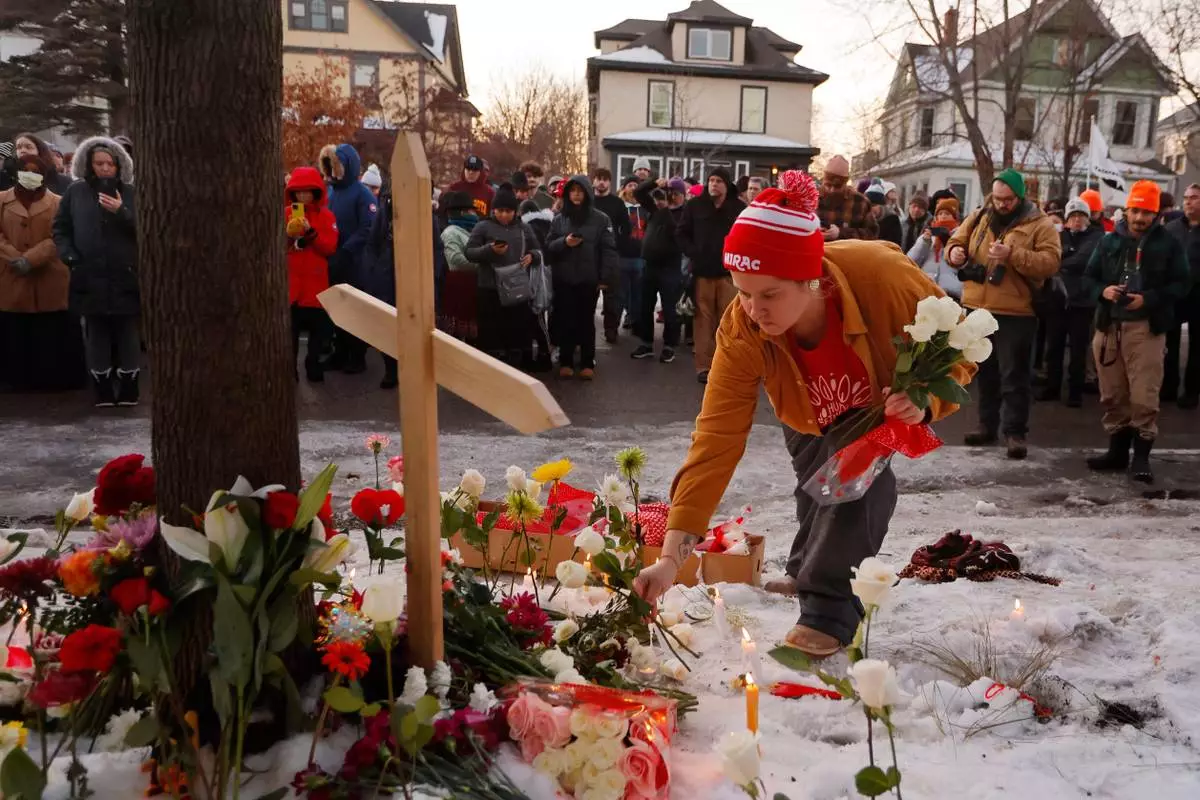
People gather for a vigil after an Immigration and Customs Enforcement officer shot and killed a motorist earlier in the day, Wednesday, Jan. 7, 2026, in Minneapolis. (AP Photo/Bruce Kluckhohn)
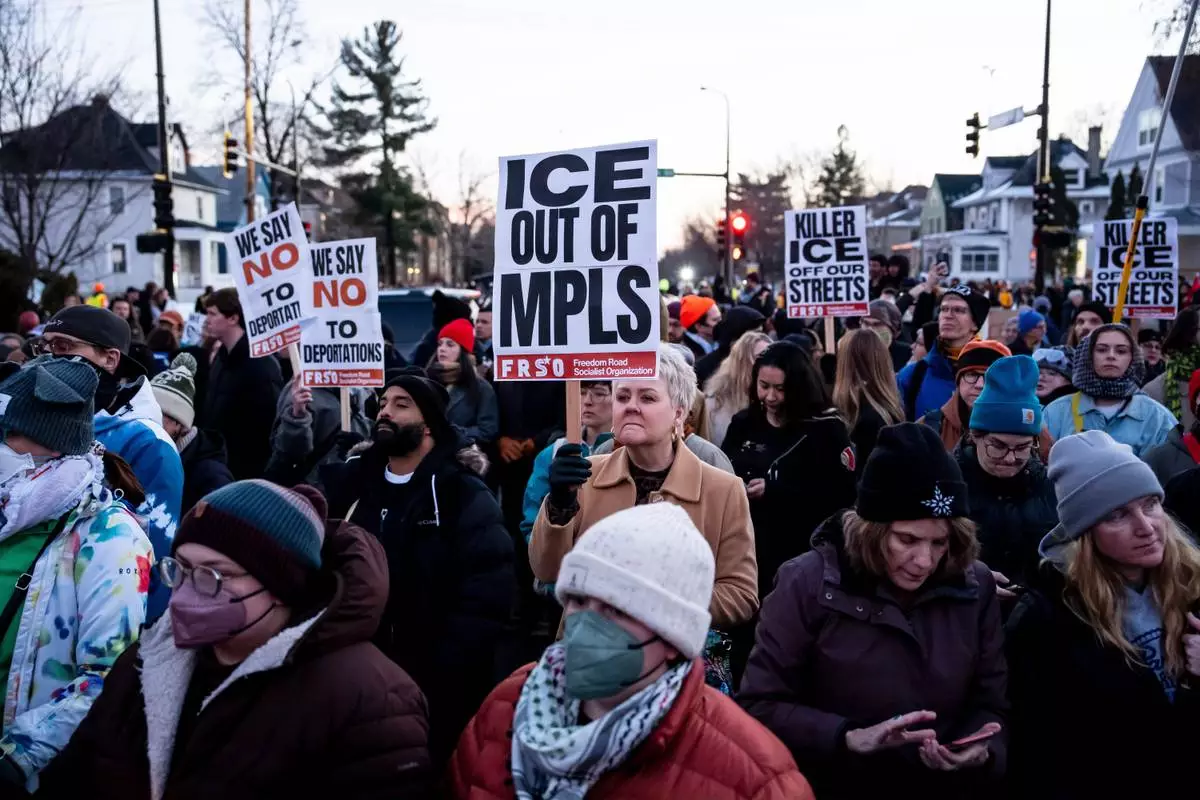
People participate in a protest and vigil after an Immigration and Customs Enforcement officer shot and killed a woman in Minneapolis, on Wednesday, Jan. 7, 2026. (Christopher Katsarov/The Canadian Press via AP)