China on Wednesday used an upgraded version of the Kuaizhou-1A (KZ-1A) carrier rocket to launch a new remote-sensing satellite into orbit.
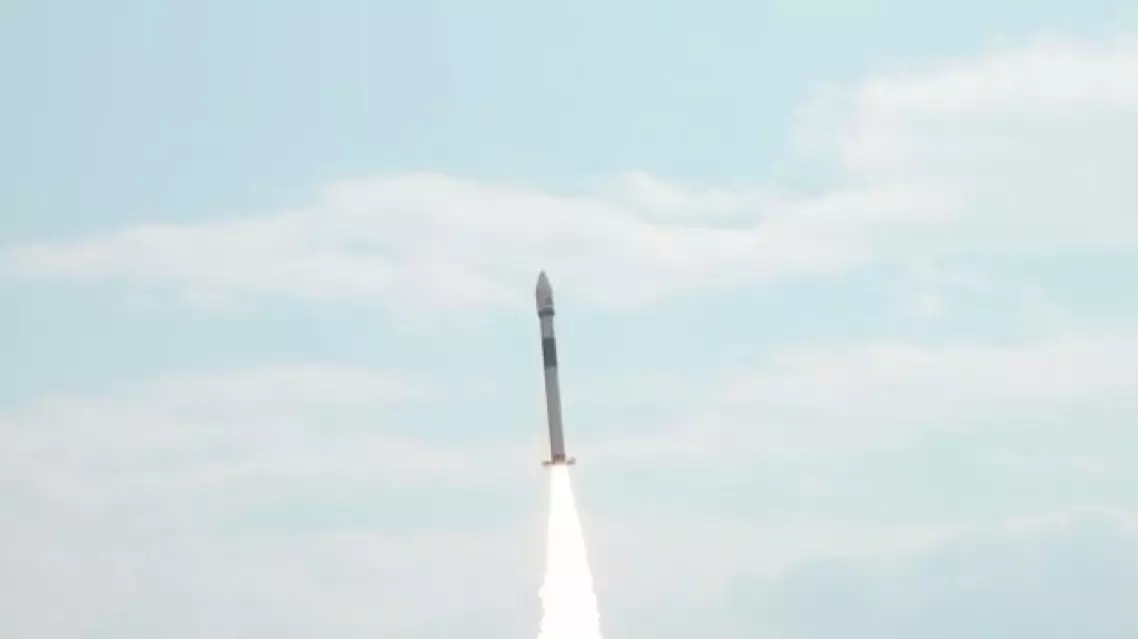
The upgraded version of the Kuaizhou-1A (KZ-1A) carrier rocket, carrying the new remote-sensing satellite equipped with a synthetic aperture radar (SAR), blasted off from the Xichang Satellite Launch Center in southwest China's Sichuan Province at 12:46 Beijing Time (0446 GMT) on Wednesday.
The upgraded version of the Kuaizhou-1A, a solid-propellant rocket, has a stronger payload capacity, higher reliability and improved performance.
"The fairing diameter has been enlarged from 1.4 to 1.8 meters, and the payload capacity of the Kuaizhou-1A in low Earth orbit has increased from 300 to 450 kilograms. Additionally, we have incorporated various technologies, including optimized high-load ratios, detasking, landing area control, and online parameter adjustment, which enhance the rocket's reliability and performance," said Fan Wei, deputy chief designer of the Kuaizhou-1A.
The mission development team also further optimized the orbital control scheme and applied landing control and other technologies, improving both the mission's adaptability and reliability, enabling it to undertake various types of launch missions, according to Fan. "Moving forward, the Kuaizhou-1A and Kuaizhou-11 will complement each other to form a system of low- and high-orbit carrier rockets, which will better serve the domestic microsatellite market," Fan said.
Remote sensing satellites refer to those tasked with observing, surveying and measuring objects on land or at sea as well as monitoring weather.
The mission marked the 28th flight of the Kuaizhou 1A model as well as China's 61st space launch so far this year.
Developed by China Space Sanjiang Group, the 20-meter Kuaizhou 1A is the country's most used solid-propellant carrier rocket model.
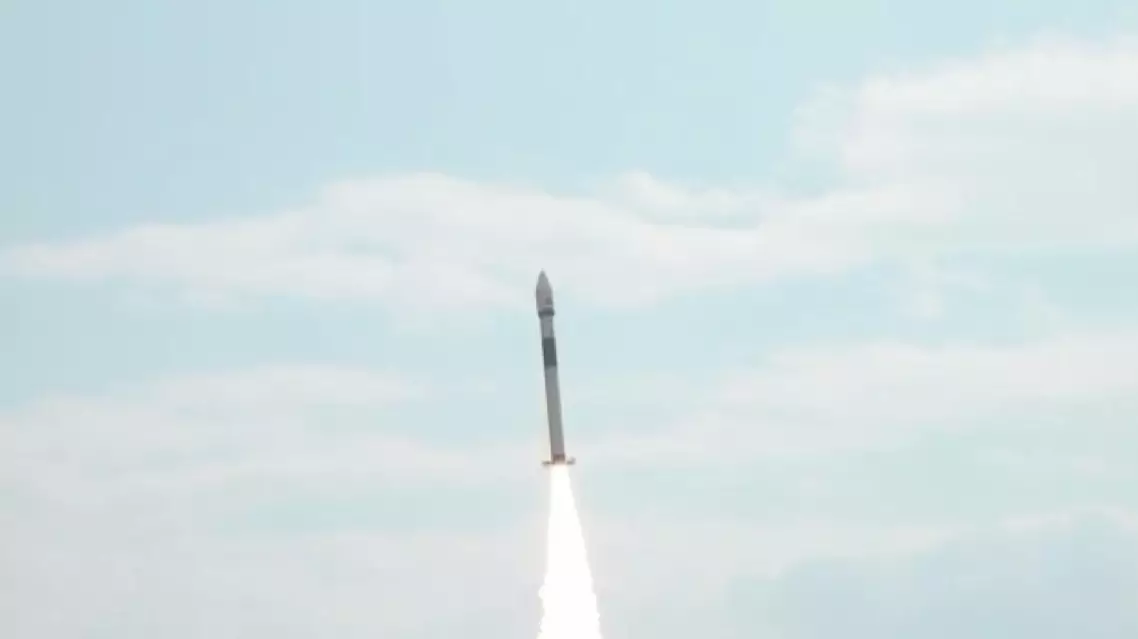
China uses upgraded version of Kuaizhou 1A carrier rocket to launch satellite
China uses upgraded version of Kuaizhou 1A carrier rocket to launch satellite
China uses upgraded version of Kuaizhou 1A carrier rocket to launch satellite
New research on a sacrificial zone of China's renowned Sanxingdui Ruins showed the ancient Shu Kingdom moved its political and cultural center from Sanxingdui to Jinsha in southwest China's Sichuan Province due to an unintentional fire.
Located in the city of Guanghan, the Sanxingdui Ruins are believed to be remnants of the Shu Kingdom dating back some 3,000 to 4,500 years. Two sacrificial pits were discovered in 1986, while another six were found in 2021. The core area of this site covers 3.6 square kilometers. The ruins are renowned for their large and medium-sized bronze artifacts, many of which feature striking and elaborate designs.
Yuanjiayuan, the ritual and sacrificial core of Sanxingdui, spans approximately 13,000 square meters and houses all the eight sacrificial pits. Radiocarbon dating places the area's peak activity in the late Shang Dynasty, roughly 3,200 to 3,000 years ago.
"The Yuanjiayuan sacrificial zone is the most significant archaeological discovery at Sanxingdui in recent years. It is the only fixed, high-ranking ritual space we have confirmed at the site," said Ran Honglin, a research fellow at the Sichuan Provincial Institute of Cultural Relics and Archaeology.
By analyzing the shape, structure, and burial patterns of the pits alongside scientific testing of building debris, bamboo-wood ash, and damaged artifacts, the team has ruled out deliberate ritual destruction or sacrificial burning. Instead, differential damage patterns suggest a different story.
"Our research indicates that an accidental fire likely destroyed the ritual objects originally displayed in the temple. The ancient Shu people then buried the damaged items in six large pits in a specific order," Ran explained.
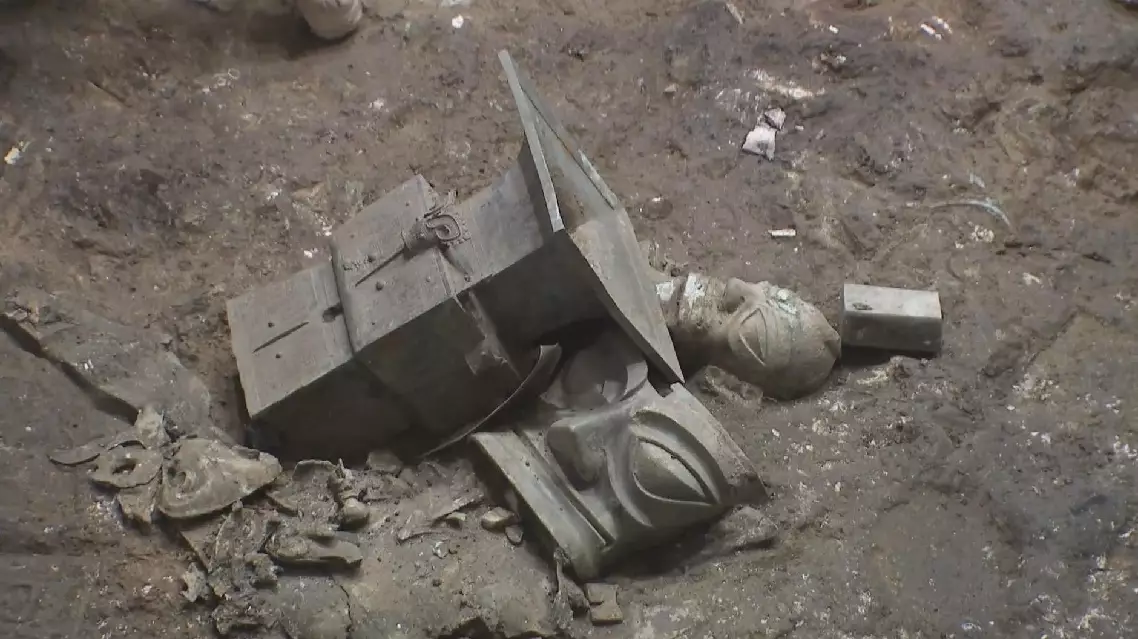
The varied degrees of damage support this theory. Large hollow bronze figures and bronze wine vessels were found severely fractured, while smaller solid bronze figurines and jade beads remained largely intact. Experts interpret this selective destruction as the result of collapsing architecture and falling debris, rather than intentional smashing. The fire, they believe, left the high-ranking sacrificial zone abandoned. Thereafter, the ancient Shu Kingdom shifted its political center some 40 kilometers south to the Jinsha site.
"We can confirm that the flourishing periods of Sanxingdui and Jinsha followed one another. This is supported by similarities in settlement location, internal layout, ritual remains, and the types of artifacts used at both sites. Both served as capitals of the ancient Shu Kingdom, with Jinsha emerging as the new capital after Sanxingdui," said Ran.
Research finds accidental fire prompts ancient Shu Kingdom to abandon old capital