China's General Administration of Customs (GAC) announced 16 new measures on Thursday, aiming to further improve the business environment at ports of entry and streamline customs clearance processes.
The measures focus on four key areas: fostering new drivers for foreign trade, promoting the import and export of high-quality goods, reducing costs and improving efficiency for foreign trade enterprises, and facilitating cross-border trade.
"In the first three quarters of this year, cross-border e-commerce imports and exports reached 1.88 trillion yuan (approximately 259 billion U.S. dollars), an increase of 11.5 percent. The implementation of preferential policies in special supervision areas such as facilitating the repair and remanufacturing of specific products in certain industries has demonstrated a positive impact on fostering new growth points for foreign trade," said Lin Shaobin, head of the General Operations Department at the General Administration of Customs.
The newly released measures place a strong emphasis on fostering new growth drivers for foreign trade. In recent years, the structure of China's import and export commodities has undergone continuous optimization and upgrading, with products characterized by high technology, high added value, and leadership in green and low-carbon transformation showing strong growth momentum.
Additionally, the measures aim to enhance support for border trade by facilitating the on-site processing of imported goods and promoting the diversified development of border trade activities.

China unveils new measures to further improve business environment, streamline customs clearance

China unveils new measures to further improve business environment, streamline customs clearance
U.S. stocks ended mixed on Friday as investors digested hotter-than-expected inflation data amid ongoing geopolitical uncertainties.
The Dow Jones Industrial Average fell 0.56 percent to 47,916.57. The S and P 500 slipped 0.11 percent to 6,816.89. The Nasdaq Composite Index rose 0.35 percent to 22,902.89.
Seven of the 11 primary S and P 500 sectors closed lower. Consumer staples and health care led the declines, falling 1.43 percent and 1.33 percent, respectively. Technology and materials were the top performers, advancing 0.76 percent and 0.64 percent.
The U.S. consumer price index (CPI) jumped 3.3 percent in March from a year earlier, representing nearly a full percentage point increase from February's annual pace, according to the Bureau of Labor Statistics. The energy index surged 10.9 percent in March, propelled by a 21.2-percent jump in gasoline prices, which alone accounted for nearly three quarters of the monthly increase across all items.
The core CPI, which excludes volatile food and energy components to measure underlying inflation, increased more modestly, rising 0.2 percent for the month and 2.6 percent year over year.
White House Deputy Press Secretary Kush Desai stated that the economy "remains on a solid trajectory," while acknowledging that food and gas prices have risen. National Economic Council Director Kevin Hassett described the current situation as "a temporary energy disruption," adding that the economic effects of the Iran conflict are "a temporary distraction that will very, very quickly go away."
However, Kathy Bostjancic, chief economist at Nationwide, argued that even if a long-lasting deal to end the war is reached and the Strait of Hormuz is fully reopened, "it would take months for oil, gasoline, diesel and other commodity supplies to snap back to pre-war levels and thus for prices to settle back to pre-conflict levels."
Meanwhile, the University of Michigan's preliminary April consumer sentiment index fell sharply to a record low of 47.6, down from 53.3 in March and well below analysts' expectations of 52.0, reflecting growing public concern over the impact of the Iran war on household finances.
Shares of the "Magnificent Seven" technology giants were mostly lower on the day. Nvidia stood out as the strongest performer, rising 2.57 percent.
Investors are now turning their attention to the upcoming U.S.-Iran talks scheduled for this weekend.
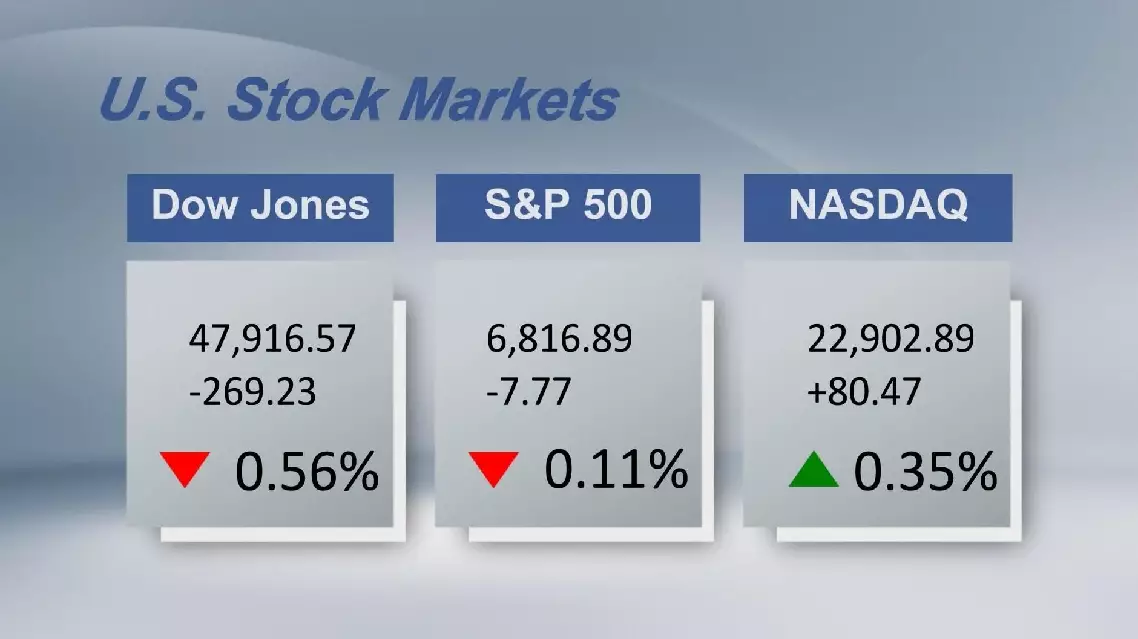
U.S. stocks close mixed after shocking inflation data