SAN JOSE, Calif.--(BUSINESS WIRE)--Dec 11, 2024--
Ayar Labs, the leader in optical interconnect solutions for large-scale AI workloads, today announced it has secured $155 million in financing led by Advent Global Opportunities and Light Street Capital to break down the AI bottleneck of data movement with its optical I/O technology. This brings the company’s total funding to $370 million and raises the company’s valuation to above $1 billion.
This press release features multimedia. View the full release here: https://www.businesswire.com/news/home/20241211964729/en/
The strength of the round and caliber of investors, including participation from AMD Ventures, Intel Capital, and NVIDIA, marks another key milestone as Ayar Labs prepares its optical solution for high volume manufacturing strategically aligned to customer roadmaps. Other new strategic and financial investors participating in the round include 3M Ventures and Autopilot. They join existing investors such as Applied Ventures LLC, Axial Partners, Boardman Bay Capital Management, GlobalFoundries, IAG Capital Partners, Lockheed Martin Ventures, Playground Global, and VentureTech Alliance.
“The leading GPU providers – AMD and NVIDIA – and semiconductor foundries – GlobalFoundries, Intel Foundry, and TSMC – combined with the backing of Advent, Light Street, and our other investors underscores the potential of our optical I/O technology to redefine the future of AI infrastructure,” said Mark Wade, CEO and co-founder of Ayar Labs. “We are incredibly fortunate to have the backing of Light Street’s deep expertise in technology-specific investments as well as Advent’s robust private and growth equity background in this funding round.”
AI infrastructure is projected to see more than $1 trillion in investments over the next decade, highlighting the critical need for solutions that eliminate bottlenecks created by traditional copper interconnects and pluggable optics.
Ayar Labs has developed the industry’s first in-package optical I/O solution to replace electrical I/O that is standards-based, commercial-ready, and optimized for AI training and inference. Optical I/O allows customers to maximize the compute efficiency and performance of their AI infrastructure, while reducing costs and power consumption, to dramatically improve profitability metrics for AI applications.
“We believe optical I/O is on the cusp of revolutionizing the future of AI infrastructure, and we recognize the significant growth potential of in-package optical interconnects,” said Jordan Katz, partner at Advent Global Opportunities, who will be joining Ayar Labs’ Board of Directors. “Our deep research into the interconnect market revealed that Ayar Labs is led by a world-class team, has industry-leading technology, and exciting engagements with Tier 1 customers. We believe that supporting Ayar Labs and its groundbreaking technology will offer transformative benefits to AI systems.”
“We are committed to fueling the growth of companies that lead technological innovation. With this significant capital infusion, Ayar Labs is well-positioned to support its growing customer base and meet the explosive demand for optical I/O solutions,” said Shef Osborn, partner at Light Street Capital. “This funding demonstrates to its customers that Ayar Labs has the resources necessary to support their AI infrastructure needs.”
This funding allows the company to scale its breakthrough optical I/O technology, the industry’s first commercially viable optical interconnect solution backed by a robust manufacturing ecosystem. Named one of America’s Best Startup Employers by Forbes earlier this year, Ayar Labs plans to increase hiring next year. A list of open roles with the company is available here.
Additional Investor Statements
“Intel Capital has long recognized the importance of pioneering new interconnect technologies to improve compute efficiency and performance,” said Srini Ananth, managing director at Intel Capital. “We have been dedicated to supporting Ayar Labs’ continued growth and are proud to reaffirm our commitment to its optical I/O solutions that aim to disrupt the AI industry.”
“As an early investor and collaborator, Applied Ventures looks forward to continue working with Ayar Labs to advance energy-efficient computing using photonics-based optical interconnects,” said Anand Kamannavar, global head of Applied Ventures and board observer of Ayar Labs. “Ayar Labs plays a key role in helping solve the critical challenge of moving vast amounts of data efficiently across chips and data center systems.”
“3M is excited to invest in Ayar Labs and our opportunities to collaborate,” said Mark Copman, senior vice president, 3M New Growth Ventures. “This partnership reinforces 3M’s commitment to advancing data center and next-gen solutions for AI infrastructure using 3M’s leading material science expertise.”
About Ayar Labs
Ayar Labs is the leader in optical interconnect solutions that move data at the speed of AI. Recognizing that the complexity and size of AI models are increasing at a rate that traditional interconnect technology cannot handle, the company has developed the industry’s first optical I/O solution that enables customers to maximize the compute efficiency and performance of growing AI infrastructure, while reducing costs, latency and power consumption. Based on open standards and optimized for both AI training and inference, Ayar Labs’ optical I/O solution is backed by a robust ecosystem that enables it to integrate smoothly into AI systems at scale. Ayar Labs was founded in 2015. For more information, visit www.ayarlabs.com.

(Graphic: Business Wire)
NEW YORK (AP) — No quick dispatching of disease investigators. No televised news conference to inform the public. No timely health alerts to doctors.
In the midst of a hantavirus outbreak that involves Americans and is making headlines around the world, the U.S. government's top public health agency, the Centers for Disease Control and Prevention, has been uncharacteristically missing in action, according to a number of experts.
To President Donald Trump, "We seem to have things under very good control," as he told reporters Friday evening.
To experts, the situation aboard a cruise ship has not spiraled because, unlike COVID-19 or measles or the flu, hantavirus does not spread easily. It has been health experts in other countries, not the United States, who have been dealing primarily with the outbreak in the past week.
“The CDC is not even a player," said Lawrence Gostin, an international public health expert at Georgetown University. “I've never seen that before.”
Not until late Friday did CDC actions accelerate.
Health officials confirmed the deployment of a team to Spain's Canary Islands, where the ship was expected to arrive early Sunday local time, to meet the Americans onboard. They said a second team will go to Offutt Air Force Base in Nebraska as part of a plan to evacuate American passengers from the ship to a quarantine center. Also, the CDC issued its first health alert to U.S. doctors, advising them of the possibility of imported cases.
The CDC's diminished role in this outbreak is an indicator the agency is no longer the force in international health or the protector of domestic health that it once was, some experts said.
The hantavirus outbreak is “a sentinel event” that speaks to “how well the country is prepared for a disease threat. And right now, I’m very sorry to say that we are not prepared,” said Dr. Jeanne Marrazzo, chief executive officer of the Infectious Diseases Society of America.
Early last month, a 70-year-old Dutch man developed a feverish illness on a cruise ship traveling from Argentina to Antarctica and some islands in the South Atlantic. He died less than a week later. More people became sick, including the man's wife and a German woman, who both died.
Hantavirus was first identified as a cause of sickness of one of the cases on May 2. The World Health Organization swung into action and by Monday was calling it an outbreak. About two dozen Americans were on the ship, including about seven who disembarked last month and 17 who remained on board.
For decades, the CDC partnered with the WHO in such situations. The CDC acted as a mainstay of any international investigation, providing staff and expertise to help unravel any outbreak mystery, develop ways to control it and communicate to the public what they should know and how they should worry.
Such actions were a large reason why the CDC developed a reputation as the world's premier public health agency.
But this time, the WHO has been center stage. It made the risk assessment that has told people the outbreak is not a pandemic threat.
“I don’t think this is a giant threat to the United States,” said Jennifer Nuzzo, director of Brown University’s Pandemic Center. But how this situation has played out “just shows how empty and vapid the CDC is right now,” she said.
The current situation comes after 16 tumultuous months during which the Trump administration withdrew from the WHO, has restricted CDC scientists from talking to international counterparts at times and embarked on a plan to build its own international public health network through one-on-one agreements with individual countries.
The administration has laid off thousands of CDC scientists and public health professionals, including members of the agency's ship sanitation program.
As this was playing out, Trump's health secretary, Robert F. Kennedy Jr., said he was working to “restore the CDC’s focus on infectious disease, invest in innovation, and rebuild trust through integrity and transparency.”
The CDC has not been completely silent on hantavirus.
The agency on Wednesday issued a short statement that said the risk to the American public is “extremely low,” and described the U.S. government as “the world’s leader in global health security.”
Said Nuzzo: “Not only was that not helpful, it actually does damage because a core principle of public health communications is humility.”
The CDC's acting director, Dr. Jay Bhattacharya, posted a message on social media that the agency was lending its expertise in coordinating with other federal agencies and international authorities. Arizona officials this week said they learned from the CDC that one of the Americans who left the ship — a person with no symptoms and not considered contagious — had already returned to the state. WHO officials said the CDC has been sharing technical information.
The CDC also is “monitoring the health status and preparing medical support for all of the American passengers on the cruise,” Bhattacharya wrote.
But federal health officials have mostly been tight-lipped, declining interview requests.
In interviews this week, some experts made a comparison with a 2020 incident involving the Diamond Princess, a cruise ship docked in Japan that became the setting of one of the first large COVID-19 outbreaks outside of China.
The CDC sent personnel to the port, helped evacuate American passengers, ran quarantines, shared genetic data on the virus, coordinated with the WHO and Japan, held public briefings and rapidly published reports “that became the world’s reference data on cruise ship COVID transmission,” said Dr. Tom Frieden, a former CDC director.
Some aspects of the international response to the Diamond Princess were criticized, and it did not halt the outbreak or stop COVID-19’s spread across the world. But some experts say it was not for the CDC's lack of trying.
“The CDC was right on top of it, very visible, very active in trying to manage and contain it,” Gostin said, while the agency's work now is delayed and subdued.
Instead of working with nearly all of the world's nations through the WHO, the Trump administration has pursued bilateral health agreements with individual nations for information sharing, public health support, and what it describes as “the introduction of innovative American technologies.” Roughly 30 agreements are currently in place.
That's not sufficient, Gostin said. “You can't possibly cover a global health crisis by doing one-on-one deals with countries here and there,” he said.
Associated Press writers Ali Swenson in New York, Darlene Superville in Washington and Susan Montoya Bryan in Albuquerque, New Mexico, contributed to this report.
The Associated Press Health and Science Department receives support from the Howard Hughes Medical Institute’s Department of Science Education and the Robert Wood Johnson Foundation. The AP is solely responsible for all content.
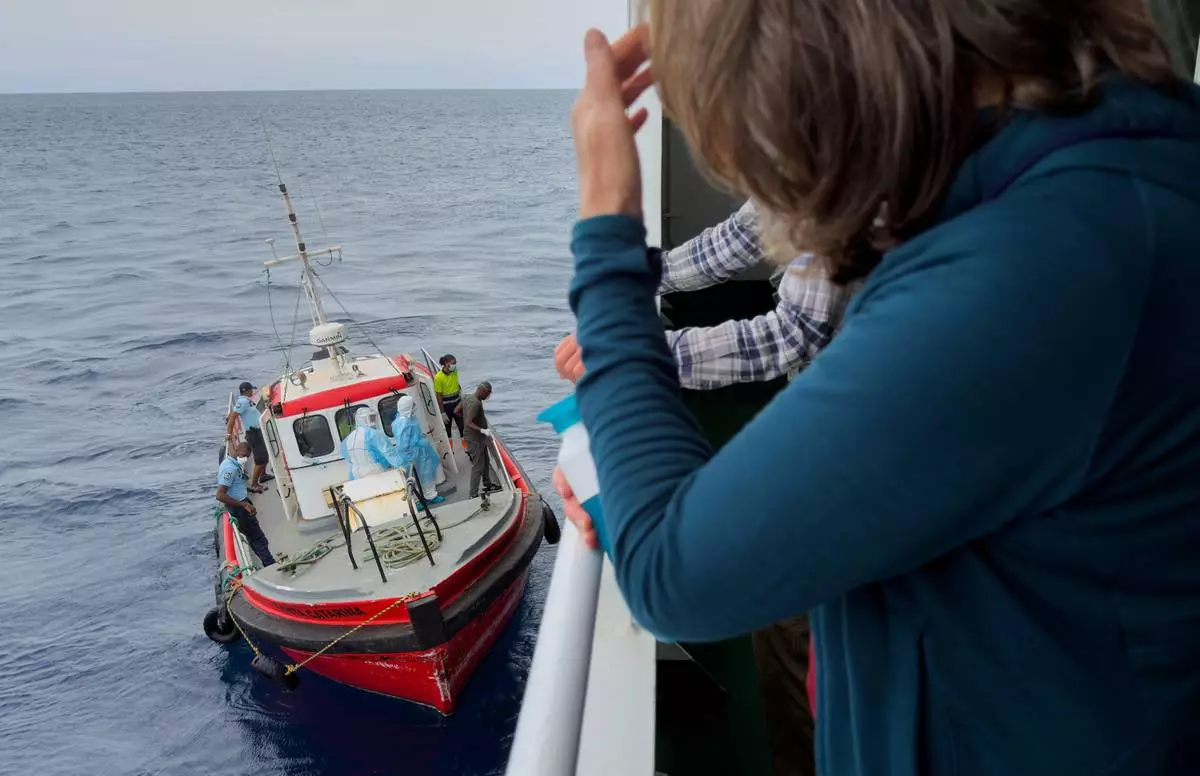
Passengers on the the hantavirus-stricken cruise ship, MV Hondius, watch epidemiologists board the boat in Praia, during their voyage to Spain's port of Tenerife, May 6, 2026. (AP Photo)

Workers set up temporary shelters in the area where passengers from the MV Hondius cruise ship are expected to arrive at the port of Granadilla in Tenerife, Canary Islands, Spain, Saturday, May 9, 2026. (AP Photo/Manu Fernandez)
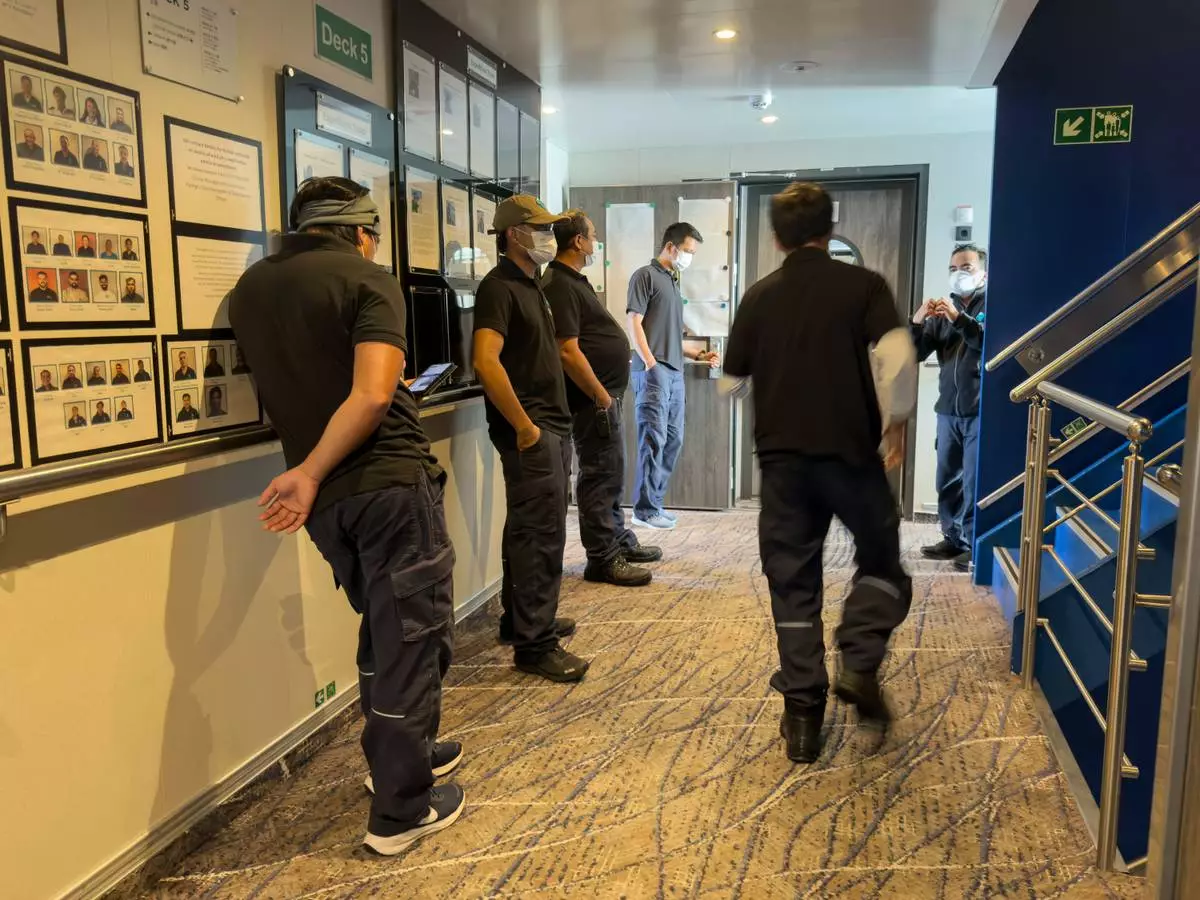
Crew members of the hantavirus-stricken cruise ship, MV Hondius, wait their turns for a first interview with epidemiologists, during the voyage to Spain's port of Tenerife, May 6, 2026. (AP Photo)
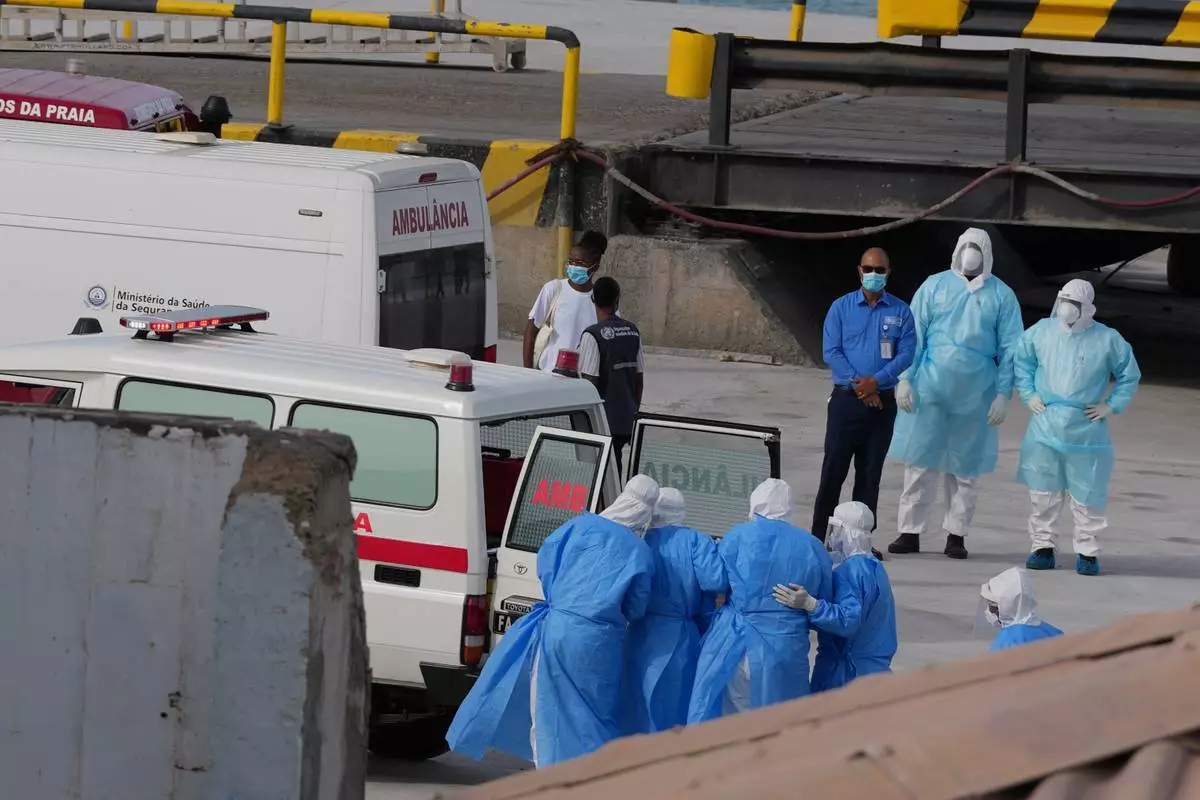
Health workers in protective gear evacuate patients from the MV Hondius cruise ship into an ambulance at a port in Praia, Cape Verde, Wednesday, May 6, 2026. (AP Photo/Misper Apawu)
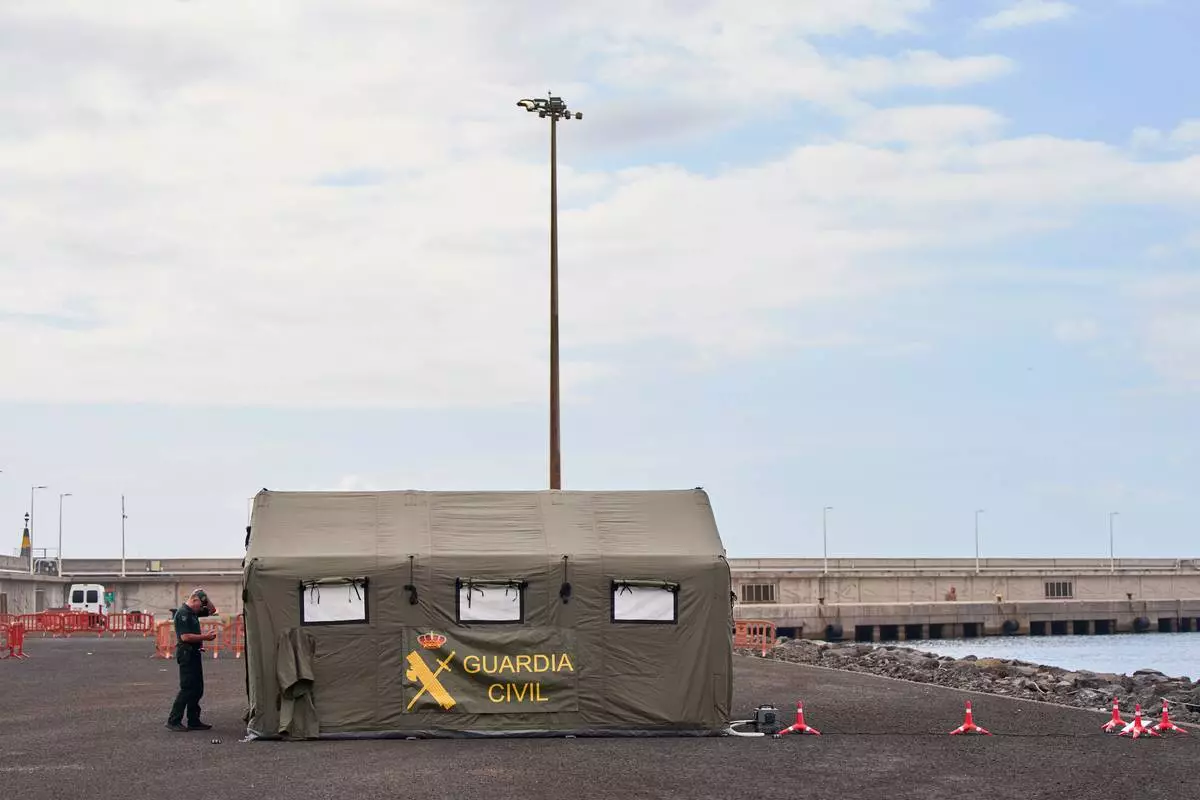
A Spanish Civil Guard officer inspects the area where passengers from the MV Hondius cruise ship are expected to arrive at the port of Granadilla in Tenerife, Canary Islands, Spain, Saturday, May 9, 2026. (AP Photo/Manu Fernandez)