SANTA CLARA, Calif. (AP) — San Francisco linebacker De'Vondre Campbell refused to enter Thursday night's game in the third quarter after losing his starting job when Dre Greenlaw returned from an injury.
Campbell had started 12 of the first 13 games of the season and played 90% of defensive snaps for the 49ers but was benched for San Francisco's 12-6 loss to the Los Angeles Rams after Greenlaw came back for his first game since tearing his left Achilles tendon in last season's Super Bowl.
Click to Gallery
FILE - San Francisco 49ers linebacker De'Vondre Campbell plays during an NFL football game against the New England Patriots, Sept. 29, 2024, in Santa Clara, Calif. (AP Photo/Godofredo A. Vásquez, File)
San Francisco 49ers' De'Vondre Campbell walks to the locker room during the second half of an NFL football game against the Los Angeles Rams in Santa Clara, Calif., Thursday, Dec. 12, 2024. (Scott Strazzante/San Francisco Chronicle via AP)
San Francisco 49ers' De'Vondre Campbell walks to the locker room during the second half of an NFL football game against the Los Angeles Rams in Santa Clara, Calif., Thursday, Dec. 12, 2024. (Scott Strazzante/San Francisco Chronicle via AP)
San Francisco 49ers' De'Vondre Campbell walks to the locker room during the second half of an NFL football game against the Los Angeles Rams in Santa Clara, Calif., Thursday, Dec. 12, 2024. (Scott Strazzante/San Francisco Chronicle via AP)
Greenlaw had eight tackles in the first half but left the game in the third quarter with soreness in his Achilles tendon. That's when Campbell refused to enter the game.
“He said he didn't want to play today,” coach Kyle Shanahan said after the loss, which left the 49ers (6-8) on the brink of playoff elimination.
Shanahan said he has never seen that before in his coaching career and said the team will “figure out something” on how to deal with it going forward.
Campbell walked to the locker room, leaving his teammates bewildered and angry.
“He's a professional,” cornerback Charvarius Ward said. “He's been playing for a long time. If he didn't want to play he shouldn't have dressed out. He could have told them that before the game. I feel like that was some selfish (stuff) that he did. It definitely hurt the team. Dre went down and we needed a linebacker. ... For him to do that, that's some selfish (stuff) to me in my opinion. He's probably going get cut soon.”
The 31-year-old Campbell signed a one-year, $5 million deal in the offseason with San Francisco after being cut by Green Bay in March.
He had been an All-Pro in 2021 for the Packers but his play fell off the last two seasons in Green Bay. He had a few bright moments in San Francisco this season but struggled frequently with tackling and in coverage.
“It’s one person making a selfish decision,” tight end George Kittle said. "I’ve never been around anybody that’s ever done that and I hope I’m never around anybody who does that again."
AP NFL: https://apnews.com/NFL

FILE - San Francisco 49ers linebacker De'Vondre Campbell plays during an NFL football game against the New England Patriots, Sept. 29, 2024, in Santa Clara, Calif. (AP Photo/Godofredo A. Vásquez, File)

San Francisco 49ers' De'Vondre Campbell walks to the locker room during the second half of an NFL football game against the Los Angeles Rams in Santa Clara, Calif., Thursday, Dec. 12, 2024. (Scott Strazzante/San Francisco Chronicle via AP)
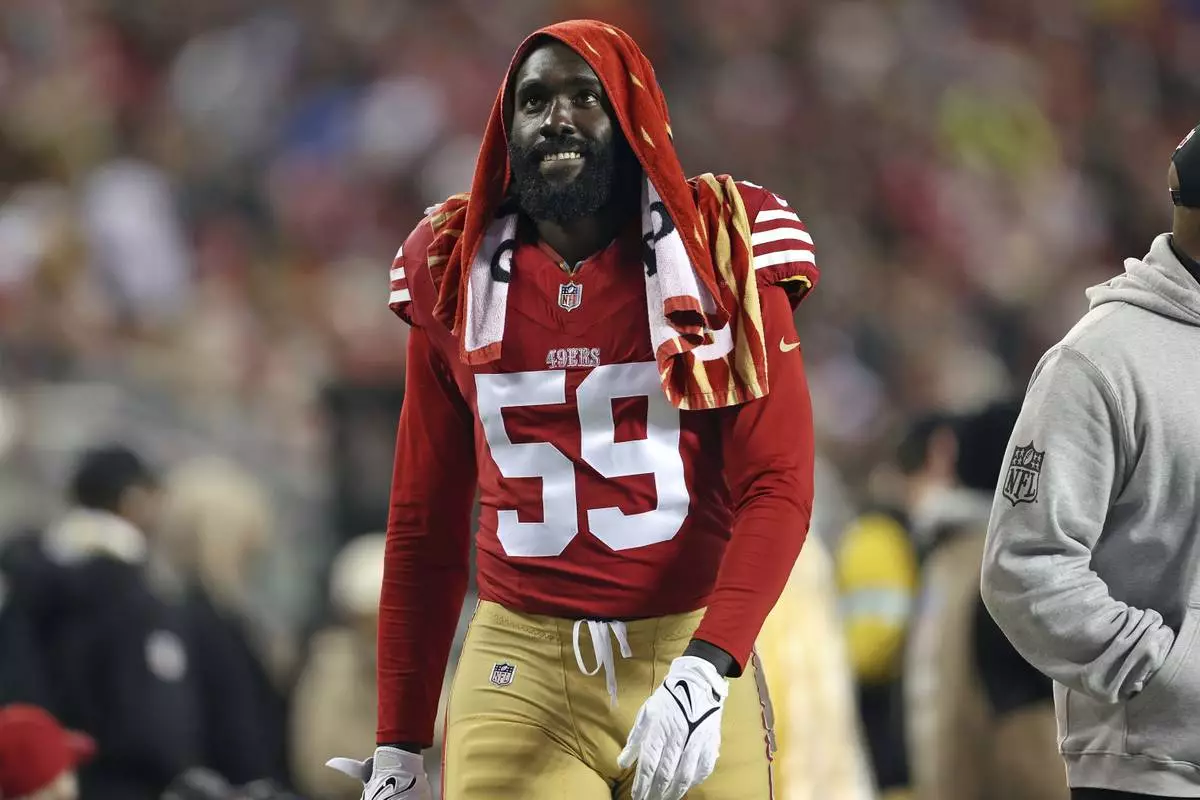
San Francisco 49ers' De'Vondre Campbell walks to the locker room during the second half of an NFL football game against the Los Angeles Rams in Santa Clara, Calif., Thursday, Dec. 12, 2024. (Scott Strazzante/San Francisco Chronicle via AP)

San Francisco 49ers' De'Vondre Campbell walks to the locker room during the second half of an NFL football game against the Los Angeles Rams in Santa Clara, Calif., Thursday, Dec. 12, 2024. (Scott Strazzante/San Francisco Chronicle via AP)
It was at a relatively minor event in upstate New York in September 2022 that Ilia Malinin, the self-anointed “Quad God" who was fast becoming the biggest name in figure skating, finally landed the jump that so many people had thought impossible.
Others had tried quad axels in competition over the years. All of them had fallen. That extra 180 degrees of rotation — necessary for the only jump in skating that starts with a forward-facing entry — proved to be a half-revolution too much.
So when Malinin landed it inside the arena made famous by the U.S. hockey team's upset of the Soviets at the 1980 Winter Olympics in Lake Placid, it not only sent shockwaves through the tight-knit skating community but made headlines around the world.
“My mind was just blown,” said two-time Olympic skater Jason Brown.
Yet by conquering the gravity-defying jump, Malinin also raised an important question: What comes next?
The six main jumps in figure skating have been standard since the early 1900s. The only difference between then and now is the number of revolutions. Dick Button landed the first double axel in 1948, and the first triple jump four years later. Kurt Browning landed the first quad, a toe loop, in 1988, and it was 10 years before Timothy Goebel landed the first quad salchow.
By landing the quad axel, Malinin may have maxed out the boundaries of human performance. Most sports scientists agree that the speed and amplitude necessary for five-revolution jumps truly is impossible, leaving figure skating at a crossroads, where a dearth of innovation threatens to take the shine off a sport already fighting to maintain popularity.
“I think it's kind of natural that we were going to get to this point,” said Malinin, the overwhelming favorite to win gold for the U.S. at the Milan Cortina Olympics. "But I haven't reached my top, whether it's in the technical and how much I can jump and spin, but also in the creativity.”
Malinin, 20, points to his signature “raspberry twist,” a somersaulting spin unlike anything that anybody else does. He created it himself, and it tends to bring down the house whenever he throws it down near the end of his programs.
Yet the flashy maneuver also underscores one of the inherent problems with trying to be creative: It doesn't get rewarded.
The International Skating Union has rigid requirements for both short programs and free skates, and it rarely pays off to deviate too far from the script. Malinin might not get a lot of extra points for landing his raspberry twist, for example, since it is not one of the six standard figure skating jumps, but a failure to land it could cost him dearly.
“Absolutely, there are a lot of things I've wanted to try,” Malinin told The Associated Press, “because I think it would be really cool and appealing. But it's a bigger risk for the program itself, and the system and scoring means it doesn't make sense.”
In other words, what's the point in trying to innovate?
“There are so many rules in your programs that you don't have too much wiggle room,” said Alysa Liu, the reigning world champion. “A lot of these rules really restrict us. Like, all of our spins look the same now, but they could look so different."
“One of my training mates, Sonja Himler, does these incredible programs," added Amber Glenn, a three-time U.S. champion, and along with Liu one of the favorites to win Olympic gold for the American team in February.
“Like, she spins the other way, jumps the other way — really cool things that, you know, someone who's watched a little bit of skating will be like, ‘Oh, I’ve never seen that before,'” Glenn said. “Whereas if I go and do, you know, the norm, and do it well, versus what she does, my scores will be better, even though what she does is way more impressive, in my opinion.”
Justin Dillon, the manager of high performance at U.S. Figure Skating, acknowledged having had hard conversations with some skaters about their programs. They may have planned something unique or interesting, but the risk wouldn't be worth the reward.
“I encourage individuality, and bringing it to the ice,” Dillon said, “but if they do something so avant-garde that it doesn't check those boxes, then it really doesn't serve them. It doesn't always mean throw it out, but what can we do to make it a home run?”
To its credit, figure skating's governing body has loosened some restrictions in recent years. The backflip, which was long banned in competition because of its inherent danger, is allowed now, though it also doesn't carry a whole lot of scoring weight.
Is that hold-your-breath element of risk and uncertainty the next big step in skating?
“I mean, you're cringing. It legit scares me," Glenn said of the backflip. “If you can do it, great. I think it's so fun. I want to learn it once I'm done competing. But the thought of practicing it in like, a warmup or in training, it just scares me.”
Brown has never been able to consistently land quad jumps in competition. Instead, he relies on near-perfect execution of triple jumps, along with arguably the best artistry in figure skating, to consistently challenge for podium placements in major competitions.
Maybe, Brown mused, the next innovation in figure skating has nothing to do with extreme feats of athletic ability.
“I have so much respect for the ways in which people are pushing the sport technically,” he said, "but I think the more that people fixate on executing an element, the less risk people take artistically, because they’re already taking these risks technically. And it is very hard to do both. So maybe the next step for figure skating is to reward the story we're trying to tell."
AP Winter Olympics: https://apnews.com/hub/milan-cortina-2026-winter-olympics

Amber Glenn skates during the "Making Team USA" performance at the U.S. Figure Skating Championships, Sunday, Jan. 11, 2026, in St. Louis. (AP Photo/Jeff Roberson)

Amber Glenn skates during the "Making Team USA" performance at the U.S. Figure Skating Championships, Sunday, Jan. 11, 2026, in St. Louis. (AP Photo/Stephanie Scarbrough)
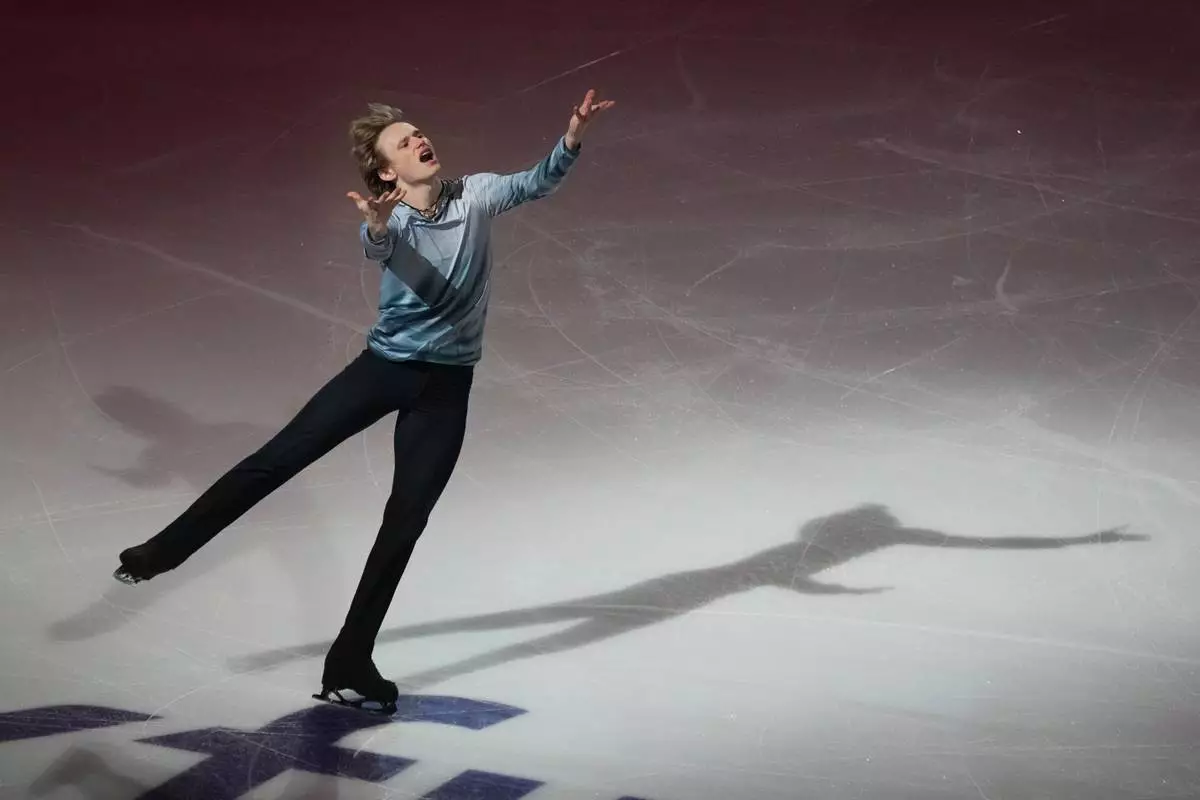
Ilia Malinin skates during the "Making Team USA" performance at the U.S. Figure Skating Championships, Sunday, Jan. 11, 2026, in St. Louis. (AP Photo/Jeff Roberson)
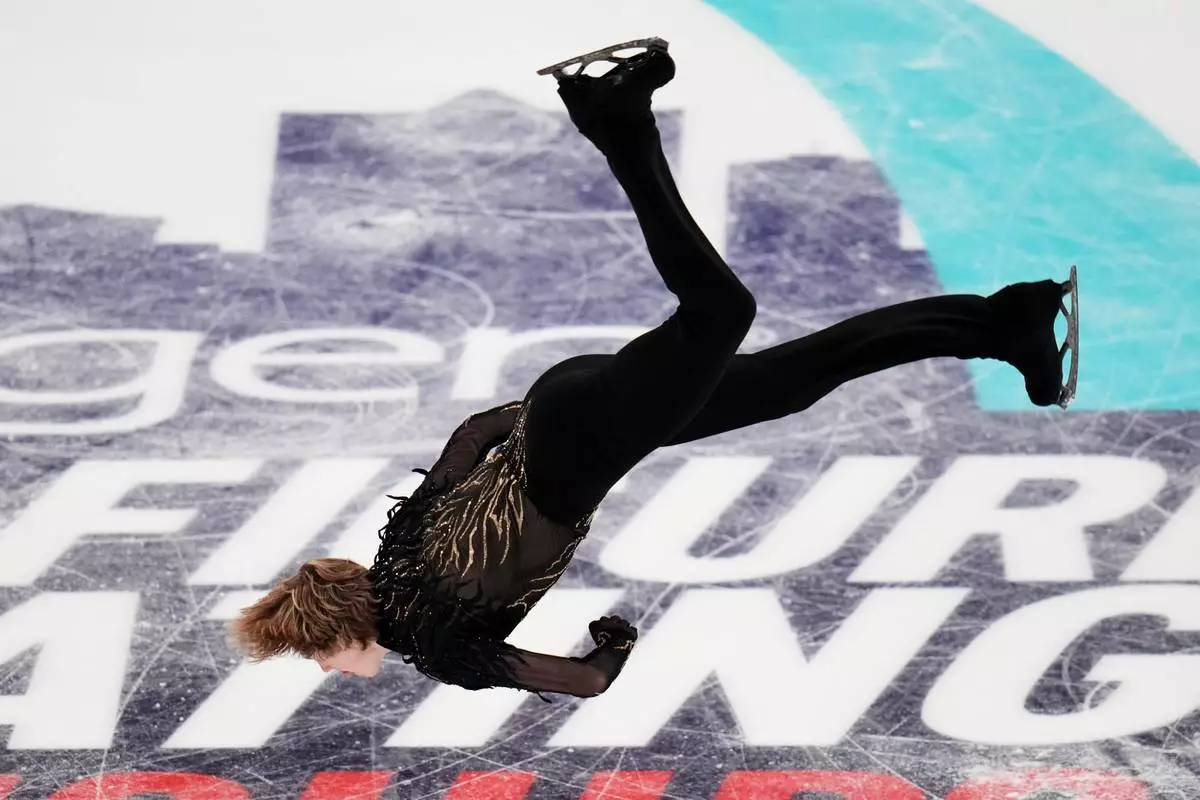
Ilia Malinin competes during the men's free skate competition at the U.S. Figure Skating Championships, Saturday, Jan. 10, 2026, in St. Louis. (AP Photo/Jeff Roberson)

Ilia Malinin competes during the men's short program at the U.S. Figure Skating Championships, Thursday, Jan. 8, 2026, in St. Louis. (AP Photo/Stephanie Scarbrough)