Zhuhai in south China's Guangdong Province is exploring the application of electric vertical take-off and landing (eVTOL) vehicles in scenarios including cultural tourism and parcel delivery as the country's low-altitude economy enjoys burgeoning growth.
The low-altitude economy refers to economic activities in airspace below 1,000 meters, with unmanned aircraft like drones, helicopters and flying cars playing a dominant role.
The groundbreaking new type of eVTOL flying cars is poised to revolutionize urban mobility as cities around the world become increasingly crowded and traffic congestion escalates. Many believe this type of aircraft will finally replace helicopters, for it features lower cost, zero direct emissions and is considered to be much safer.
Several eVTOL models are being tested on Guishan Island in Zhuhai, as the island is one of the future operation spots for the aircraft.
"Its flying path is planned by our ground station. With just one click, the aircraft takes off and follows the flight path we've programmed. If one of the propellers malfunctions, the others can still function normally, ensuring a smooth landing," said Wang Hongye, the operations manager of WESKY, a Zhuhai-based air transportation company, when he explained how the aircraft works.
The autonomous aircraft being tested is EH216-S, a flagship product of eHang, a Nasdaq-listed Chinese eVTOL manufacturer. The "2" stands for two-seater and "16" means it has 16 small-scale propellers, enabling it to be almost silent when flying overhead and more importantly, to be much safer.
The concept of eVTOL can be traced back to early visions of urban air mobility, specifically taking transportation into skies. The aircraft can navigate not only in urban areas, but also the difficult-to-reach destinations like the Guishan Island.
Air taxi services, emergency transportation and sightseeing tours – these are the tasks that eVTOLs will be able to do in the near future.
"Its flying altitude is typically around 50 meters, and the current speed is about 30 kilometers per hour. This aircraft is currently primarily designed for sightseeing. If it flies too high or too fast, the experience for tourists won't be as enjoyable. We plan to begin with the commercial operation of sightseeing and then expand to inter-island transfers," said Wang while introducing the tasks that eVTOLs can do now and in the near future.
Another type of drones that could fly at a speed of up to 90 kilometers per hour is already in operation in the island to deliver postal packages, emergency medical supplies and even food deliveries from the Zhuhai's mainland. On its way back, the aircraft can bring freshly caught seafood to the mainland. Each flight takes only half an hour.
Even though this logistic drone flies on autopilot, everything can be controlled from the ground.
"Their job is mainly just monitoring. From his screen, we can see where the aircraft is, its altitude, and its speed," Wang said.
In recent years, the eVTOL industry has taken off in China, driven by advances in battery technology and autonomous systems. And that is where China has natural advantages, as its electric vehicle sector has boomed in recent years.
At the 2024 Zhuhai Airshow, several eVTOL manufacturers showcased their latest models, many of which are either Chinese EV makers or rely on their charging solutions.
Industry reports forecast that by 2030, the scale of China's low-altitude economy could reach 2 trillion yuan, or around $270 billion. By then, the country could have up to 100,000 eVTOLs serving as air taxis and personal vehicles.
However, reaching that target won't be easy. Low-altitude aviation sector should be highly regulated to face the challenges posed by weather and complex operation system to ensure safety.
"Our operating environment at low altitudes is even more complex than at high altitudes. On one hand, there are many obstacles that can affect flight. On the other hand, the weather conditions at low altitudes can be highly complicated. So, figuring out how to establish operating rules or an intelligent operating system in this dense and complex environment is a major challenge for us,” said Chen Zhjie, an academician from Chinese Academy of Engineering.
Industry reports forecast that by 2030, the scale of China’s low-altitude economy could reach 2 trillion yuan, or around $270 billion. By then, the country could have up to 100,000 eVTOLs serving as air taxis and personal vehicles.
【Voice_over】 Whether it’s high-altitude or low-altitude, the aviation sector is, and should be, a highly regulated industry for safety. Perhaps, once all the necessary rules are in place, the skies of tomorrow will be closer than we think. Wang Tianyu, CGTN, Zhuhai, Guangdong Province. (OUT)
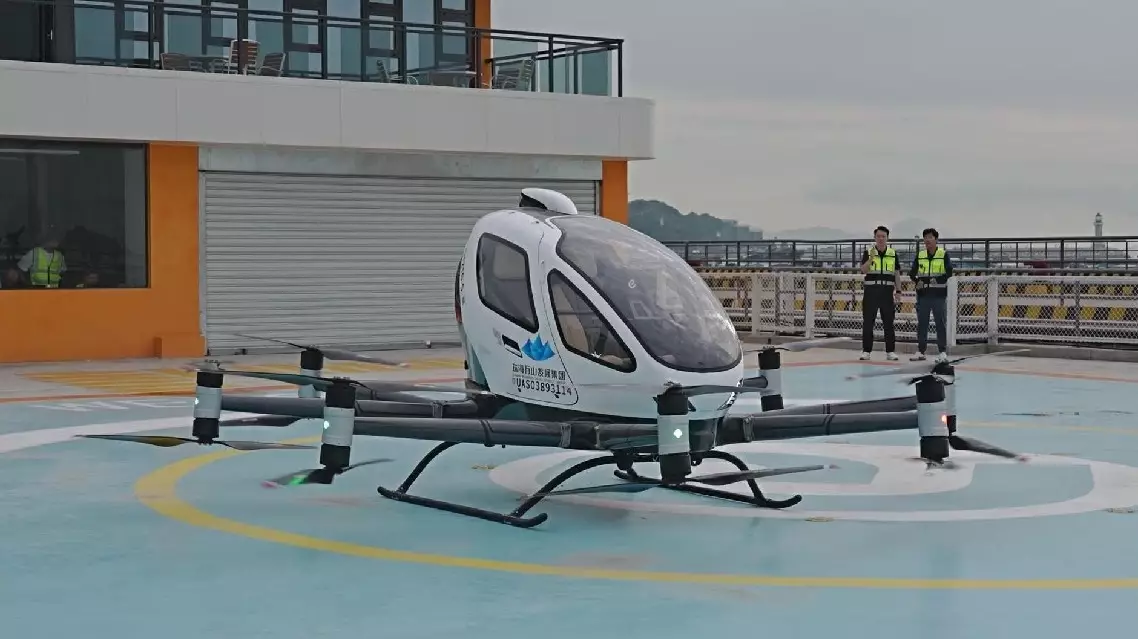
Zhuhai explores application scenarios of eVTOL as low-altitude economy takes off in China