China's annual Central Economic Work Conference has set a proactive agenda for the nation's 2025 economic growth with focus on domestic demand, innovation-driven development, and expanded openness, offering new opportunities for global investors amid an increasingly complex and challenging international landscape, said a China Media Group (CMG) commentary on Friday.
An edited English-language version of the commentary is as follows:
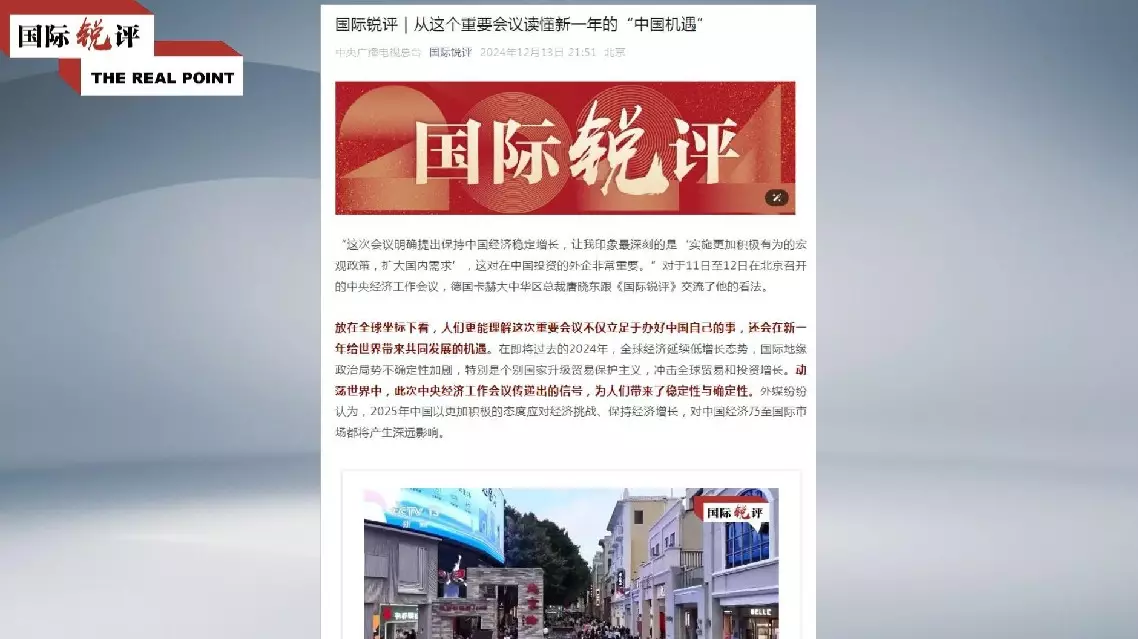
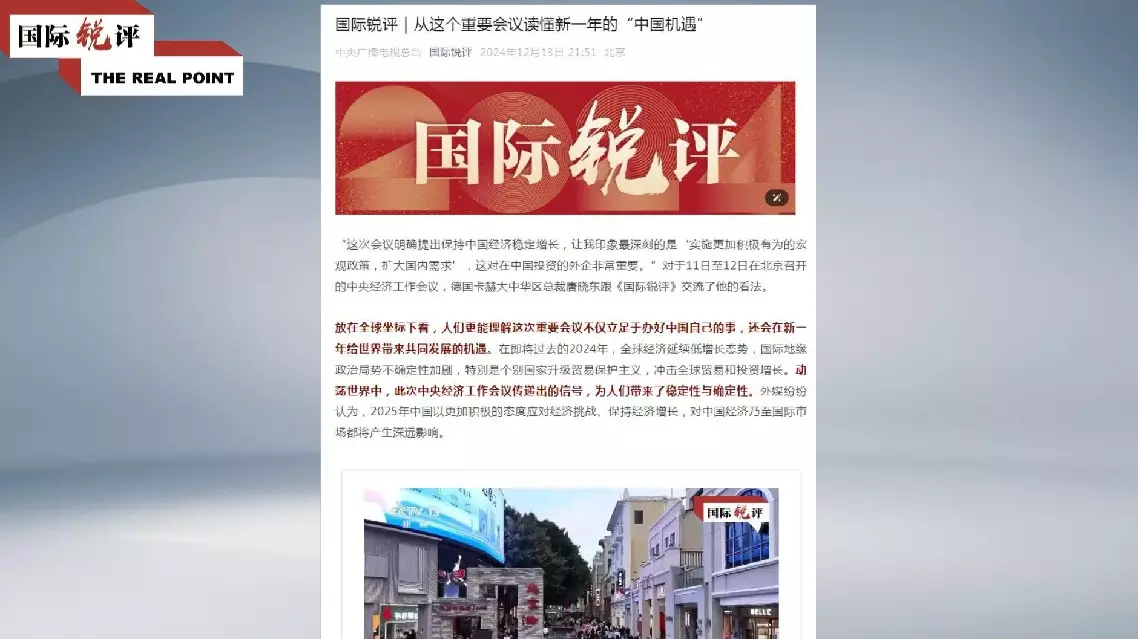
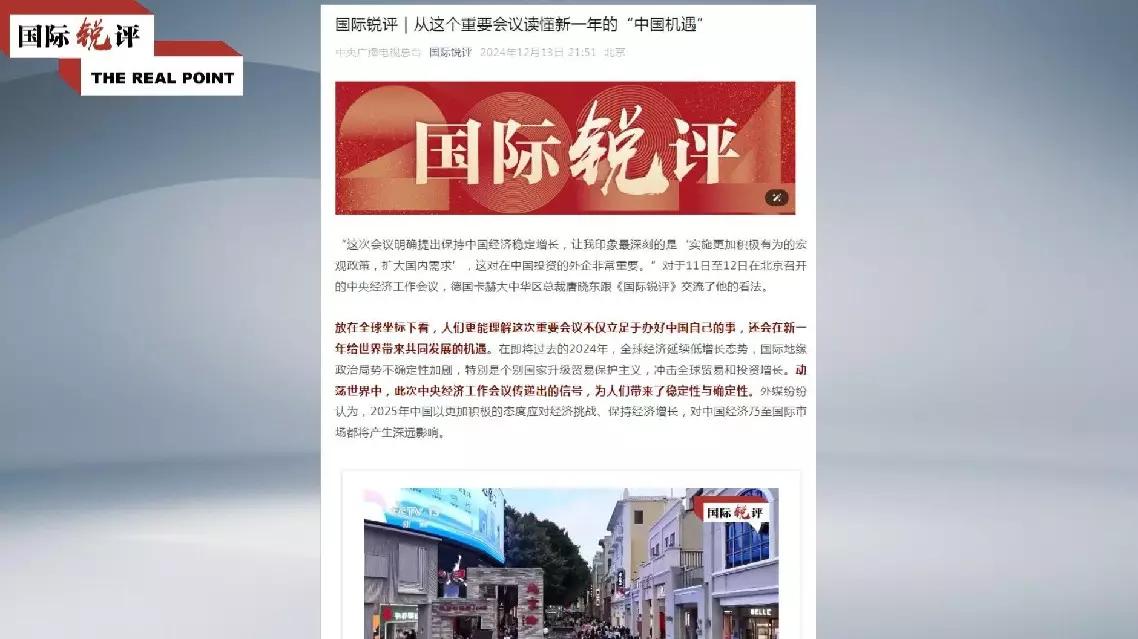
"This conference explicitly emphasized the need to maintain steady economic growth in China. What left the deepest impression on me was the call to 'implement more proactive and effective macroeconomic policies and expand domestic demand.' This is extremely important for foreign enterprises investing in China," Tang Xiaodong, president of Karcher Greater China, said in a recent interview with the CMG.
The Central Economic Work Conference was held in Beijing from December 11 to 12.
When viewed in the global context, it becomes clearer that this significant meeting is not only focused on managing China's own affairs, but also aims to create opportunities for shared development worldwide in the coming year. In the outgoing year of 2024, the global economy continued its low-growth trajectory, while international geopolitical uncertainty intensified. In particular, some countries have escalated their trade protectionism, disrupting global trade and investment growth.
Amid a turbulent global landscape, the conference has sent a signal of bringing more stability and certainty to the world. Foreign media widely believe that in 2025, China's more proactive approach to addressing economic challenges and maintaining growth will have a profound impact on both the Chinese economy and international markets.
Every goal is achieved through unremitting efforts. The conference noted that the main goals and tasks for economic and social development in 2024 will be successfully accomplished. Such achievements have not come easily. In the first three quarters of this year, China's GDP growth rate ranked among the top of the world's major economies. From January to October, China's total import and export volume reached a record high for the same period in history. Furthermore, China's development of new quality productive forces has been at the forefront globally.
These solid performances have strongly demonstrated that the long-term positive trend of China's economy remains unchanged, and China has continued to be the "most important engine" of global economic growth.
One key term in the global economy is "expectation," and China's "more proactive and impactul" policy orientation fosters positive expectations. This conference emphasized "implementing a more proactive fiscal policy" and "a moderately loose monetary policy," with the latter being mentioned for the first time in over a decade, sparking widespread domestic and international discussions.
Media outlets such as Reuters have noted the conference's proposals to raise the fiscal deficit ratio, issue extra-long-term special bonds and local government bonds, and lower required reserve ratios and interest rates at appropriate times. These measures will significantly boost confidence and help build momentum for the country's economic recovery and growth.
The international community has also noted that among the priorities in nine aspects for the nation's economic work in 2025, the top priority is to vigorously boost consumption, make investment more productive, and comprehensively expand domestic demand. Specific measures include intensifying efforts to encourage equipment upgrading and consumer goods replacement, expanding service consumption, and actively developing sectors including the debut economy, the ice-and-snow economy, and the silver economy [in response to challenges presented by an aging population that is still expanding].
Analysts at ING, a global financial institution of Dutch origin, believe that China's push to stimulate consumption is a "good sign" that will enhance market confidence. Fabrice Megarbane, former president of L'Oréal North Asia and CEO of L'Oréal China, told the CMG that L'Oréal will seize opportunities in the silver economy by launching customized products and leveraging platforms such as the China International Import Expo (CIIE) to introduce "debut" brands, products, and services.
When describing the current characteristics of China's economy, "new quality productive forces" is a key term, and as expected, it appears among next year's major economic tasks -- giving full rein to the leading role of innovation in science and technology to spur the development of new quality productive forces and the modernization of the industrial system.
Data shows that the development of China's new quality productive forces are rapidly taking shape. China has moved up one spot to 11th place in the ranking of the world's most innovative economies, and is also home to 26 of the world's top 100 sci-tech innovation clusters, maintaining its position as the global leader for two consecutive years. A recent article on The Economist website noted that many multinational companies' research and development centers in China have become cradles of innovation.
In 2025, whether it involves advancing the "AI+" initiative, cultivating future industries, or actively leveraging digital and green technologies to upgrade traditional industries, these measures aimed at driving China's economy toward "new" development will offer more opportunities for foreign investors to engage in deeper operations in the country. Grace Lieblein, president of Dow Greater China, told the CMG that the conference's emphasis on innovation is highly encouraging, and she believes that China's industrial upgrading will drive demand for advanced materials, which Dow hopes to address by continuously providing innovative and sustainable material solutions.
"Openness" is a defining characteristic of China's economy. In 2024, China has fully abolished all market access restrictions on foreign investment in manufacturing, established, for the first time, a national-level negative list management system for cross-border service trade, allowed the establishment of wholly foreign-owned hospitals in nine pilot locations, and launched pilot programs in four regions to expand the opening up of value-added telecom services.
So, what will be the focus of China's openness in 2025? It includes the orderly expansion of self-reliance and unilateral opening up, the steady advancement of institutional opening up, the expansion of pilot programs for opening up in sectors such as telecommunications, healthcare, and education, and the deepening and solidification of high-quality Belt and Road cooperation. Maximilian Foerst, president and CEO of ZEISS Greater China, predicts that China will become the world's largest wealth creator, saying "with a market as vast and diverse as China, we simply cannot ignore it."
China's economy is like an ocean, constantly surging forward. In 2025, China will usher in the final year of its 14th Five-Year Plan (2021-2025). Although the country's economic performance still faces many difficulties and challenges, the supporting conditions and fundamental trend for economy's long-term sound development remain unchanged. Behind its "more proactive" development attitude lies China's unwavering determination to expand high-level openness to the outside world and its consistent desire to welcome companies from around the globe to share in development opportunities.
China's economic blueprint for 2025 highlights stability, growth, shared global development: commentary
China's economic blueprint for 2025 highlights stability, growth, shared global development: commentary
China's economic blueprint for 2025 highlights stability, growth, shared global development: commentary