A new round of trade-in subsidy program has been energizing China's consumer market these days, with many regions across the country seeing a surge in demand for home appliances and digital devices.
According to a notice jointly issued by the Ministry of Commerce and other government departments, individual consumers purchasing energy- and water-efficient household appliances are eligible for subsidies of up to 1,500 yuan (about 213 U.S. dollars) per item under the country's 2026 home appliance trade-in subsidy program.
Eligible products include refrigerators, washing machines, televisions, air conditioners, water heaters and computers, with the subsidy set at 15 percent of the final purchase price after discounts.
In addition, subsidies cover certain digital and smart products, including mobile phones, tablet computers, smartwatches and smart bands, priced at no more than 6,000 yuan each. For these products, the subsidies are capped at 500 yuan per item. In north China's Shanxi Province, the subsidies have unlocked consumption potential in green and smart goods.
"I bought a refrigerator. I had my eye on it a few days ago, but it was a bit expensive. Then, on the day when the national trade-in program began, its price was down by 2,000 yuan, so I bought it immediately," said a consumer.
"This year, we've added smart glasses into products, which have captured young people's attention," said Li Li, a telecommunications store manager.
In Xi'an City, northwest China's Shaanxi Province, many home appliance stores have offered more discounts and upgraded services in addition to the country's trade-in subsidy program, which has boosted customers' purchase intention.
"I've got my eye on this refrigerator. The price was originally over 9,000 yuan, but now with the nationwide subsidy program, it's 7,650 yuan," said Ms. Gao, a consumer.
In east China's Anhui Province, since the implementation of the new round of the trade-in subsidy program, the average daily sales of digital products have continued to grow.
Stores and e-commerce platforms have launched additional discounts and interest-free installments, which, combined with government consumption vouchers, have further stimulated consumer enthusiasm for electronics and home appliances.
"I have been following the price of this phone for a while, and I was hesitant. But then I saw the government's subsidy program, which saved me about 500 yuan. It is a great deal," said Li Lijuan, a consumer.
"We ordered the new robot vacuum at an e-commerce service station in the morning and it was delivered to our home in the afternoon. A staff member even came to our home to teach us how to use it. It's very convenient," said Han Weili, a consumer.
The subsidies have also driven up consumption in central China's Hunan Province.
"Today I came to buy kitchen appliances such as the water heater, the water purifier, and the range hood. As the nationwide subsidy program is in effect now, there's no need to snap up coupons, and the discounts are quite substantial. I ordered the whole set of appliances, and their prices are within my expectations. I'm very satisfied," said Li Ruyi, a consumer.
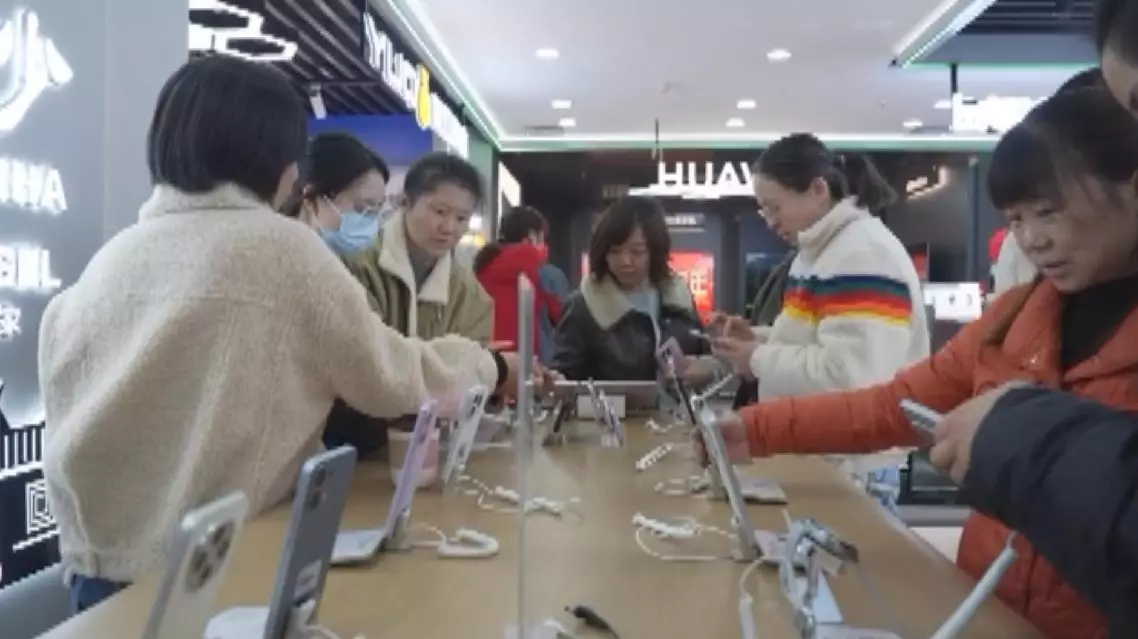
China's new round of trade-in subsidy program drives consumer goods sales