China's advances in the low-altitude economy became manifest as its first domestically developed engine specifically for electric vertical takeoff and landing (eVTOL) aircraft rolled off the production line.
The AEE25 aviation electric engine, developed by the AECC (Aero Engine Corporation of China) Aeroengine Control System Institute, was delivered in Wuxi City, east China's Jiangsu Province, on Friday, setting a national record for torque density, meaning a lighter engine that allows the aircraft to carry more passengers or cargo.
The achievement marks a major breakthrough in key aviation electric propulsion technologies, with the engine's performance reaching internationally advanced levels.
The AEE25 converts electrical energy from onboard batteries into lift and thrust for rotor systems. The engine has achieved a torque density of 40 newton-meters per kilogram, the highest among China's publicly disclosed 200-kW-class aviation electric engines.
The engine integrates six core components -- a main motor and its controller, a cooling system motor and its controller, and a variable-pitch actuator and its controller -- into one.
"This is a highly integrated product. For aircraft manufacturers, it can start to work after being installed with the propeller and connected to power and the bus, thus simplifying the aircraft design process. In addition, the engine is designed to be safe enough, with all motors designed in duplicate, and all controllers having two channels. In the event of any single-point failure, the power output can be guaranteed," said Liu Guoping, deputy director of the AECC institute.
The AEE25 will be installed on the E20 eVTOL aircraft developed by Shanghai TCab Technology Co., Ltd (TCab Tech). The engine has also entered the airworthiness certification process alongside the aircraft program.
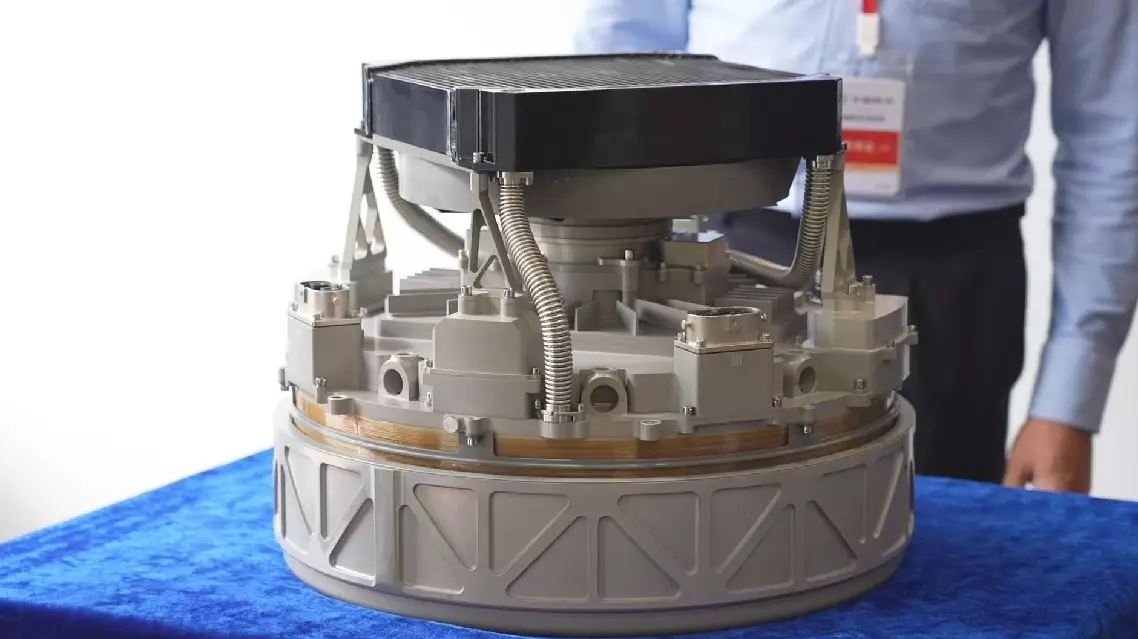
China's first homegrown eVTOL engine rolls off production line