As China's Three-North Shelterbelt Forest Program (TSFP) enters a new phase focused on improving quality and effectiveness, decades of sustained efforts to combat desertification have transformed vast areas of northern China into oase, with expanding greenery steadily pushing back deserts.
TSFP represents the world's largest afforestation program launched in 1978 to tackle desertification in northwestern, northern and northeastern parts of China.
Part of the Horqin Sandy Land, the largest of China's four major sandy lands, lies in Ongniud Banner of Chifeng City in north China's Inner Mongolia Autonomous Region. The region has pioneered an innovative approach to desertification control by building roads through sandy areas and carrying out restoration work along the routes.
To date, Ongniud Banner has constructed 18 such roads, while setting up straw checkerboard barriers and establishing forest and grass shelterbelts along the routes. Supported by this network, more than 3.6 million mu (about 240,000 hectares) of sandy land has been rehabilitated.
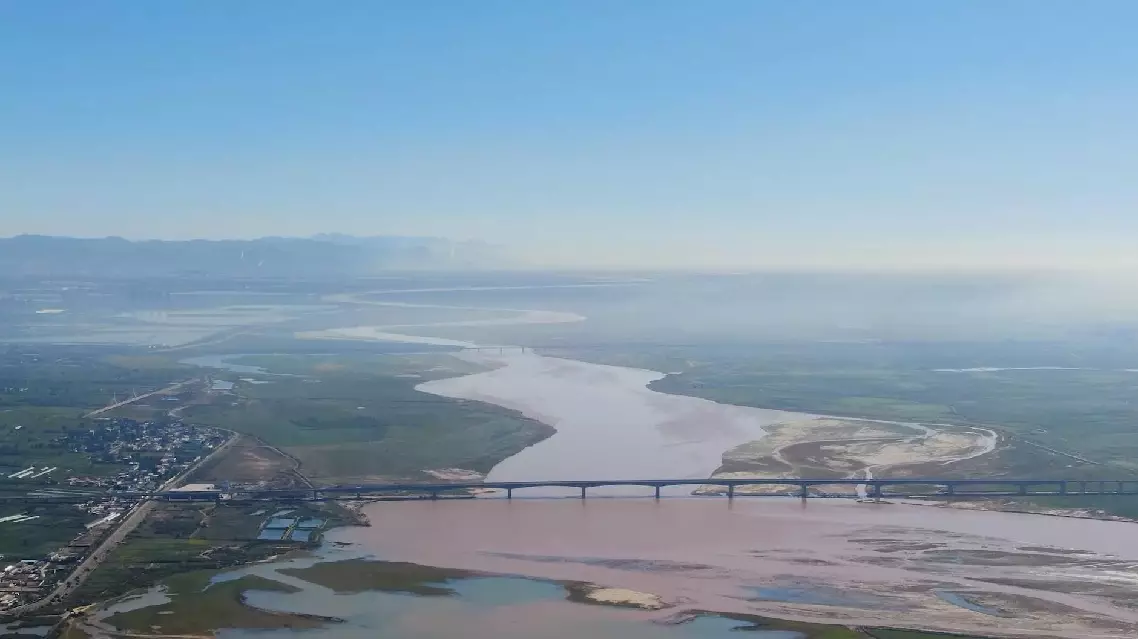
Along the northern edge of the Kubuqi Desert in Erdos City of Inner Mongolia, shifting sands once swept toward the banks of the Yellow River, China's second-longest river, posing serious challenges to local livelihoods and production. After more than four decades of restoration efforts, a 420-kilometer shelterbelt now stretches along the river. The annual volume of sand flowing from the desert into the Yellow River has fallen from 27 million tonnes to 4 million tonnes.
In Dengkou County of Bayannur City in Inner Mongolia, the Ulan Buh Desert covers 4.269 million mu (about 284,600 hectares), or 77.38 percent, of the county's total land area of 5.5171 million mu (about 367,800 hectares). Local authorities have adopted a restoration model combining the construction of straw checkerboard sand barriers with layered planting of trees and shrubs, helping establish a strong ecological barrier against desertification. Over the past four decades, the county's microclimate has improved markedly, while the total area of natural water bodies and man-made wetlands has steadily expanded.
Urad Rear Banner, also in Bayannur City, lies along the eastern edge of the Ulan Buh Desert. The area was once plagued by drifting sands that moved along the mountains and encroached on farmland. Since 2024, the banner has completed the treatment of 1.2037 million mu (about 80,200 hectares) of desertified land. Meanwhile, integrated conservation and restoration projects covering forests, grasslands, wetlands and deserts have been completed across 4.5852 million mu (about 305,700 hectares) of land.
Along the Ulan Buh section of the Yellow River in Alxa League, vast expanses of shifting sand once dominated the landscape, creating a high risk of sediment accumulation on the riverbed. Since 2022, local authorities have launched an ecological restoration project aimed at preventing sand from entering the river. Through area-specific rehabilitation measures, the installation of sand barriers, and the planting of trees, shrubs and forage grass, large areas of sandy land have been brought under control. Today, the area's overall vegetation coverage has exceeded 35 percent.
Substantial strides made in desertification control in north China