China's ecological governance, which balances nature protection with local economic development, is highly effective and has become a subject of strong interest for countries around the world seeking replicable lessons, said Andre Rodrigues de Aquino, a lead environmental specialist at the World Bank.
In an interview with China Global Television Network, Andre Rodrigues de Aquino shared his insights on China's protected area reform, replicable eco-governance models and inclusive ecological development achievements.
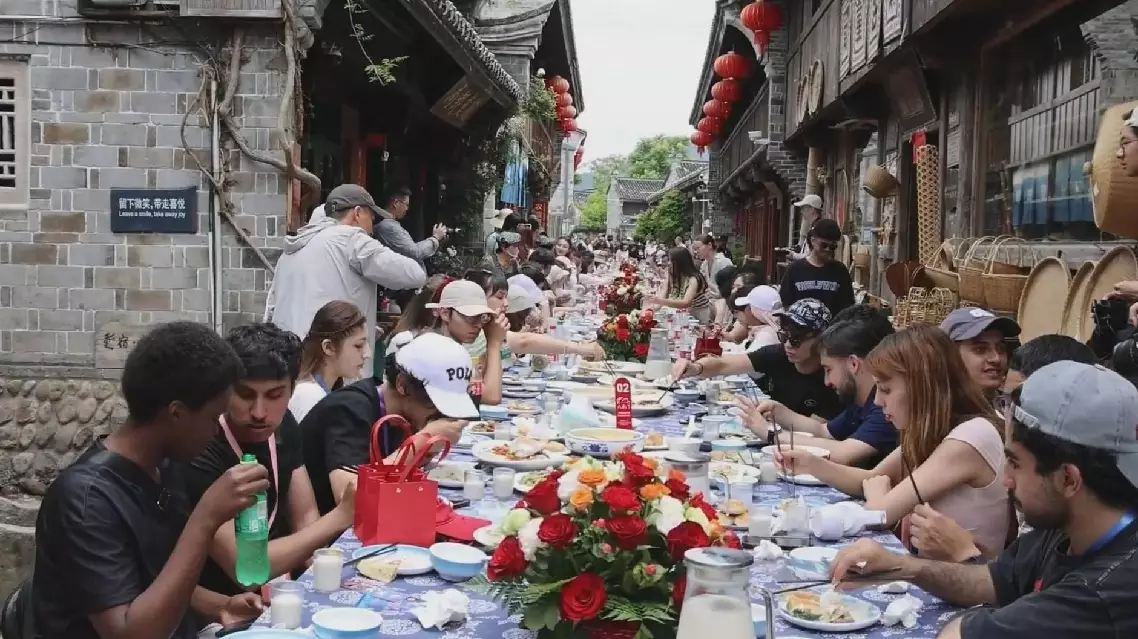
He recalled that in May, as a representative of the World Bank, he joined a delegation with members from over 30 countries -- including policymakers and development partners working in protected area management -- for an exchange event in Chengdu, southwest China's Sichuan Province, aimed at improving the effectiveness of protected area systems.
"We brought together, with the government of China, a delegation of almost 30 countries to learn and exchange with China on progress to effectively manage protected and conservation areas. And 'effectively' here means both ecologically -- increasing biodiversity, vegetation, water quality -- but also, fundamentally, economically and socially -- increasing jobs, increasing incomes, [and] improving the skills of people that live around protected areas," he said.
During his tour in Sichuan, Andre Rodrigues de Aquino also visited the Giant Panda National Park. In his view, the Giant Panda National Park has done an excellent job balancing wildlife protection with the development of diverse economic activities. He described the park's experience as highly valuable and worthy of being replicated elsewhere.
"One of the reasons we chose such one is exactly because of the results that the panda national park has shown in terms of increasing income of local people and employing people in park-related activities. We assess the progress as commendable and significant because it has allowed for the increase of jobs by improving the infrastructure of the parks," said the environmental specialist.
"And by so doing, increasing the offer of tourism activities for people, which in turn leads to more jobs, but also improving the skills of people living around the protected areas. We had the chance to interact with some of these people that were working in different types of business -- sometimes extracted industries such as mining -- and have been able to move to jobs such as tourism, hospitality. This progress in promoting economic development through nature-compatible activities is really something that all the countries around here are very interested in learning," he said.
According to Andre Rodrigues de Aquino, a key takeaway from China's experience in balancing wildlife conservation with the sustainable livelihoods of local communities is its effective coordination and long-term vision.
"China has been undergoing a reform of the protected area system, as you all know. And there is a lot of elements that are replicable. One of the key ones is bringing multiple, fragmented protected areas -- managed through different arrangements with different visions -- into a coherent, long-term vision, which in China is what the national parks became. So, it’s a center of a common vision. This is something that our participants have taken notice of and think can be replicable. Something else -- and this was new to most people coming -- is the co-management with different institutions, including community organizations," he said.

China's eco-governance proves to be highly effective: expert