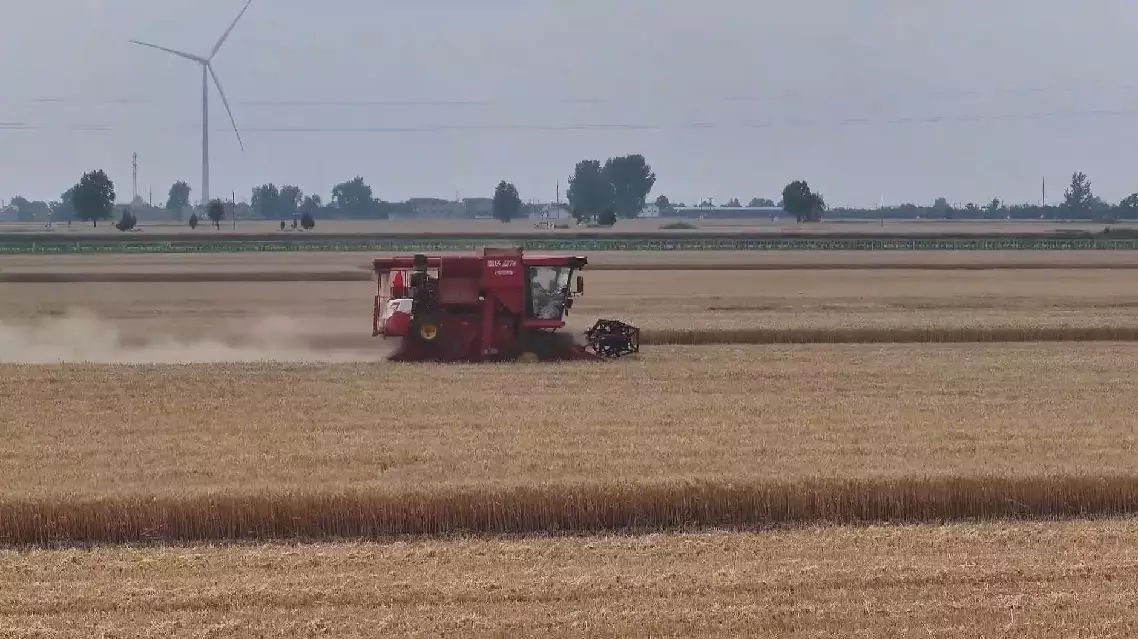
China has harvested nearly 60 percent of its wheat crop, covering about 13.33 million hectares, according to the Ministry of Agriculture and Rural Affairs.
Farmers across major producing regions are racing against the clock, seizing brief windows of clear weather to push forward the harvest amid impending rain.
In north China's Hebei Province, the winter wheat harvest has reached its peak. In Handan City, upon receiving weather forecasts predicting rain, large-scale grain grower Wang Pengfei immediately coordinated with local township officials and agricultural machinery stations to deploy seven combine harvesters for continuous, round-the-clock operations.
"The quality of the cutting is quite good. Even though we are rushing the harvest, the machine damage rate is very low, and there is almost no seed loss," Wang said.
To cope with the changeable weather, east China's Shandong Province has stockpiled over 4,600 grain harvesters and established more than 2,000 wheat drying service points.
In Wucheng County of Dezhou City, farmers are harvesting through the night and then transporting the grain to drying facilities to prevent spoilage.
"We rush into the fields to harvest when the rain stops, and immediately put the wheat into the dryers as soon as it's brought back," said Guo Yanzhi, a local farmer.
In east China's Jiangsu Province, agricultural innovation is helping lift wheat yields, as trials of several new varieties have produced strong harvests.
In Funing County, Yancheng City, a wheat variety developed through space-induced mutation is showing exceptional advantages. Unlike ordinary wheat, whose ears are only half the length of a palm, the space-bred variety boasts ears measuring 25 to 30 centimeters long. The stalks are thick and robust, while the grains are notably plump.
"We just tested the thousand-grain weight of this super wheat, and it has reached about 100 grams, with a yield of around 800 kilograms per mu (about 0.067 hectares)," said Cheng Kui, an agricultural expert.
Meanwhile, in Xinyi City, a high-stem wheat variety has reached heights of 1.8 to 2.8 meters, taller than many people, with yields of 700 to 800 kilograms per mu. Its thick stalks can be used as natural drinking straws, processed into livestock feed, or woven into crafts such as straw hats. Another new variety features ears more than 30 centimeters long and yields of 800 to 1,000 kilograms per mu.
"The length of the wheat ears can reach that of my forearm. The grain count is very high, and the grains are exceptionally plump," said Li Fengrong, another agricultural expert.
China's wheat harvest nears 60 pct as farmers race against rain
China's new regulation on outbound investment is not only about regulating domestic enterprises but also about sending a global signal of cooperation that benefits all overseas partners seeking long-term, stable growth, according to a Chinese economic expert.
The regulation, which will take effect from July 1, enhances policy transparency and clarifies regulatory boundaries to boost investment stability and efficiency. It aims to promote China's high-standard opening up and the high-quality development of its outbound investment, protect the legitimate rights and interests of investors and their outbound investment, and safeguard national sovereignty, security and development interests.
To that end, the 34-article regulation highlights efforts to align with international high-standard economic and trade rules, advance high-quality Belt and Road cooperation, and promote international cooperation in industrial and supply chains.
The regulation applies to all domestic investors in China. Without official approval, these investors cannot export or use restricted goods, technologies, services or data in overseas investment, nor covertly transfer restricted resources by sending technical personnel abroad.
For the first time, specific penalties are set: regulators may order violators to halt prohibited investment, dispose of overseas assets, confiscate illegal gains, and impose fines of up to one percent of the total investment value for non-compliance.
Nonetheless, experts note that the new regulation does not mark a policy shift toward curbing outbound investment. Instead, it equips authorities with clearer legal grounds for investor protection and reciprocal countermeasures.
"I would say that the Chinese government is trying to improve the efficiency and also the stability of China's outward direct investment. As China is playing a more and more important role in the global outward investment regime, I would say that it is likely that the Chinese government should do more to help enterprises enjoy the benefits by investing in other countries in the proper ways. So, this kind of new regulation -- it's not just trying to regulate Chinese enterprises themselves, but also trying to give better and clearer signals to the world, like the home countries for the investment," said Zhou Mi, a senior research fellow at the Chinese Academy of International Trade and Economic Cooperation.
Experts widely agree that the core purpose of the regulation is to enhance cross-government coordination and policy transparency. This will provide a more predictable environment for outbound investment, benefiting not only Chinese investors but also their overseas partners seeking stable, long-term growth.
"We would like to open our channels for cooperation with local governments on improving the stability of investment. I think that China's outward investment is growing very fast. It's not only in traditional industries, but also in many of these new and innovative industries. So, we are facing so many uncertainties about some of the possible technical improvements or the threats related to national security. It is not only a concern for China, but also for other partners," Zhou said.

China's new outbound investment regulation to boost transparency, global cooperation: expert