Members of China's 41st Antarctic expedition team have successfully initiated unloading supplies for its research base on the continent after spending more than a month at sea, utilizing an innovative relay race approach involving two icebreakers to overcome unusually severe ice conditions.
The unloading operations for around 5,300 cubic meters of cargo, weighing approximately 2,030 tonnes, took place on Dec 7 alongside the Zhongshan Station, China's largest research facility in southeastern Antarctica and serves as a crucial support hub for the Kunlun and Taishan stations.
The cargo includes construction materials, scientific equipment and essential logistical supplies.
The two vessels, Xuelong and Xuelong 2, or Snow Dragon and Snow Dragon 2, commenced the unloading process, facing daunting challenges presented by the thick ice, extreme weather, and unpredictable sea ice conditions of Antarctica.
The expedition team has to navigate carefully around icebergs and floating ice, all while maintaining safety during the transfer of cargo. Team members donned heavy snow suits to manage the heavy equipment and perform their tasks in biting winds.
This year, a chaotic ice belt several kilometers wide surrounds the Zhongshan Station, with ice thickness exceeding three meters. The complex and rare ice conditions are making it difficult for the "Xuelong 2" to guide the "Xuelong" to the designated unloading location quickly.
As the two icebreakers converged on Dec 7, Xuelong 2 undertook the unprecedented task of transferring supplies from Xuelong to the designated unloading point at the Zhongshan Station.
"We are currently employing a transfer method where we first move supplies urgently needed by the Zhongshan Station on Xuelong, along with materials crucial for subsequent research tasks, to Xuelong 2. Xuelong 2 will then independently break through the ice to the designated unloading point to deliver these supplies to the Zhongshan Station. Initially, we locate a suitable ice surface near Xuelong, unload the materials onto the ice, and subsequently lift and transfer them to Xuelong 2. This operation involved transferring nearly 280 tons of supplies," said Xiao Zhimin, captain of Xuelong 2.
Despite the challenges posed by the complex ice conditions, the unloading and transfer operations at the Zhongshan Station are progressing smoothly by taking the "Double Dragon Antarctic Exploration" approach.
"The unloading process itself marks the first step of our Antarctic expedition. Previously, Xuelong 2 mainly served as an icebreaker and guide for Xuelong. This year, innovatively, we are utilizing Xuelong 2 as a shuttle for the first time. This can be seen as a significant innovation within the 'Double Dragon Antarctic Exploration',"said Hu Hongqiao, deputy leader of China's 41st Antarctic expedition team.
In addition to unloading goods, the first group of 34 team members from Xuelong has already arrived at the Zhongshan Station and will commence research operations. Next, Xuelong will continue unloading using helicopter lifts, while Xuelong 2 will depart for China's Qinling Station in Antarctica, the country's fifth research station in the continent.
The 41st Chinese Antarctic expedition involves three vessels for support: Xuelong and Xuelong 2 set sail from south China's Guangzhou City, primarily for scientific research, personnel transport, and logistical supply tasks, while the cargo vessel Yong Sheng departed from Zhangjiagang, east China's Jiangsu Province in mid-November to deliver construction materials for the Qinling Station.
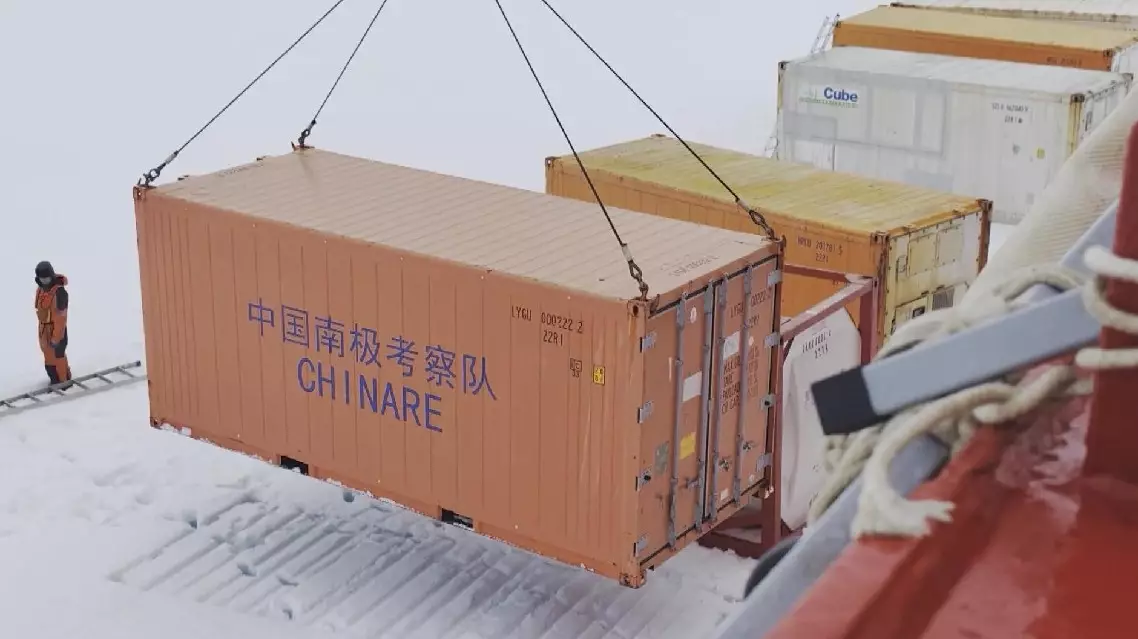
China's Antarctic expedition team pioneers innovative unloading operations