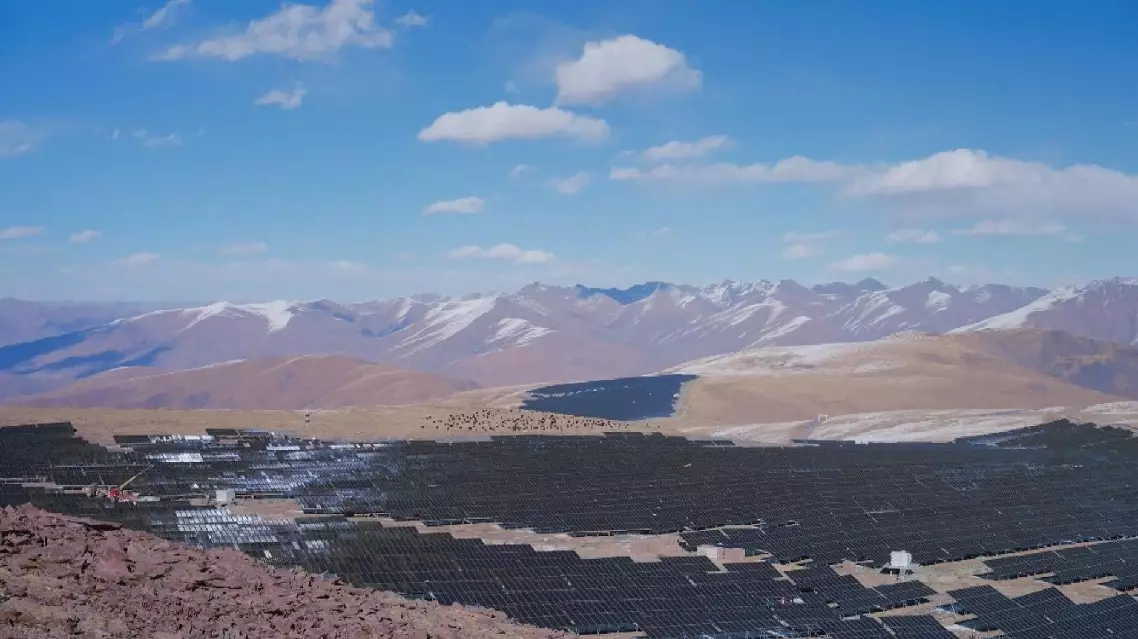
The second phase of the Huadian Xizang Caipeng Photovoltaic Power Station in Shannan Prefecture of southwest China's Xizang Autonomous Region, the world's highest-altitude photovoltaic project, officially began operations on Saturday.
The power station's second phase is located at an altitude ranging from 5,046 to 5,228 meters above sea level, setting a new record for the highest elevation of such a power station.
Spanning an area of approximately 134 hectares, the second phase boasts an installed capacity of 100,000 kilowatts. The annual average solar radiation at the site is more than double that of flatlands at the same latitude in China, earning it an "A-grade" classification for solar energy richness under the national solar energy resource assessment standards.
The first phase of the power station, which began operations at the end of 2023 at an altitude of 5,100 meters, has already generated over 60 million kilowatt-hours of electricity. With the addition of the second phase, the combined output of the two facilities is set to significantly alleviate electricity shortages during the winter and spring seasons in the central Tibetan region.
"After the second phase of the project is put into operation, we expect an annual power output of 155 million kilowatt-hours, sufficient to meet the annual needs of 50,000 households. This is equivelant to saving about 46,700 tonnes of standard coal annually and reducing carbon dioxide emissions by about 101,800 tons," said Tao Kun, project manager of Huadian Xizang Caipeng Photovoltaic Power Station.
To overcome the unique challenges of constructing photovoltaic projects at such high altitudes, the project team continually innovated construction methods. Despite the second phase being twice the size of the first, the introduction of an assembly-line installation process for support structures boosted construction efficiency by nearly 40 percent, shortening the project timeline by 42 days, which ensured the project was completed to high-quality standards before the onset of the harsh plateau winter.
The second phase utilizes cutting-edge photovoltaic panels with a photoelectric conversion efficiency 7.5 percent higher than those in the first phase. These panels are "bifacial", meaning they generate power from both sides. Light reflected from the ground, or even snow, can be absorbed by the rear panel, enhancing efficiency by 20 percent compared with single-sided panels.
These advanced solar panels, designed to operate for over 25 years, are built to withstand extreme conditions, including gales with speeds ranging from 32.7 to 36.9 meters per second, temperatures as low as minus 40 degrees Celsius, and up to 1.8 meters of snow accumulation.
The second phrase also adopts a "solar-grazing combination" model, allowing for power generation above and livestock grazing below. The extensive solar panels reduce sunlight exposure to the ground, retaining soil moisture and supporting vegetation growth even in winter.
As China continues to expand its renewable energy capacity, integrating energy storage systems has become critical to building a modern power grid. Incorporates advanced grid-forming energy storage technology, the Caipeng Photovoltaic Power Station has effectively addressed the inherent instability of renewable energy sources.
The 16 large white storage units in the power station, resembling giant "power banks", store solar energy collected during the day and deliver it to the grid at night. Beyond storage, this innovative system can also stabilize grid voltage and frequency, ensuring a reliable and secure power supply even during grid voltage fluctuations.
World's highest solar power project put into operation in China's Xizang