The Third China-Indian Ocean Region Forum on Blue Economy Development Cooperation was held on Monday in Kunming, southwest China's Yunnan Province, bringing together 300 government officials, scholars and business leaders from over 50 countries to discuss ways to advance the development of the maritime economy.
The forum, themed "Future of the Blue Indian Ocean -- Development Practice of the Global South," focused on tackling crises like climate change and marine pollution, while unlocking development opportunities in the Indian Ocean.
A highlight of this year's forum was a government-business dialogue, where officials and business leaders discussed paths for broader international collaboration by engaging multiple stakeholders.
International organizations also emphasized their pivotal role in facilitating cooperation.
"We are multilateral investment bank. We have a lot of investments -- five billion dollars of investment in China, 300 projects all around the world, 60 billion in projects. We have the capacity. We provide cheaper and longer-term financing for all these things. Fixing oceans and repurposing ports, those things take money and take time, and we are here to provide that type of financing, which actually makes sense for the developing countries," said Rodrigo Salvado, director general of the operational partnership department of the Asian Infrastructure Investment Bank (AIIB).
The China International Development Cooperation Agency, one of the forum's organizers, said its aim is to support projects such as the creation of a low-carbon demonstration zone in Seychelles.
"Next, we are willing to deepen opening-up and cooperation with other countries to jointly create a 'new engine' for the blue economy. We will consolidate consensus on sustainable marine development to build a 'new space' for blue development. Maritime dialogue and consultations will be strengthened to seek a 'new model' for blue governance. We will also promote mutual learning among maritime cultures with other countries to create a 'new chapter' of maritime civilization," said Zhao Fengtao, deputy director of the China International Development Cooperation Agency.
"Through cooperation with China, I see the importance and significance of advancing our objective of developing the emerging sectors, like marine biotechnology, circular economy, and also aquaculture, and also among the renewable energy sector. But China can also play a very pivotal role in research, especially in marine scientific research," said Phillianne Ernesta, Principal Secretary of the Department of Blue Economy of Seychelles' Ministry of Fisheries and Blue Economy.
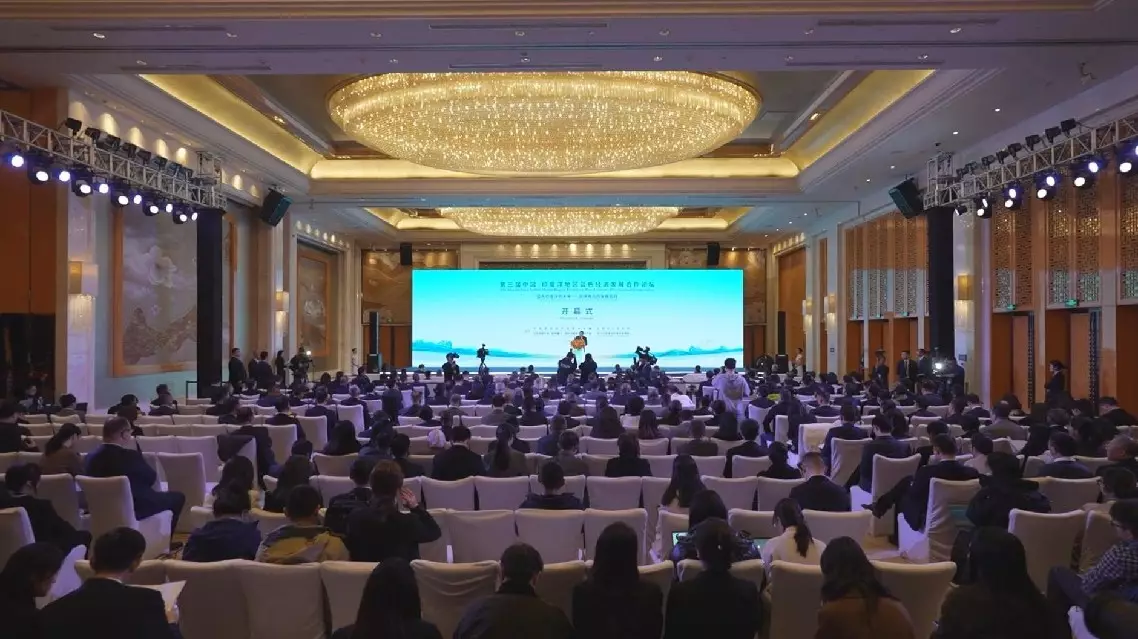
3rd China-Indian Ocean forum on maritime development cooperation held in Kunming
China's first 500-kV cross-border alternating-current power interconnection project entered service Monday, creating the highest voltage grid tie between the two countries and advancing Belt and Road energy cooperation.
The project raises two-way power transfer capacity between the two countries from 50,000 kW to 1.5 million kW, enabling the annual transmission of about 3 billion kWh of clean electricity, roughly 30 times the capacity of previous lines, according to China Southern Power Grid.
As the largest cross-border grid project and the highest-voltage power link between China and Laos, it connects southwest China's Yunnan Province with Oudomxay and Luang Namtha provinces in northern Laos.
Cross-border electricity trading began as the project entered operation. About 4.81 million kWh of power from clean energy bases in northern Laos was transmitted to Yunnan through the new line, marking a more regular and institutionalized phase of power connectivity between the two countries.
It is also the first time an overseas new energy project has participated in China's electricity market, the company said. The power involved in the transaction came from a large mountain photovoltaic project in Laos, one of the core supporting power sources for the interconnection line.
"This project is the cross-border power grid project with the highest voltage level between China and Laos. Leveraging the China-Laos power grid interconnection and the power markets in southern China, surplus hydropower from Laos can be transmitted to China during the rainy season, while China can supply supplemental power to northern Laos during the dry season. This project represents yet another landmark achievement between China and Laos in deepening power cooperation and jointly advancing the high-quality development of the Belt and Road Initiative," said Li Jingru, general manager of Electricite du Laos Transmission Company Limited (EDL-T), a joint venture of China Southern Power Grid and Lao state-run Electricite du Laos.
The solar project has an average annual power generation capacity of about 1.65 billion kWh. In 2026, it is expected to transmit about 1.1 billion kWh of solar power across the border, supporting energy complementarity between the two countries.
"In the future, efforts will be made to further promote normalized cross-border electricity trading, meet the trading needs such as electricity transmission from Laos to China's Yunnan, from China's Yunnan to Laos, and from Laos to China's Guangdong, and facilitate the optimal allocation of energy resources in the Lancang-Mekong region," said Li Minhong, marketing director of China Southern Power Grid.
Construction of the interconnection project began in late February last year. Spanning a total length of 177.5 km, the transmission line includes a 145-km Chinese section and a 32.5-km Lao section.
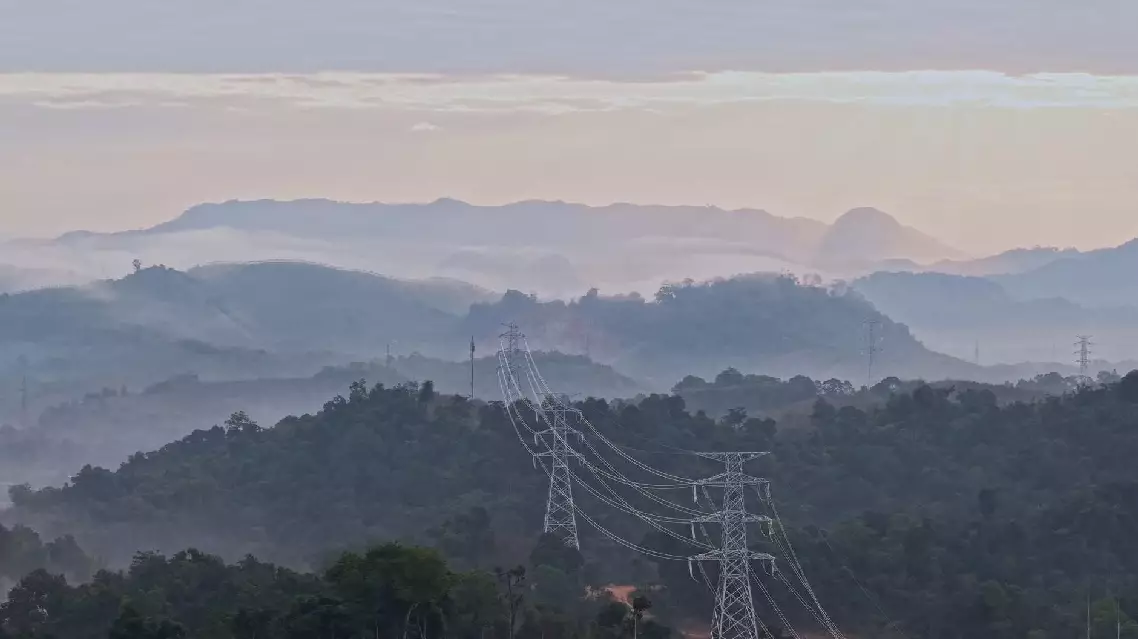
New China-Laos power link expands transfer capacity 30-fold, boosts electricity trading