CAPE CANAVERAL, Fla.--(BUSINESS WIRE)--Dec 17, 2024--
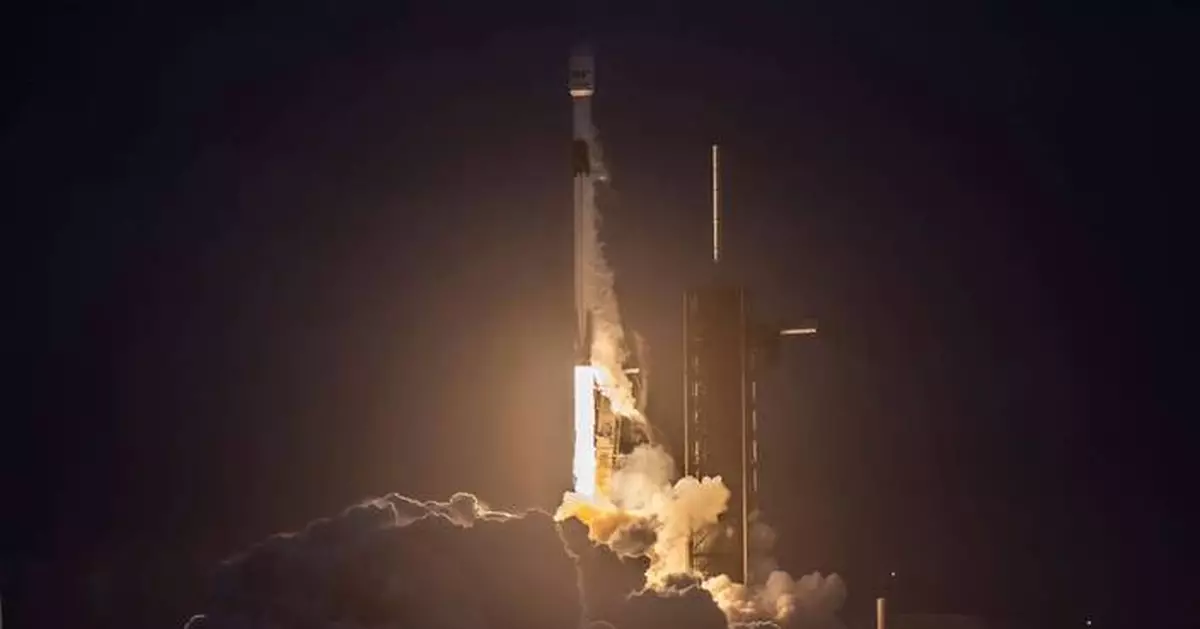
SES announced today that its latest pair of O3b mPOWER satellites was successfully launched into space by a SpaceX Falcon 9 rocket from Kennedy Space Center in Florida, United States, at 5:26 pm local time. Both satellites will join the first six O3b mPOWER spacecraft already in operation at medium Earth orbit (MEO), adding incremental capacity to the initial O3b mPOWER constellation.
This press release features multimedia. View the full release here: https://www.businesswire.com/news/home/20241217948405/en/
The seventh and eighth O3b mPOWER satellites feature redesigned payload power modules and will bolster SES’s second-generation MEO system to continue delivering high throughput and predictable low latency services at scale.
SES has been deploying O3b mPOWER services worldwide since April 2024 delivering high-performance network services to customer sites across Asia-Pacific, Africa, the Middle East and the Americas in multiple market segments. The system’s exceptional flexibility means it can provide services ranging from tens of Mbps to multiple gigabits per second of capacity to any site. Key O3b mPOWER customers include Microsoft, Princess Cruises, Marlink, Jio Platforms, Orange, Claro Brasil, Vodafone Cook Islands, CNT Ecuador, NATO Support and Procurement Agency, and the Governments of Luxembourg and the United States.
“O3b mPOWER is our most powerful, technically advanced, flexible satellite constellation in space. As we increase the number of satellites in our constellation, we also exponentially increase the capacity and efficiency of our network. Ever since the start of service of O3b mPOWER earlier this year, we have seen how it has become an integral part of the connectivity experience of our customers. We have also learned a lot and have put all of those insights to work as we progress in our innovation journey to scale up our services and meet even the most sophisticated requirements of our customers,” said Adel Al-Saleh, CEO of SES.
The O3b mPOWER system comprises an initial constellation of 13 high-throughput and low-latency satellites as well as extensive ground infrastructure. The remaining five O3b mPOWER satellites are currently being manufactured and are scheduled for launch over the next 18 months.
For additional information on O3b mPOWER, visit the newsroom.
Follow us on:
Twitter | Facebook | YouTube | LinkedIn | Instagram
Read our Blogs>
Visit the Media Gallery>
About SES
SES has a bold vision to deliver amazing experiences everywhere on Earth by distributing the highest quality video content and providing seamless data connectivity services around the world. As a provider of global content and connectivity solutions, SES owns and operates a geosynchronous orbit fleet and medium Earth orbit (GEO-MEO) constellation of satellites, offering a combination of global coverage and high-performance services. By using its intelligent, cloud-enabled network, SES delivers high-quality connectivity solutions anywhere on land, at sea or in the air, and is a trusted partner to telecommunications companies, mobile network operators, governments, connectivity and cloud service providers, broadcasters, video platform operators and content owners around the world. The company is headquartered in Luxembourg and listed on Paris and Luxembourg stock exchanges (Ticker: SESG). Further information is available at: www.ses.com

SES’s Seventh and Eighth O3b mPOWER Satellites Successfully Launched, Bolstering MEO Constellation (Photo: Business Wire)
UNITED NATIONS (AP) — Nearly 25,000 children caught in conflict were victims of a record number of violations last year, including killings, rape and recruitment to fight, and for the first time, government forces — not armed groups — were the main perpetrators, a new United Nations report says.
Secretary-General Antonio Guterres’ annual report, released this week, has a blacklist of violators against children: government forces from eight nations and 67 armed groups from 16 countries and territories.
The number of violations — which also include abductions, attacks on schools and hospitals, and denial of humanitarian access to help them — rose for a fourth straight year to 38,558, according to the report that is based on verified U.N. data. It said 24,174 children, a third of them girls, were affected, with several thousand subjected to multiple violations.
“The scale and persistence of these violations demand more than acknowledgment — they demand resolve,” the U.N. special representative for children in armed conflict, Vanessa Frazier, said in an analysis of the report.
She urged the 193 U.N. member nations to confront the findings and “recognize that protecting children is not an aspiration but an obligation, and that the decisions taken today will shape the futures they may or may not live to claim.”
For the first time since the U.N. authorized monitoring of abuses against children in conflict 30 years ago, the report said that “government forces were responsible for a majority of grave violations.”
Topping the 2025 list are the Israeli military and its security forces, with 12,445 violations. That is followed by Congo, with 4,114 violations, and Myanmar, Somalia and armed groups in Nigeria, all with over 2,000 violations. Government forces from Sudan, South Sudan, Syria and Russia's armed forces in Ukraine are also on the blacklist.
The blacklist also includes Hamas and Palestinian Islamic Jihad, which carried out the Oct. 7, 2023, surprise attacks in southern Israel that killed some 1,200 people, mostly civilians, and sparked the war in Gaza. The U.N. says Israeli settlers were responsible for 326 grave violations last year, and Guterres warned that if these attacks continue, the settlers could be put on the blacklist.
The report says government forces were “the main perpetrators” of 6,266 killings of children — a 34% increase from last year — as well as 7,958 injuries.
The U.N. said it verified the killing of 2,668 Palestinian children by Israeli forces in Gaza and 55 Palestinian kids in the West Bank and east Jerusalem. The U.N. received reports of the killing of an additional 4,588 children in Gaza and injuries to 346 Israeli children that it is in the process of verifying, the report said.
Guterres said he was “appalled by the magnitude of grave violations against children” in Palestinian territories and Israel, “gravely alarmed by the staggering increase in grave violations” perpetrated by Israeli forces, and “deeply alarmed at the staggering rise in attacks carried out by Israeli settlers” affecting children with no accountability.
The U.N. chief urged Israel to develop and sign a plan with the United Nations to end the killing and maiming of children and attacks on schools and hospitals with time-bound commitments.
Israel's U.N. Ambassador Danny Danon accused Guterres of blurring “the fundamental distinction between a democratic state fighting for its survival and murderous terrorist organizations” like Hamas and Islamic Jihad rather than standing with the victims of the Oct. 7, 2023, attacks. He said this will be Guterres' legacy — “one of the greatest moral failures in the history of the United Nations.”
Frazier, the special representative for children in conflict, told reporters Thursday that there are a number of reasons government forces were responsible for more violations this year. That includes “the impunity that we are seeing towards international law” and changes in warfare from battlefields to densely populated places using new weapons like drones and explosives that cover a wide area, she said.
“Children were impacted while escaping fighting, seeking food, water or medical care, and navigating areas heavily contaminated by explosive remnants of war, often contributing to life-long disabilities,” she said in the analysis of the report.
The U.N. said it verified the recruitment and use of 6,607 children in conflict, with the highest numbers in Congo, Nigeria, Haiti, Somalia and Colombia. It said 5,129 youngsters were abducted, mainly in Nigeria, Congo, Somalia, Myanmar and Mozambique.
And it reported 1,783 child victims of rape and sexual violence, with the highest number in Congo, Nigeria, Somalia, Sudan and Haiti.
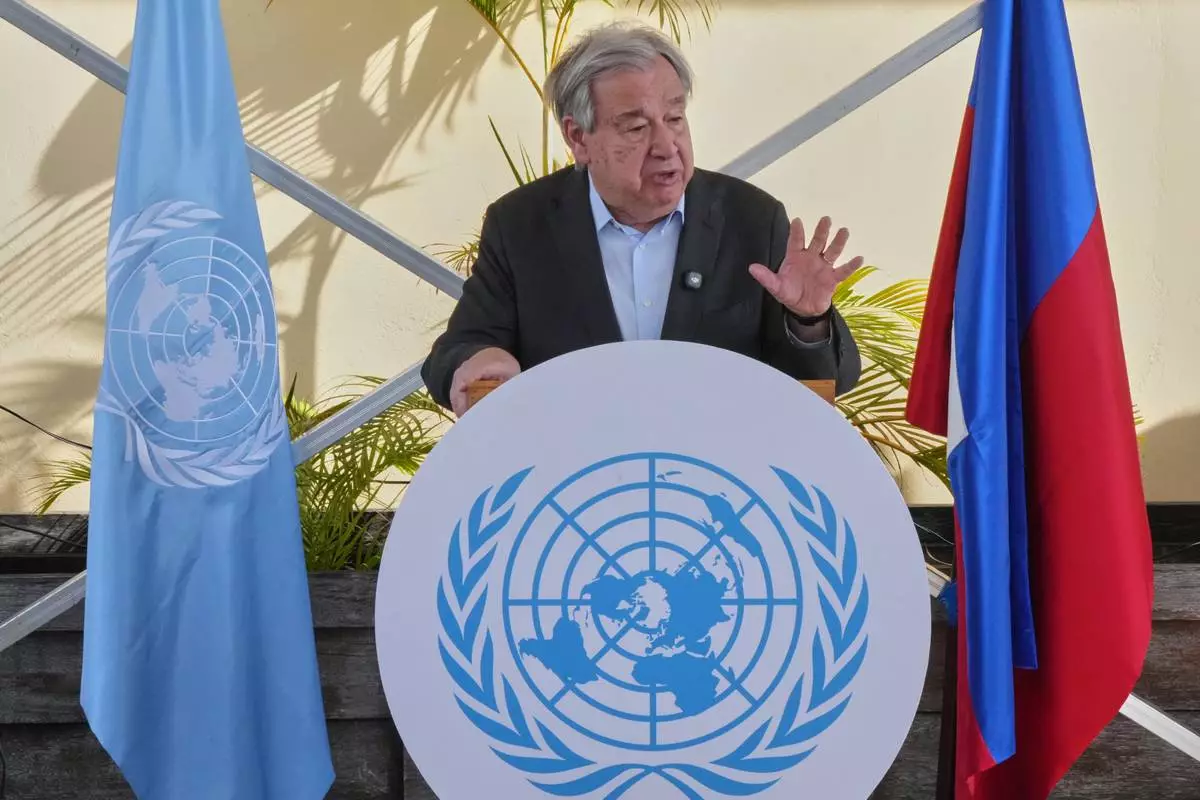
UN Secretary-General Antonio Guterres speaks during a press conference at the United Nations Integrated Office in Haiti (BINUH) in Port-au-Prince, Tuesday, June 16, 2026. (AP Photo/Odelyn Joseph)