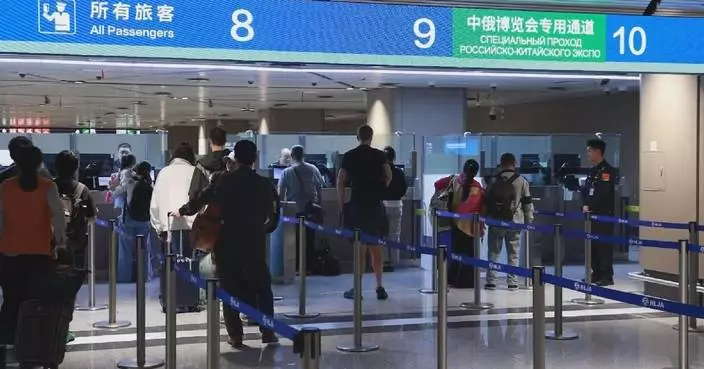
Shanghai’s Pudong Airport customs had handled over 30 million inbound and outbound travels this year as of Wednesday, 78 percent more than the yearly total of 2023.
Boosted by visa-free and other favorable policies, China’s major ports of entry have reported surges in inbound arrivals, with Shanghai’s Pudong Airport customs standing out.
Among the 30 million entries and exits recorded, 7.6 million were made by foreigners, featuring a 110 percent year-on-year increase. Most of the foreign travelers are from Japan, South Korea, and the United States, with 1.22 million entering under visa-free policies.
Chinese mainland residents accounted for 20.2 million cross-border trips via Pudong Airport as of Wednesday, marking an 80 percent rise compared with the same period last year.

Shanghai airport handles 80 pct more entries, exits than 2023
The 2026 Asia-Pacific Economic Cooperation (APEC) Ministers Responsible for Trade Meeting will be held from May 22-23 in Suzhou City, east China's Jiangsu Province, with preliminary consultations and seminars kicking off on Monday.
Multiple consultations have commenced, including discussions on the joint statement to be issued at the meeting and ways to promote cooperation in digital trade.
Additionally, the "Big Market for All: Export to China" Suzhou special event and the Suzhou products promotion event opened Monday.
Experts emphasized that the minister's meeting will play a timely role in advancing regional economic integration and tackling emerging trade challenges through deeper cooperation in digital and green sectors.
"APEC is the highest-level and most influential economic cooperation mechanism in the Asia-Pacific region. On the 20th anniversary of the vision for a Free Trade Area of the Asia-Pacific (FTAAP), the 2026 Suzhou APEC Ministers Responsible for Trade Meeting will play a positive role in safeguarding the multilateral trading system, stabilizing Asia-Pacific cooperation, and leading global open development, countering the increasingly intensifying wave of trade protectionism," said Yuan Qian, deputy director of the trade and investment research division of the Institute of World Economics and Politics, which is under the administration of the Chinese Academy of Social Sciences.
"At the same time, as a new round of technological revolution and industrial transformation accelerates, this meeting takes cooperation in emerging areas such as digital and green as important content, better aligning with the trend of global technological innovation and development, countering global economic growth pressures, and opening up new spaces for regional cooperation and development," the expert added.
Terms such as digital economy, electronic bills of lading, and green supply chains appear frequently in the agenda of the APEC trade ministers' meeting.
"Although electronic bills of lading may seem small, their impact on international trade is very critical. They can improve customs clearance efficiency and reduce customs clearance costs. If promoted, it will not only affect these developed economies and large traders, but more importantly, it will significantly enhance the ability of some small and medium-sized economies and some developing countries to participate in international trade and improve their trade efficiency," said Zhou Mi, deputy director of the Institute of American and Oceania, Chinese Academy of International Trade and Economic Cooperation, which is under the administration of the Ministry of Commerce.
This year, a key topic of the meeting is the digital economy.
"In the past, people thought the digital economy was an option; now it has become a must. Because having advantages in digital economy development means having greater advantages in international trade. They (member economies) have seen some of China's practices and approaches in the digital economy field and hope to use such a platform to further improve their own technology and strengthen coordination with China," said Zhou.
Founded in 1989, the APEC is the highest-level, broadest and most influential economic cooperation mechanism in the Asia-Pacific region. About 700 representatives from 21 APEC economies and international organizations will gather in Jiangsu for the APEC Ministers Responsible for Trade Meeting.
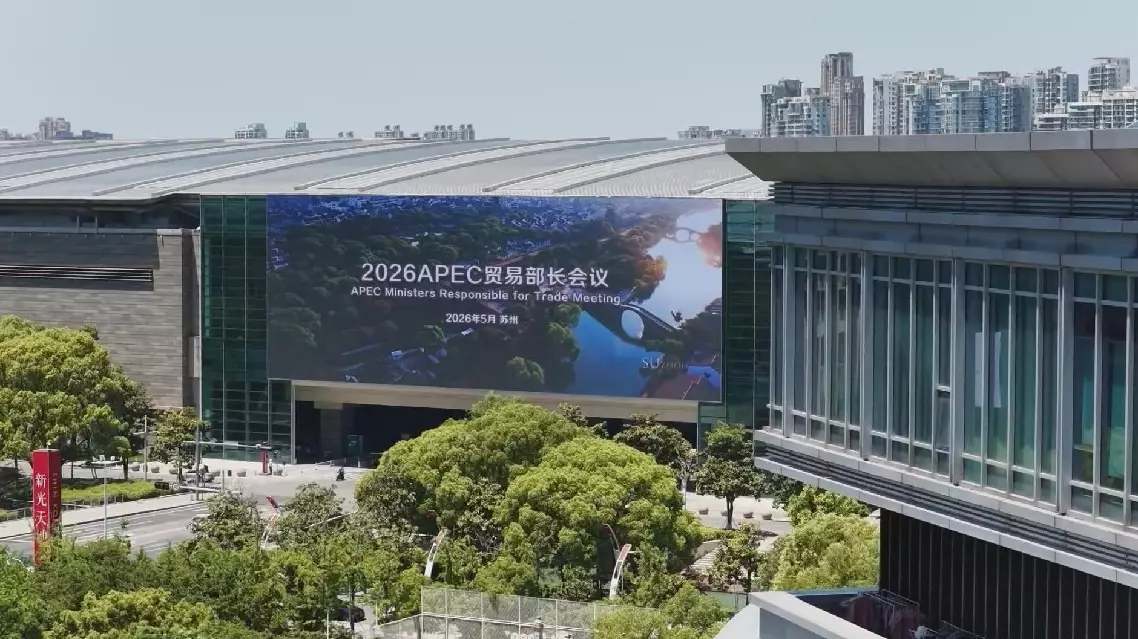
Preliminary consultations begin for APEC trade ministers' meeting