Chinese families are choosing to celebrate their most important annual feast - which falls on Jan 29 in 2025 - in unconventional ways other than gathering around a home-cooked meal.
The Chinese Lunar New Year's Eve dinner is a cherished tradition for Chinese people as family members get together to celebrate the most important traditional festival.
In a gleaming indoor ski resort in Shanghai, preparations are underway for a new way to open up the holidays. The resort operator commits to a fusion of leisure and tradition by offering a tourism package.
Guests will dine after hitting the slopes, with lion dances and sugar-painting demonstrations adding festive flair.
"The hotel's Spring Festival Eve dinner is very popular. We have buffet with mezzanines and traditional round table dinner settings. We also specially prepared the lion dance performance, Chinese knot handicraft workshop, sugar painting experience and other Chinese New Year custom activities for customers so that guests have an immersive good experience of the Chinese New Year. Currently we have received neaarly 1,000 orders," said Wang Hui, head of the indoor ski resort.
For those seeking a different experience, dining at sea offers an exciting alternative. The Ada Magic City, China's first large domestic cruise ship, will set sail from Shanghai on Jan 28, embarking on a six-day journey to Jeju of South Korea, and Fukuoka and Nagasaki in Japan.
The cruise will feature a series of festive activities, including traditional window paper cutting and spring festival scrolls writing, along with four hours of continuous Chinese New Year celebrations.
"Following the launch of our Spring Festival team voyages, we have received an enthusiastic response from consumers in the market. The sales has been exceptionally good. (Customers) from across China and over 10 foreign countries have booked these voyages to celebrate the Chinese New Year with families and friends," said David Wong, hotel director of Ada Magic City.
In Nanjing, capital of east China's Jiangsu Province, many restaurants are introducing incorporate family reunion dinners and tourism with intangible heritage elements, leading to a surge in bookings.
Most restaurants in the city have already begun taking reservations, with some starting as early as late September.
The Jiangsu Restaurant Association predicts that by New Year's Day 2025, many chain restaurants will be fully booked, with 80 percent of banquet halls already reserved and over 70 percent of star-rated hotel dining rooms booked.
The Chinese Lunar New Year falls on Jan 29 in 2025, with an eight-day public holiday running from Jan 28 to Feb 4.
Such extension is also driving growth in the tourism market, prompting hotels and travel agencies to offer "Spring Festival dinners + holiday tour" packages.
A well-established restaurant in Nanjing reports a room booking rate exceeding 60 percent.
"Throughout the Spring Festival, we will invite folk artists to stay in our hotel every day to provide guests with different folk culture experience, including rubbing 'Fu' (happiness) character on-site, making lanterns and sugar figurines and trying on the intangible cultural heritage of paper-cut art. We want to offer our customers a more plentiful experience," said Qu Ying, assitant general manager of the restaurant.
"To mmet those demands, we have introduced a 'hotel + Spring Festival Eve dinner' product. Tourists can have the New Year's Eve dinner in the hotel on the same day. This year, more and more tourists have signed up for the New Year's Eve dinner in the hotel, and the growth trend has been very obvious," said Liu Feng, head of a travel agency.
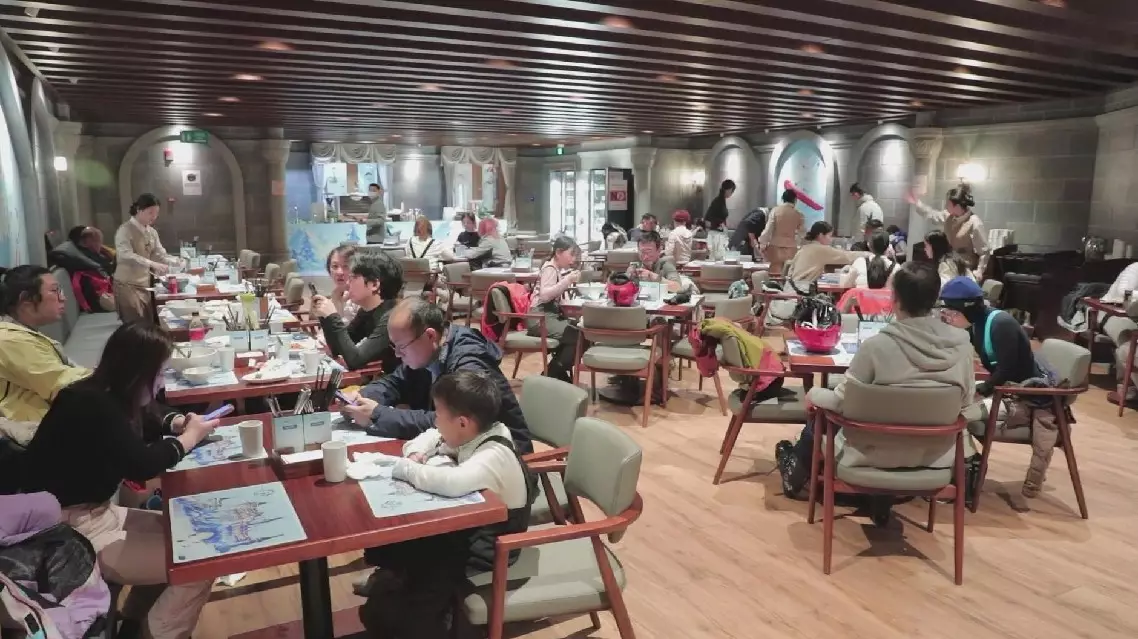
Innovative reunion dinners blend cultural tradition with modern entertainment