Skip to Content Facebook Feature Image

China's first onshore testing platform for offshore wind turbines put into use

China

China

China

China's first onshore testing platform for offshore wind turbines put into use

2024-12-27 17:29 Last Updated At:12-28 00:07

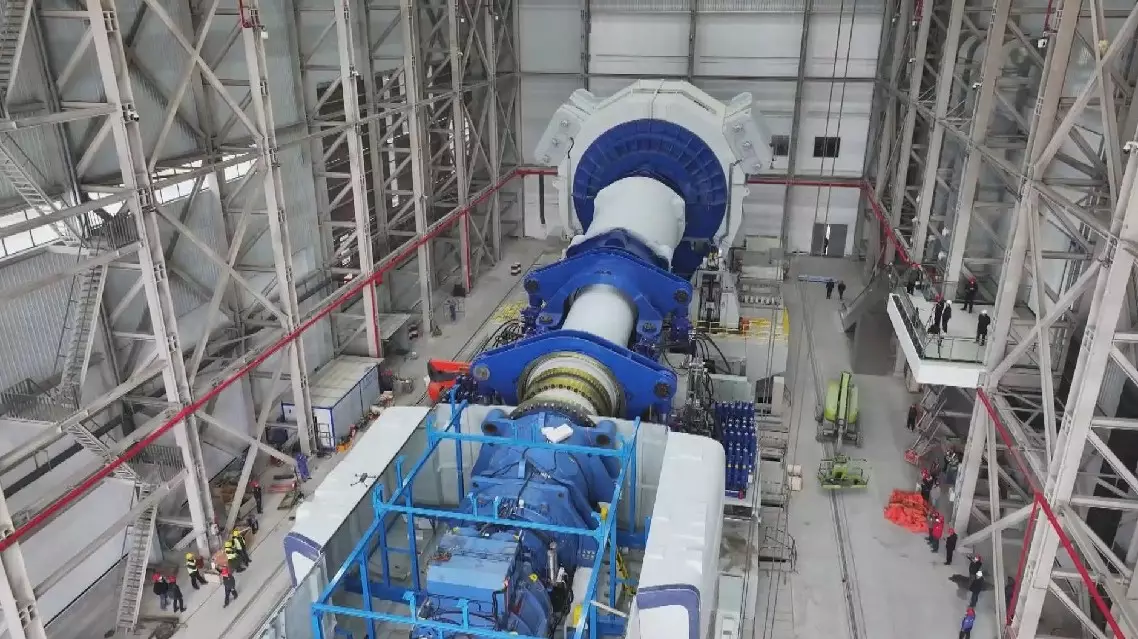
China's first full-scale onshore testing platform for offshore wind turbines was put into use on Thursday in east China's Fujian Province, showcasing world-leading abilities.

Consisting of multiple cutting-edge equipment, the platform can simulate complex offshore working environments of wind turbines to test their quality and performance, with a maximum simulation capacity of 27.5 megawatts (MW).

"The experimental platform can provide 35 meganewton-meters (MNm) of torque, which is the largest capacity among all platforms worldwide. This means that we can simulate a force environment for the world's largest-set wind turbines, whose capacities are 20 megawatts, under the effect of a level 18 typhoon to test their performance," said Qin Shiyao, deputy director of the New Energy Institute under the China Electric Power Research Institute.

To improve its adaptability, researchers developed adjusting systems to fit turbines of different angles.

"Since the pitch angles of the offshore wind turbines being tested vary for each model, we have developed a system that integrates hydraulics, electrical components, and control, allowing us to freely adjust the 1,200-ton motor within a range of 6 to 10 degrees, with an adjustment precision of 0.01 degrees. This has never been achieved internationally," said Xue Yang, head of the Offshore Wind Power Digitalization Technology Laboratory, Fuzhou Branch of China Electric Power Research Institute.

Different from previous on-the-spot testing methods, the platform provides a controllable and more comprehensive environment to test the performance of wind turbine under extreme winds, significantly shortening the time.

"In the past, our tests were mainly carried out by installing turbines offshore, and the testing was highly dependent on weather conditions. With this test platform, we can more comprehensively test the operational conditions of wind turbines. The original testing time, which took half a year to a year, can now be shortened by more than half," said Xue.

Researchers are also planning to upgrade the platform with digital technologies, aiming to facilitate the development of new-type wind turbines.

"We are also building a digital twin platform that will help verify and optimize the design and development of wind turbines. In the future, it will also support the development of larger-capacity turbines," said Xue.
China's first onshore testing platform for offshore wind turbines put into use

China's first onshore testing platform for offshore wind turbines put into use

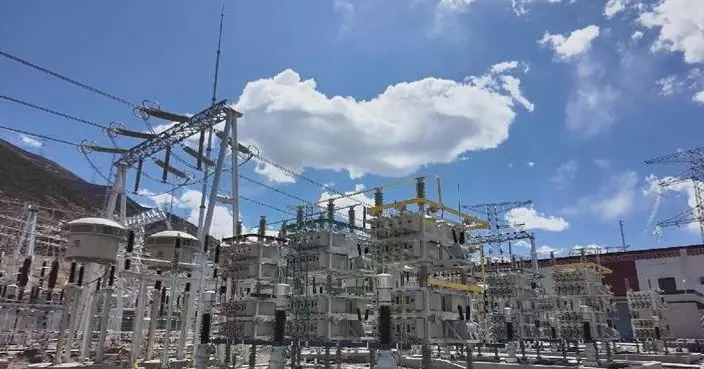
China's first onshore testing platform for offshore wind turbines put into use
China's first onshore testing platform for offshore wind turbines put into use
Serbian President Aleksandar Vucic on Monday local time reaffirmed the country's commitment to abiding by the one-China principle, saying that Taiwan is an inalienable part of China.

Vucic made the remarks during his inspection of the Chinese-built Danube Corridor fast road in eastern Serbia.

He also agreed that the Taiwan question is purely an internal affair of China.

"I have one message that is important. I said that our goal is to maintain global peace and stability. It is also important to respect the UN Charter, international law, and the Five Principles of Peaceful Coexistence. Serbia will continue to firmly support the People's Republic of China in safeguarding its territorial integrity. Serbia supports the one-China principle with all its political strength. Taiwan is an inalienable part of China. This is Serbia's consistent position on the Taiwan question. It was and it will remain the policy of Serbia," he said.

During the site visit to Golubac, Vucic spoke with Chinese and Serbian workers on the Danube Corridor expressway, highlighting cooperation between the two countries.

Vucic said the road would significantly improve connectivity along the Danube and support economic development in eastern Serbia. He expressed satisfaction with the quality of construction and confidence in the Chinese builders.

Alongside the president are Li Ming, Chinese ambassador to Serbia; Aleksandra Sofronijevic, minister of construction, transport and infrastructure; Aleksandar Antic, director of state-run company Koridori Srbije; Zoran Drobnjak, acting director of Roads of Serbia; as well as local officials and municipal leaders.

Ambassador Li said that the project has a "far-reaching" effect on Serbia's development. It is "the crystallization of the wisdom of the people and enterprises of both countries," he said.

The 68-km Danube Corridor links the Branicevo district in eastern Serbia with the capital of Belgrade and the international E75 highway. Serbia opened 31.85 km of the route to traffic in February 2025, with work continuing on the remaining sections.

Serbian president reaffirms commitment to one-China principle during inspection of Chinese-built Danube Corridor

Serbian president reaffirms commitment to one-China principle during inspection of Chinese-built Danube Corridor

Recommended Articles