Skip to Content Facebook Feature Image

Malaysian PM eyes China as key market for durian exports

China

China

China

Malaysian PM eyes China as key market for durian exports

2024-12-28 17:51 Last Updated At:12-29 01:37

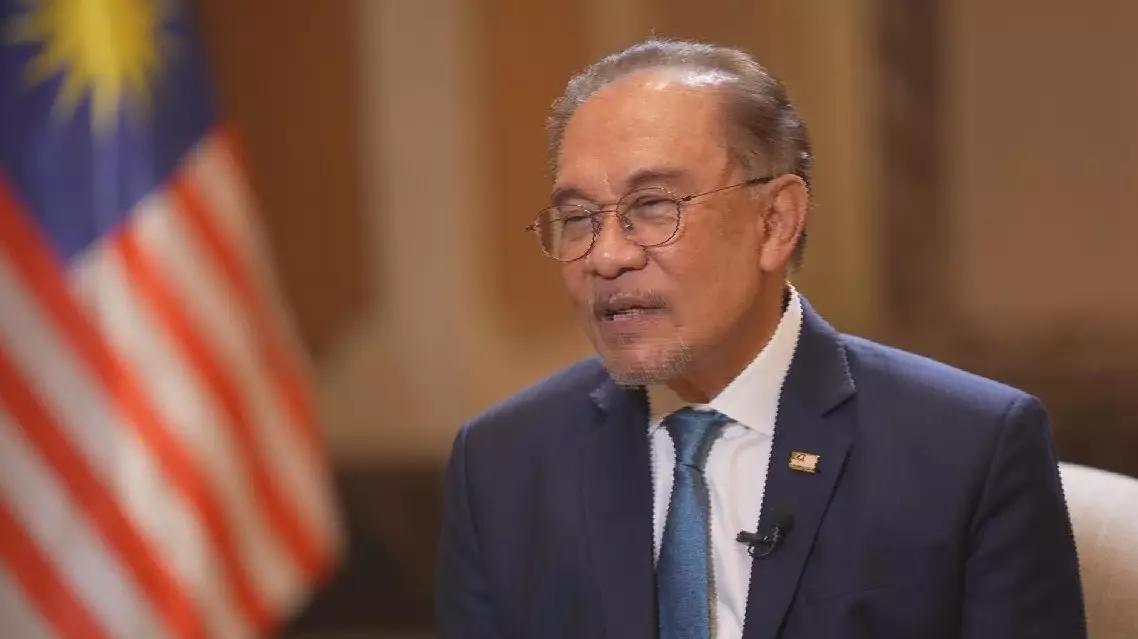
Malaysian Prime Minister Anwar Ibrahim sees vast opportunities for durian exports to China, with plans to expand shipments to more provinces to tap into the vast and growing market.

A total of 15 tons of fresh durians from Malaysia arrived in central China's Zhengzhou on August 24, marking the first batch of Malaysian fresh durians to enter the Chinese market.

This batch of Malaysian fresh durians, including 10 varieties such as Black Thorn and Musang King, was sourced from nine Malaysian export companies. The durians were distributed by the cold chain from Zhengzhou Xinzheng International Airport to cities including Beijing, Shanghai, Shenzhen, Xiamen, and Shenyang.

"You see the openness, the willingness to adjust and accommodate our request. Because initially, of course, there was only frozen durian, and frozen durian is of course exquisite and delicious. But when you taste fresh durian, it is going be the super exquisite," said Anwar during an interview with China Media Group (CMG) aired on Friday.

"That's why I think in diplomatic relations, bilateral relations, the issue of trust and respect is important. I feel comfortable to make a request, I mean after our foreign ministry officials, and trade and investment ministries have done their work. So, we were successful. And I think there's a huge potential, unbelievable the interest in durian by Chinese. And I think great future because I think we crossed almost one billion (ringgit). It is huge potential. And that's only a small part, we go one of two provinces in China. Can you imagine if we can get to 10 provinces, then it is going to be enormous. Just durian, of course, but I think we should not end at durian," he said.
Malaysian PM eyes China as key market for durian exports
Malaysian PM eyes China as key market for durian exports
Days after a powerful 7.5-magnitude earthquake struck western Colombia on Aug 10, families in Cali, the worst affected city, are confronting heartbreaking obstacles simply to lay their loved ones to rest.

Cali's morgue sustained damage in the quake and was forced to close operations after part of the Hospital Universitario del Valle collapsed. As a result, recovered bodies must be transported to the neighboring town of Palmira, which escaped structural destruction.

The influx has severely overwhelmed Palmira's facilities, leaving them short on refrigeration capacity. Grieving relatives waiting outside must wear masks as they endure agonizing waits, caught in a system operating far beyond its designed capacity.

While some families have managed to bid a painful farewell and gained a measure of closure, such as the relatives of Maria Esmeralda Ordonez in Cali, countless others remain in painful limbo.

"Thankfully it's not turned out like it has for others who today are still fighting to rescue loved ones, people who are still lying beneath the rubble. The chances of survival are very slim, but miracles are happening," said Ivan Delgado, a relative of Maria Esmeralda Ordonez.

For many families whose relatives have been recovered, the ordeal is far from over. They must navigate the bureaucracy that comes with a death.

Securing the release of a body requires a prosecutor's order, an accompanying undertaker, and a considerable amount of paperwork -- a grueling process compounded by a system operating well beyond its capacity.

Camilo Mendez, a relative of victims, knew this pain firsthand after an agonizing three-day wait to claim the bodies of his aunt and grandmother.

"From the information we've gotten here and there, you can really tell we're not prepared for this kind of event. Moving the bodies, all of it, it was very slow, very disorganized. My grandmother and my aunt were in one place, then another. It was pretty chaotic, honestly," said Mendez.

To support the exhausted crowds, volunteers and psychologists have set up tents near the Palmira facility, offering comfort and counseling.

"It's an exhausting process. You're here waiting for an answer, and no one knows when it will come. There are people with one, five, six relatives they can't find. A body may be recovered today, another tomorrow, and that's how it's gone," said Alison Morales, a volunteer psychologist.

"The community has been extraordinary, all kinds of donations, the communal kitchen, water for the people waiting," she added.

Although Palmira itself was spared the worst of the earthquake -- sustaining cracks on a few buildings and no fatalities -- it has absorbed the profound, far-reaching grief of a region struggling to bury its dead.

Families face heart-breaking delays burying victims of Colombian earthquake

Families face heart-breaking delays burying victims of Colombian earthquake

Recommended Articles