Skip to Content Facebook Feature Image

Packers CB Jaire Alexander's knee injury is expected to sideline him for rest of the season

Sport

Packers CB Jaire Alexander's knee injury is expected to sideline him for rest of the season
Sport

Sport

Packers CB Jaire Alexander's knee injury is expected to sideline him for rest of the season

2025-01-02 08:06 Last Updated At:08:11

GREEN BAY, Wis. (AP) — The Green Bay Packers apparently will have to make their entire postseason run without two-time Pro Bowl cornerback Jaire Alexander.

Packers coach Matt LaFleur said Wednesday that Alexander is undergoing surgery to repair the knee injury that has kept the 2018 first-round pick from playing for most of the past two months.

“Most likely, he’s going to be done for the rest of the year,” LaFleur said.

The knee injury first sidelined Alexander for a 24-14 loss to the Detroit Lions on Nov. 3. After the Packers had a week off, Alexander returned for a game at Chicago but played just 10 defensive snaps before the injury sidelined him for the rest of that 20-19 victory.

Alexander hasn’t played since, as he’s missed six straight games. Now he probably won’t be back at all this season.

“It’s the situation,” LaFleur said. “It stinks that we’re here, but we’re here.”

Alexander’s absence creates a major hurdle for the Packers in their bid to make a Super Bowl run as a wild card. The Packers (11-5) are slotted as the NFC’s No. 7 seed, which would force them to open the postseason at Philadelphia (13-3) and stay on the road for their entire playoff run.

The Packers still could earn the No. 6 seed if they beat the Bears (4-12) at home on Sunday while the Washington Commanders lose at Dallas.

Green Bay ranks 17th in the NFL in passing yards allowed per game. Its vulnerability in that regard was apparent Sunday as the Packers allowed Sam Darnold to throw for a career-high 377 yards in a 27-25 loss at Minnesota.

The Packers remain confident they can make a deep playoff run with the defensive backs they have available.

“I have full trust in the guys in our room,” safety Xavier McKinney said. “I’ve been saying for a long time. We have a lot of talented guys, a lot of guys who are smart and can adjust on the fly. I feel good about our group. Obviously, we have guys who are being called upon each week. I feel really good about this group and what we have.”

Alexander’s injury has resulted in more playing time for 2023 seventh-round draft pick Carrington Valentine and 2021 first-round pick Eric Stokes. Valentine played every defensive snap against the Vikings and had his second interception in his past three games.

“It’s really next-man up mentality,” Valentine said. “We’re always going to go out there and compete and just put our best foot forward.”

Alexander, 27, has been one of the league’s top cover corners when available for much of his career, but he has played just 34 regular-season games over the past four seasons.

He played just four games in 2021, before a shoulder injury knocked him out for the rest of that season. Alexander missed just one game the following season, but he played just seven games in 2023 and has appeared in seven more this season.

He missed three games with a back issue, six more with a shoulder injury and served a one-game suspension last season. This season, a groin injury sidelined him for two games before his knee problem arose.

’’I know how badly he wants to be out there,” Stokes said. “The moment I found out, I was just like, ‘Dang.’ I sent him a text. ‘I know how you feel. I know what type of player you is. I know you really want to be out there for us,’ and all that stuff. He said, ‘Anything y’all need help with, just hit me. I’m going to be there.'"

AP NFL: https://apnews.com/hub/nfl
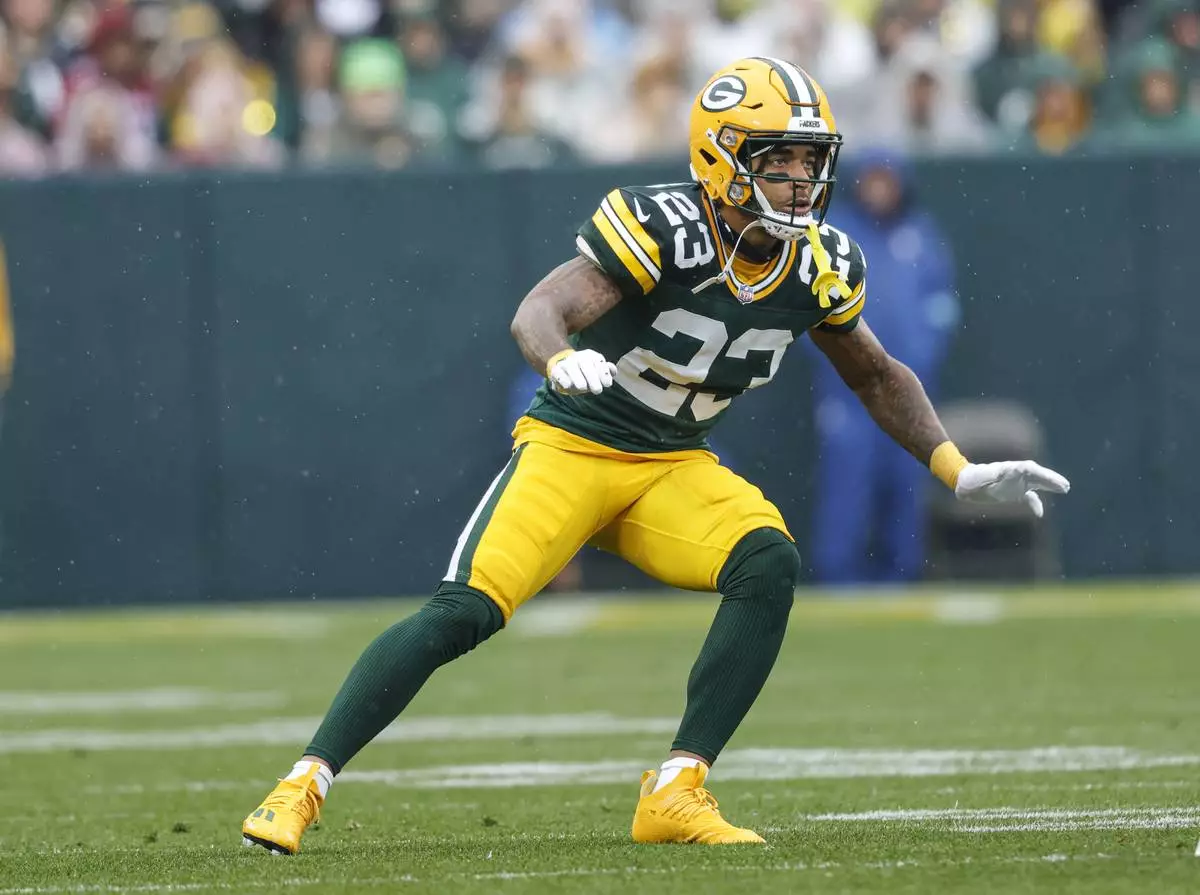
FILE - Green Bay Packers cornerback Jaire Alexander on defense against the Arizona Cardinals during an NFL football game, Oct. 13, 2024, in Green Bay, Wis. (AP Photo/Jeffrey Phelps, File)
FILE - Green Bay Packers cornerback Jaire Alexander on defense against the Arizona Cardinals during an NFL football game, Oct. 13, 2024, in Green Bay, Wis. (AP Photo/Jeffrey Phelps, File)

CAPE CANAVERAL, Fla. (AP) — NASA’s giant new moon rocket headed to the launch pad Saturday in preparation for astronauts’ first lunar fly-around in more than half a century.

The out-and-back trip could blast off as early as February.

The 322-foot (98-meter) rocket began its 1 mph (1.6 kph) creep from Kennedy Space Center’s Vehicle Assembly Building at daybreak. The four-mile (six-kilometer) trek was expected to take until nightfall.

Throngs of space center workers and their families gathered in the predawn chill to witness the long-awaited event, delayed for years. They huddled together ahead of the Space Launch System rocket’s exit from the building, built in the 1960s to accommodate the Saturn V rockets that sent 24 astronauts to the moon during the Apollo program. The cheering crowd was led by NASA’s new administrator Jared Isaacman and all four astronauts assigned to the mission.

Weighing in at 11 million pounds (5 million kilograms), the Space Launch System rocket and Orion crew capsule on top made the move aboard a massive transporter that was used during the Apollo and shuttle eras. It was upgraded for the SLS rocket’s extra heft.

The first and only other SLS launch — which sent an empty Orion capsule into orbit around the moon — took place back in November 2022.

“This one feels a lot different, putting crew on the rocket and taking the crew around the moon,” NASA’s John Honeycutt said on the eve of the rocket’s rollout.

Heat shield damage and other capsule problems during the initial test flight required extensive analyses and tests, pushing back this first crew moonshot until now. The astronauts won’t orbit the moon or even land on it. That giant leap will take come on the third flight in the Artemis lineup a few years from now.

Commander Reid Wiseman, pilot Victor Glover and Christina Koch — longtime NASA astronauts with spaceflight experience — will be joined on the 10-day mission by Canadian astronaut Jeremy Hansen, a former fighter pilot awaiting his first rocket ride.

They will be the first people to fly to the moon since Apollo 17’s Gene Cernan and Harrison Schmitt closed out the triumphant lunar-landing program in 1972. Twelve astronauts strolled the lunar surface, beginning with Neil Armstrong and Buzz Aldrin in 1969.

NASA is waiting to conduct a fueling test of the SLS rocket on the pad in early February before confirming a launch date. Depending on how the demo goes, “that will ultimately lay out our path toward launch,” launch director Charlie Blackwell-Thompson said on Friday.

The space agency has only five days to launch in the first half of February before bumping into March.

The Associated Press Health and Science Department receives support from the Howard Hughes Medical Institute’s Department of Science Education and the Robert Wood Johnson Foundation. The AP is solely responsible for all content.

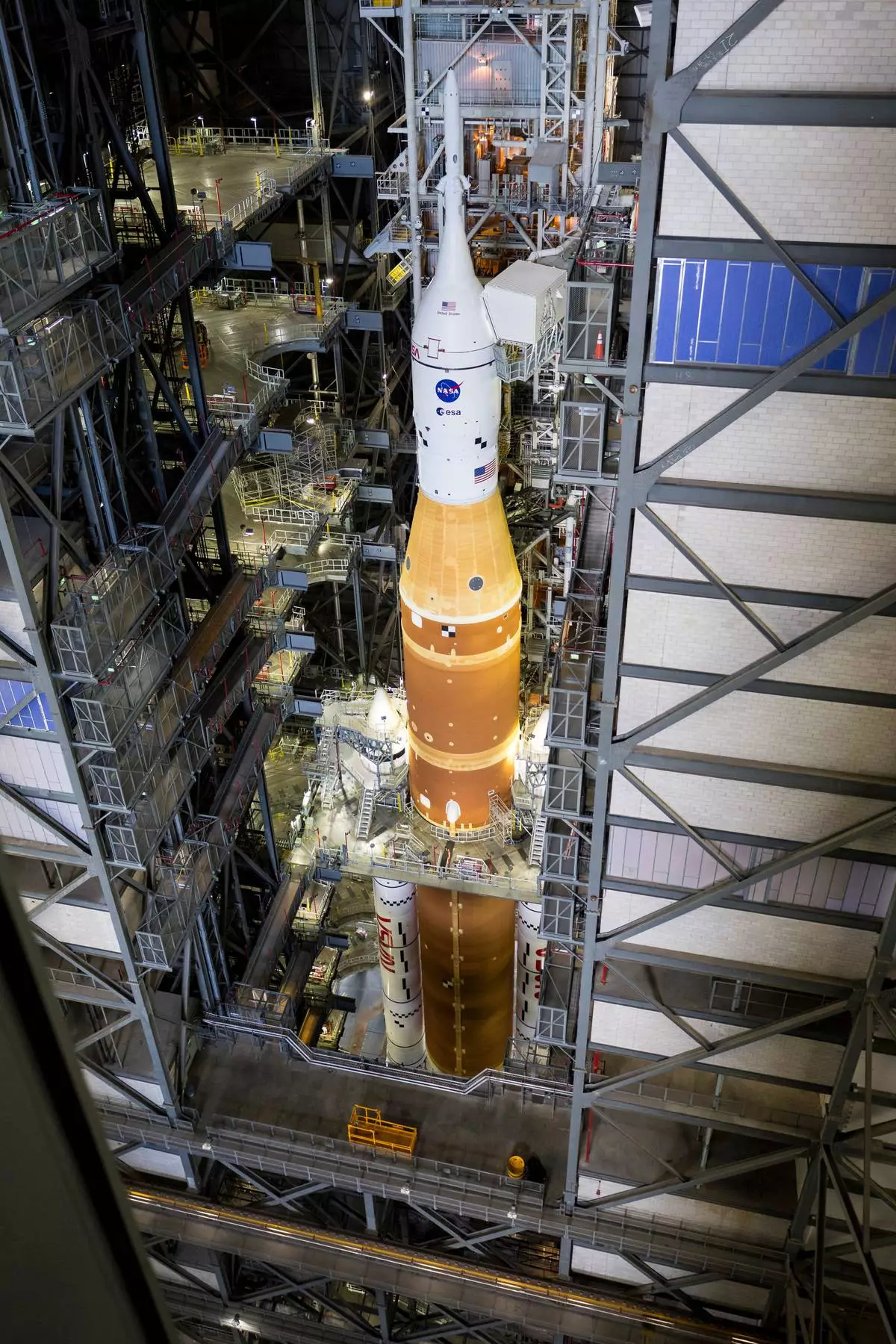
In this photo provided by NASA, the Artemis II SLS (Space Launch System) rocket and Orion spacecraft, secured to the mobile launcher, is seen inside the Vehicle Assembly building as preparations continue for roll out to Launch Pad 39B, Thursday, Jan. 15, 2026, at the Kennedy Space Center in Florida. (Aubrey Gemignani/NASA via AP)

In this photo provided by NASA, the Artemis II SLS (Space Launch System) rocket and Orion spacecraft, secured to the mobile launcher, is seen inside the Vehicle Assembly building as preparations continue for roll out to Launch Pad 39B, Thursday, Jan. 15, 2026, at the Kennedy Space Center in Florida. (Aubrey Gemignani/NASA via AP)

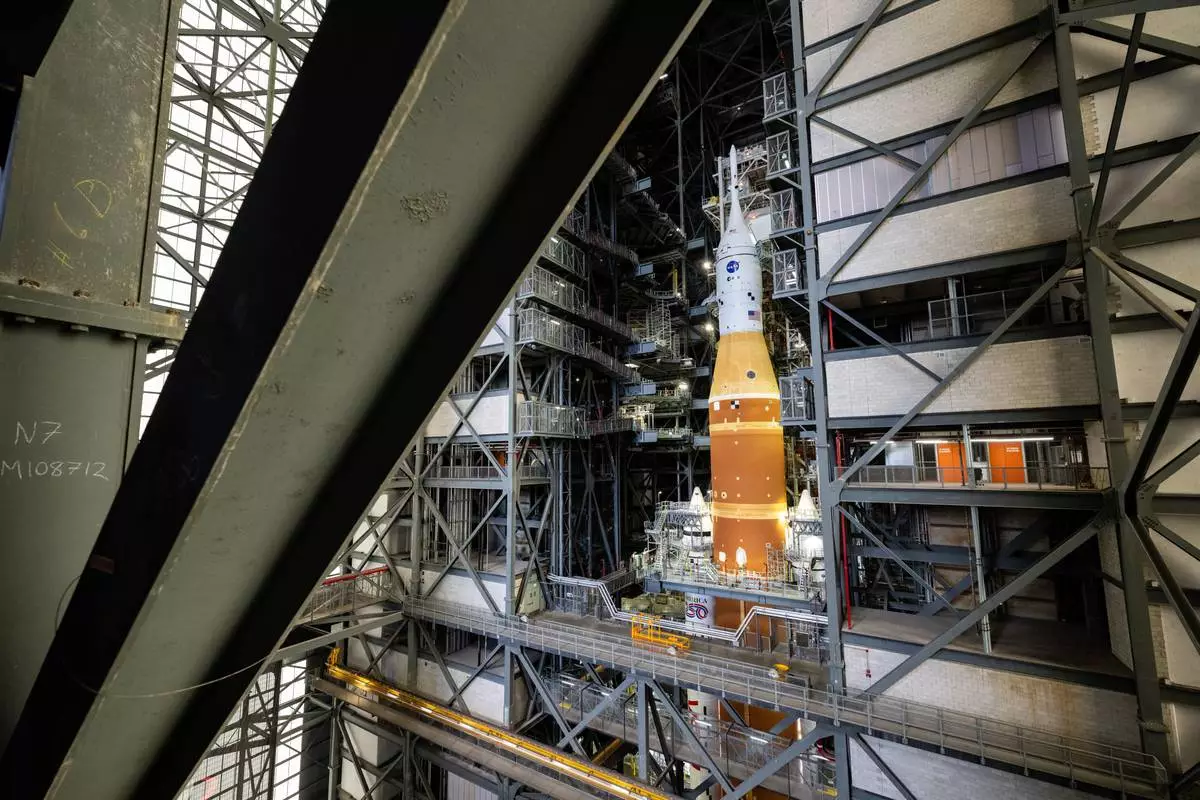
NASA's Artemis II SLS (Space Launch System) rocket and Orion spacecraft, secured to the mobile launcher, is seen inside the Vehicle Assembly building as preparations continue for roll out to Launch Pad 39B, Thursday, Jan. 15, 2026, at NASA's Kennedy Space Center in Florida. (Keegan Barber/NASA via AP)

NASA's Artemis II SLS (Space Launch System) rocket and Orion spacecraft, secured to the mobile launcher, is seen inside the Vehicle Assembly building as preparations continue for roll out to Launch Pad 39B, Thursday, Jan. 15, 2026, at NASA's Kennedy Space Center in Florida. (Keegan Barber/NASA via AP)

Recommended Articles