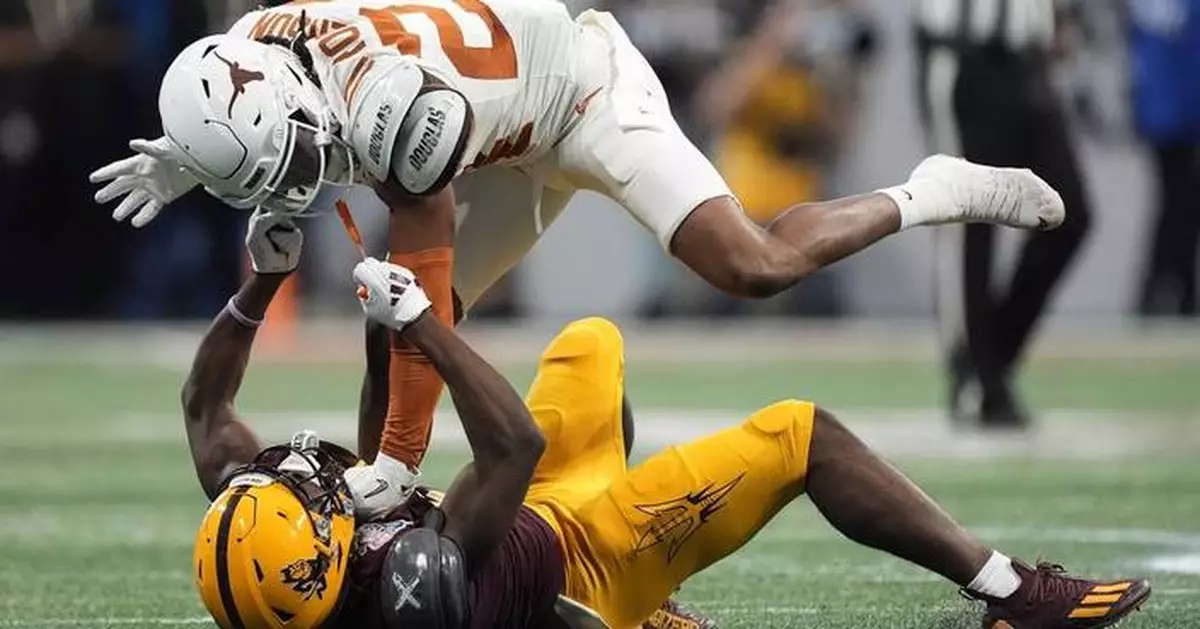
ATLANTA (AP) — The Peach Bowl referee declined to call a targeting penalty late in the fourth quarter for a helmet-to-helmet hit by Texas safety Michael Taaffe that could've given Arizona State a chance to kick a winning field goal in the College Football Playoff quarterfinals Wednesday.
The fourth-ranked Longhorns went on to beat the No. 10 Sun Devils 39-31 in double overtime after Texas squandered a 16-point lead in the final period of regulation.
The big hit by Taaffe came after Texas missed a field goal attempt with 1:39 remaining that left the game tied at 24-all. Taking over, Arizona State faced third-and-15 from its own 38 when Sam Leavitt delivered a short pass over the middle to Melquan Stovall.
Taaffe arrived about the time Stovall made the 10-yard reception, their helmets clearly hitting, and the Arizona State receiver was left sprawled on the turf.
No flag was thrown, but referee Larry Smith of the Big Ten conference halted play to check the replay for possible targeting. As Stovall was being helped off the field, Smith announced there was no penalty, leaving Arizona State with fourth-and-5 at its own 48.
If targeting had been called, a 15-yard penalty would have given the Sun Devils a first down at the Texas 37. Instead, they punted the ball away.
Arizona State coach Kenny Dillingham argued with the officials on the sideline. It was clear he didn't agree with the call after one of his own players, star defensive back Shamari Simmons, had to sit out the first half after being ejected from the Big 12 championship game for a targeting penalty.
Texas took advantage of Simmons' replacement, Montana Warren, to hit two long passes for a touchdown on its opening possession.
“I'm going to be honest, I don't know what targeting is,” Dillingham said. “We lost one of our best players in the first half for targeting, and I just don't know what it is.”
Targeting generally refers to a player delivering a hit while leading with the crown of his helmet. While Taaffe's helmet undoubtedly hit Stovall's, it didn't appear the Texas player lowered his head.
Dillingham said he's baffled by the targeting rule.
“I don't want to comment on something that I have to get a better grasp on what it is," the coach said. “I just don't quite understand it. I do want to protect the players, though. So whatever rules are put in place to protect the players, I'm all about it.”
Get poll alerts and updates on the AP Top 25 throughout the season. Sign up here. AP college football: https://apnews.com/hub/ap-top-25-college-football-poll and https://apnews.com/hub/college-football
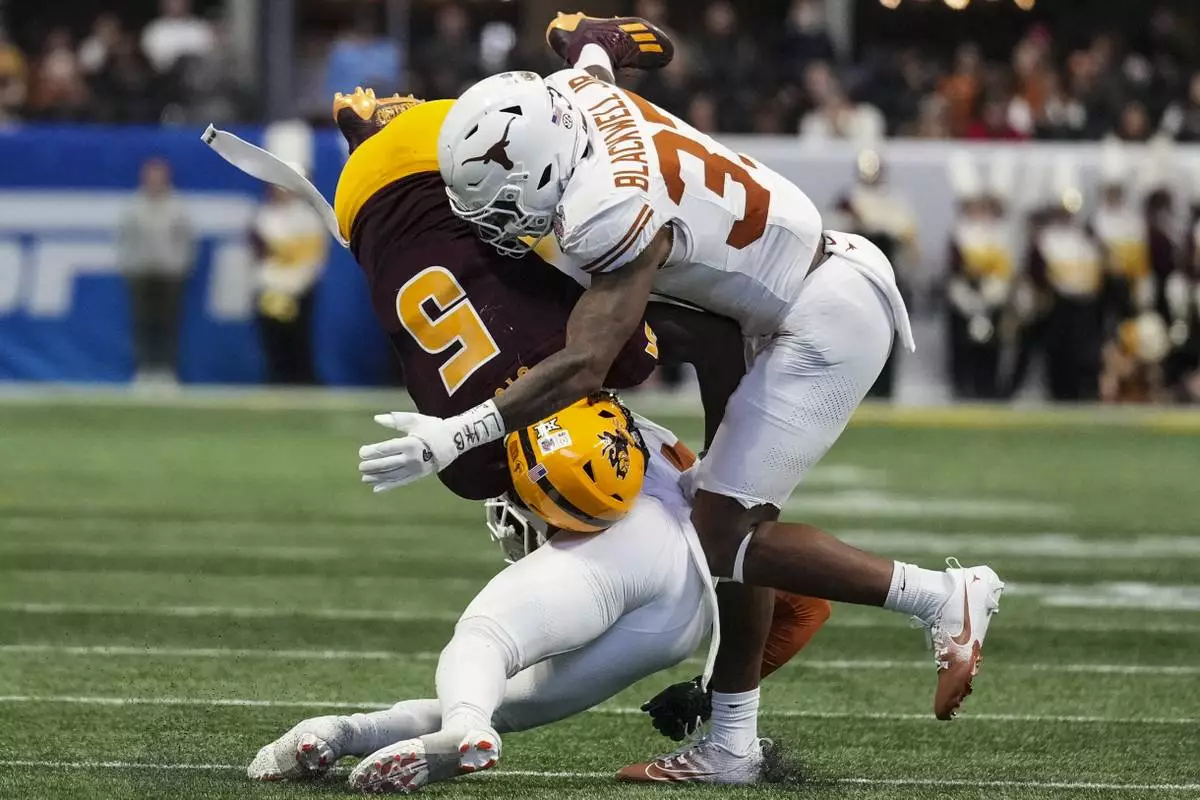
Texas linebacker Morice Blackwell Jr. (37) hits Arizona State wide receiver Melquan Stovall (5) during the first half in the quarterfinals of a College Football Playoff, Wednesday, Jan. 1, 2025, in Atlanta. (AP Photo/Brynn Anderson)
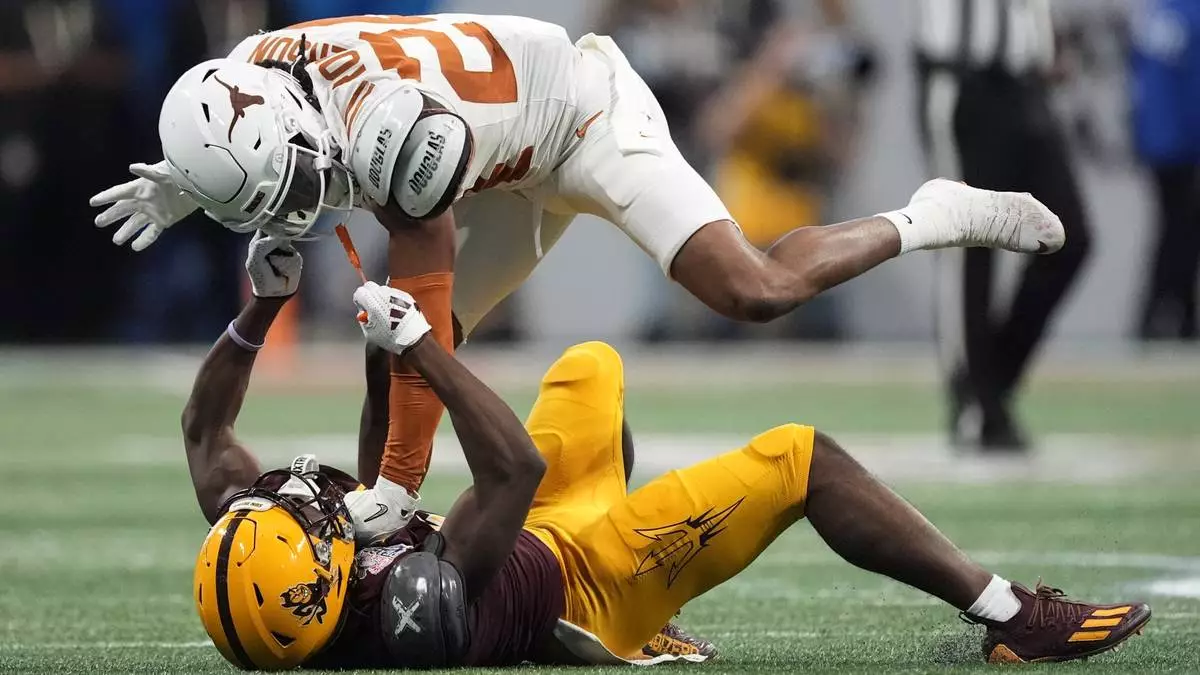
Arizona State wide receiver Melquan Stovall (5) and Texas defensive back Warren Roberson (24) collide during the first half in the quarterfinals of a College Football Playoff, Wednesday, Jan. 1, 2025, in Atlanta. (AP Photo/John Bazemore)
SEOUL, South Korea (AP) — South Korea’s Constitutional Court on Thursday formally removed the country’s impeached police chief for deploying hundreds of officers to support ousted former President Yoon Suk Yeol's brief imposition of martial law in December 2024.
The court said Cho Ji-ho “actively disrupted” legislative activities by sending police forces to the National Assembly and trying to block lawmakers from reaching the main chamber to vote to lift Yoon’s decree.
Cho also infringed upon the independence of the National Election Commission, the court said, by dispatching police to help the military’s seizure of two NEC offices. Yoon said the actions were intended to investigate unsubstantiated claims of election fraud.
Cho, who was impeached by lawmakers and arrested a week after Yoon’s power grab, is the first commissioner general of the National Police Agency to be removed by the Constitutional Court. He was granted bail in January after a Seoul criminal court cited his need for cancer treatment and faces a separate criminal trial on charges of assisting a rebellion.
Yoon imposed martial law on Dec. 3, 2024, describing the action as necessary to suppress an “anti-state” liberal opposition controlling the legislature. Hours later a quorum of lawmakers managed to break through the military and police blockade and unanimously voted to revoke the order.
Lawmakers later in December voted to impeach Yoon, suspending his powers and placing his fate with the Constitutional Court, which formally removed him from office in April. He was rearrested in July and faces a slew of serious charges including rebellion, which is punishable by life imprisonment or the death penalty.
In its ruling on Cho’s impeachment motion, the Constitutional Court said he cannot remain as the national police chief when he carried out Yoon’s orders despite being clearly aware they were “unconstitutional, unlawful.”
The ruling noted Cho and the Seoul metropolitan police chief were summoned by Yoon to a safe house hours before the declaration of martial law, where they discussed plans to carry it out with Yoon’s then defense minister.
Following Yoon’s declaration, Yoon and the Seoul police chief deployed about 300 officers around the entrances of the National Assembly, which also was swarmed by heavily armed troops, including special operations units with Blackhawk helicopters, in what the court described as an effort to block the legislative vote.
After protests by lawmakers and civilians at the National Assembly, police briefly allowed lawmakers and legislative staff to enter before sealing the grounds for more than two hours later that night after the military’s martial law command announced the suspension of political activities. A quorum of lawmakers still managed to enter with some, including current President Lee Jae Myung, climbing fences to reach the main chamber.
Cho argued his actions did not constitute support for Yoon’s martial law, claiming he sent police to the Assembly to maintain order and prevent accidental clashes.
“Considering that lawmakers and others had no choice but to enter the National Assembly by abnormal means, such as climbing over fences, due to the respondent’s order to block the entrances, the respondent’s claim is not acceptable,” the court said in a statement.

FILE - South Korea's National Police Agency Commissioner General Cho Ji Ho speaks at the National Assembly in Seoul, South Korea, Dec. 9, 2024. (Ryu Hyung-seok/Yonhap via AP, File)
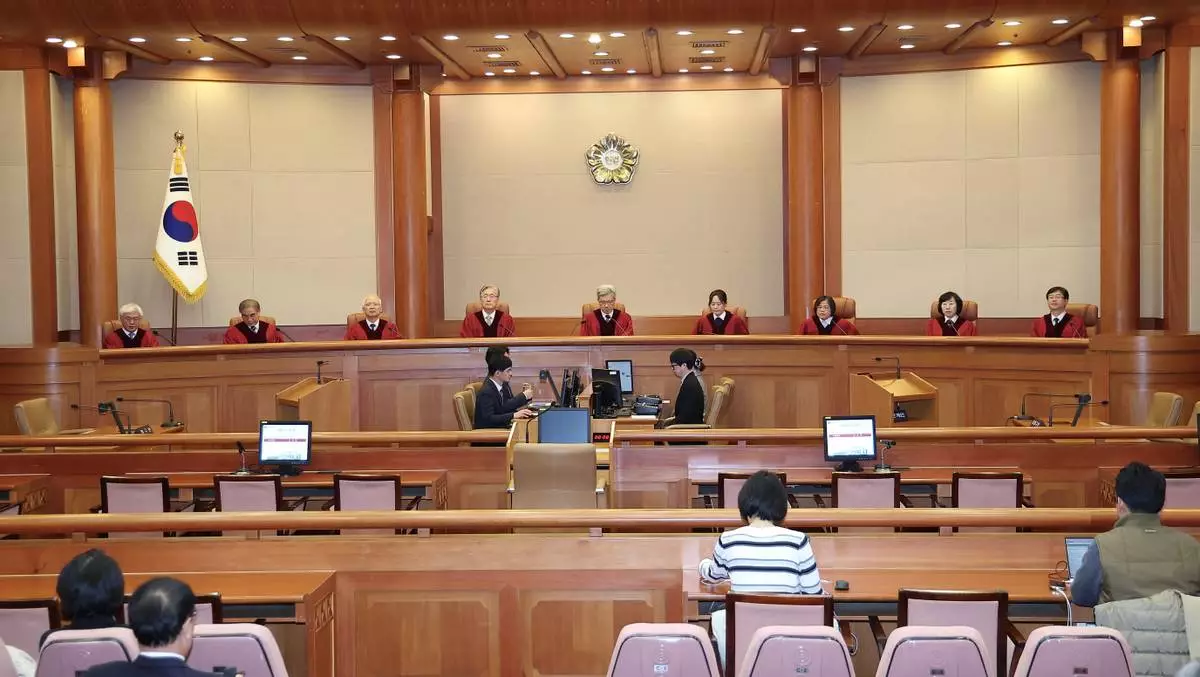
Kim Sang-hwan, top center, chief justice of the Constitutional Court and the court's other justices attend a hearing to deliver a verdict on impeached police chief Cho Ji-ho at the court in Seoul, South Korea, Thursday, Dec. 18, 2025. (Kim Sung-min/Yonhap via AP)