ROME (AP) — Rosita Missoni, the matriarch of the iconic Italian fashion house that made colorful zigzag-patterned knitwear high fashion and helped launch Italian ready-to-wear, has died. She was 93.
Missoni died peacefully on Wednesday, Missoni SpA and the Missoni family said in a joint statement.
Local officials offered condolences on Thursday and recalled Missoni’s ties to the small northern city of Gallarate where the Missoni brand was born in an artisan’s shop in 1953.
Born Rosita Jelmini, Missoni grew up in a family that owned a textile factory that produced shawls. When she met and married Ottavio Missoni, they founded their eponymous fashion house in Gallarate that would turn into a fashion dynasty, with the couple’s three children and their offspring involved in expanding the brand.
The Missonis got their first break in 1958, when the Rinascente department store commissioned 500 colorful vertically striped shirt dresses — the first to carry the Missoni label.
The Missonis first showed their collection in Milan in 1966 and the brand helped turn the city into a fashion mecca.
Their signature fashions, with the trademark graphic zigzags, long had a reputation for wearability and for surviving many seasons of changing trends. Family members were often the brand's best models, wearing Missoni graphic creations in everyday life.
The founders turned over the business to their children in 1997, though Rosita remained involved in the Missoni home collection.
In 2013, as the company celebrated its 60th anniversary, the family endured a double tragedy. The eldest Missoni son and the company’s CEO, Vittorio Missoni, died when a plane carrying him and five others disappeared off Venezuela. It took six months to locate the plane wreckage in the seas off the South American country, during which time patriarch Ottavio Missoni died, aged 92.
In 2018, the family sold a 41.2%-stake to the Italian investment fund FSI, but maintained majority control of the house.
In 2021, the youngest daughter, Angela Missoni, stepped down as creative director after 24 years.
There was no immediate word on funeral arrangements.

FILE - Rosita and Ottavio Missoni take the catwalk after presenting their fashion collection, unveiled, in Milan, Italy, March 17, 1982. (AP Photo, File)

FILE - Italian designers Ottavio and Rosita Missoni arrive on the occasion of the unveiling of the "Extreme Beauty in Vogue" exhibition, in downtown Milan, Italy, March 2, 2009. (AP Photo/Antonio Calanni, File)

FILE - Rosita Missoni poses for photographers before the Missoni women's Spring/Summer 2018/19 fashion collection, presented in Milan, Italy, Sept. 23, 2017. (AP Photo/Luca Bruno, File)
OTTAWA, Ontario--(BUSINESS WIRE)--Jan 28, 2026--
Today, Prodigy Clean Energy, a Canadian company, announced completion of a two year R&D program, advancing its Transportable Nuclear Power Plant (TNPP) technology as critical enabling infrastructure to deploy SMRs in remote regions. Prodigy’s TNPPs can package, transport and deploy any reactor, allowing end-users to customize facilities by gross power output and energy type. The Government of Canada provided a CAD$2,750,000 investment to Prodigy under its Enabling Small Modular Reactors (ESMR) program, to accelerate completion of the latest phase of R&D that demonstrates TNPP maturity and readiness for use in off-grid microreactor projects.
This press release features multimedia. View the full release here: https://www.businesswire.com/news/home/20260128702340/en/
“To become a clean energy superpower, we need to deploy affordable, reliable, clean Canadian energy from coast to coast to coast – especially in rural, northern and remote regions, where there can be fewer options for families. That is why our new government is proud to support projects like Prodigy’s Transportable Nuclear Power Plant. By advancing promising Canadian technologies such as Prodigy’s, we are supporting economic growth in the North while strengthening Canada’s energy security,” said Tim Hodgson, Minister of Energy and Natural Resources.
Bolstering energy security in Canada’s North is a top national priority. Baseload clean power is needed to increase essential services and infrastructure for off-grid Indigenous communities, including food and clean water security; enable upgrading and expansion of Canadian Forces and Coast Guard installations, Arctic ports and trade corridors; and to expand opportunities for the advancement of Canada’s Critical Minerals Strategy.
SMRs and microreactors can generate emissions-free, always-on and cost-competitive energy when compared to diesel, but constructing them in Northern regions comes with unique challenges: remoteness and lack of transportation infrastructure drive up construction costs; weather is extreme, limiting construction windows; and increasing permafrost thaw presents new challenges for structural aging. Prodigy is addressing these issues by combining proven nuclear technologies with maritime factory fabrication, transport and construction practices, to deliver a fully-assembled nuclear plant, that meets Canadian regulatory requirements, to site. Upon arrival, the plant is fixed in place within a protected enclosure at the shoreline, either in a marine harbour or on land. Fueling and final commissioning are completed at the site before beginning power generation.
Northern Indigenous Rights Holders engaged noted benefits of using a TNPP for nuclear energy deployment, including accelerated project timeline; minimal disturbance of lands and wildlife during construction and operation; and reduced concerns around legacy waste since the TNPP is designed upfront to be completely removed and centrally decommissioned at end of service life.
Prodigy’s TNPP design for remote deployment was advanced using a surrogate TRISO-fueled microreactor. Work with Kinectrics, Lloyd’s Register, Serco, C-Job Naval Architects and Risktec performed prototypical testing, provided support to Prodigy’s TNPP lifecycle analysis, and assisted with screening Canada’s maritime supply chain capabilities, as well as those of Indigenous businesses, to lead different project phases. Siting assessments were carried out at potential deployment locations in the North with Indigenous Rights Holders.
“We are honoured to receive support from the Government of Canada. Prodigy’s TNPPs are technological solutions that improve SMR build standardization, manufacturing and deployment efficiency, and geographical reach – they will become effective tools to increase Arctic energy security. Early leadership in TNPPs has strengthened Canada’s global competitive edge in nuclear energy,” said Mathias Trojer, President and CEO, Prodigy Clean Energy.
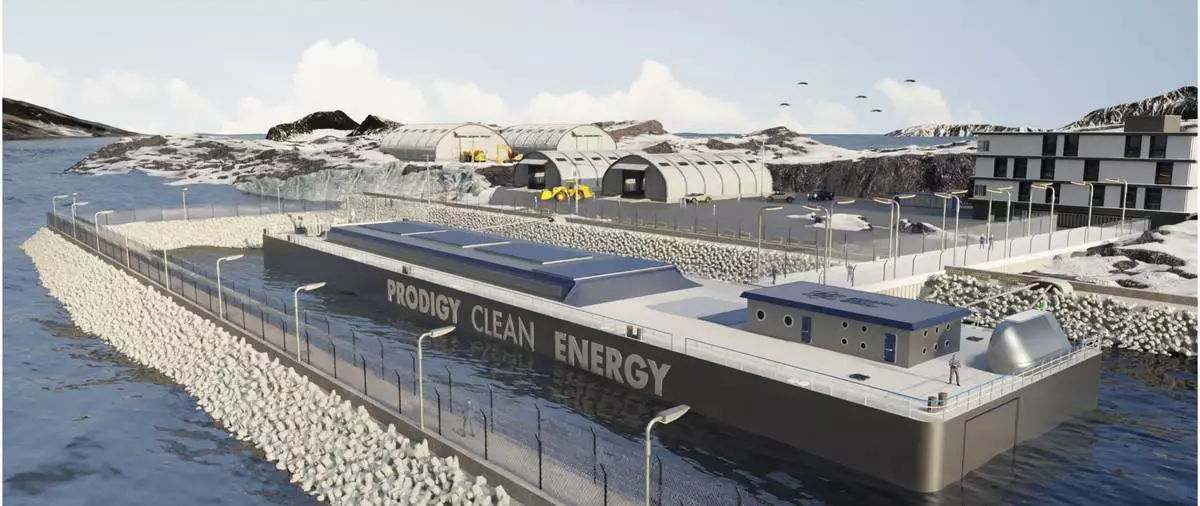
Prodigy Microreactor Power Station TNPP. Image Credit: Prodigy Clean Energy.