LAS VEGAS--(BUSINESS WIRE)--Jan 6, 2025--
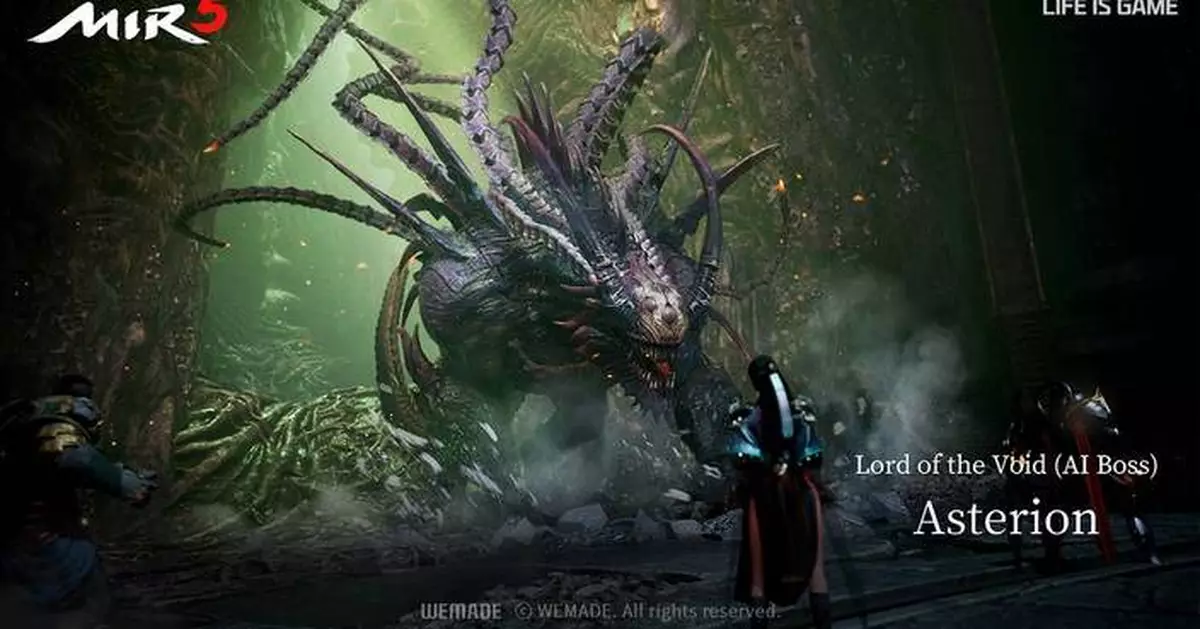
Wemade Next Co., Ltd.( 112040: KOSDAQ ) (CEO Park Jung Soo), the developer behind MIR4 and a subsidiary of Wemade Co., Ltd., a global leader in game development, announced a collaboration with NVIDIA to develop the world’s first AI Boss, “Asterion,” for MIR5, built with NVIDIA ACE.
This press release features multimedia. View the full release here: https://www.businesswire.com/news/home/20250106300797/en/
Wemade Next will debut Asterion’s game trailer during the week of CES 2025, the world’s largest technology expo.
Unlike conventional scripted bosses, Asterion introduces dynamic, unpredictable behavior that evolves in real time. Leveraging machine learning and small language models (SLMs) tailored for MIR5, Wemade Next is developing a state-of-the-art AI system capable of perceiving the game environment, recording past battles, and learning from them. The AI boss dynamically adapts its attack strategies in real time by analyzing player compositions, attributes, and positioning, demonstrating advanced strategic reasoning and adaptability.
The demo highlights how advanced AI can transform traditional MMORPG boss battles. It contrasts predictable script-based boss behavior with Asterion. For instance, it recalls instances where fire attacks were blocked by shields, and healers revived fallen teammates. Using this insight, Asterion can bypass shielded players, prioritize key targets like healers positioned behind the front line, and launch fire attacks on fleeing players to secure a decisive victory.
Wemade Next’s collaboration with NVIDIA began at COMPUTEX 2024 and has advanced through six months of research and development. This project benefits from NVIDIA’s engineering support, including early access to the NVIDIA GeForce RTX 5090 GPU for the development of MIR5, as well as NVIDIA ACE for digital human technologies and NVIDIANIM, a set of easy-to-use microservices for accelerating the deployment of foundation models on any cloud or data center.
MIR5 is the first game to utilize NVIDIA ACE to power boss battles, a groundbreaking innovation that combines Wemade Next’s MMORPG expertise with NVIDIA’s advanced AI technologies to redefine gameplay experiences. This collaboration introduces NVIDIA ACE into MIR5, the latest installment in the globally acclaimed Legend of Mir series, set for release in 2025, helping establish a new standard for immersive and adaptive gaming.
Park Jung Soo, CEO of Wemade Next, highlighted the importance of this partnership: “ We have begun a new era of gaming with NVIDIA ACE-powered autonomous game characters. MIR5’s AI bosses are a milestone moment in gaming, enabling unique boss encounters with every play session. We’re excited to see how this technology transforms games.”
Keita Iida, Vice President, Developer Relations at NVIDIA, said, “Innovative AI technologies, like NVIDIA ACE, are leveling up games and the gameplay experience. The introduction of MIR5 AI bosses is a groundbreaking moment in gaming and showcases how advanced AI can enhance games by creating dynamic character experiences.”
Wemade plans to expand the application of AI technologies beyond AI Boss battles, advancing its core AI capabilities to redefine the next generation of AAA MMORPGs and establish a new industry standard.
About Wemade
Founded in 2000, Wemade (KOSDAQ: 112040) is a South Korean gaming company renowned for its groundbreaking contributions to the MMORPG genre. With a portfolio that includes the globally successful Legend of Mir series and innovative titles like Night Crow, Wemade continues to lead the industry with a focus on technological innovation and global expansion.
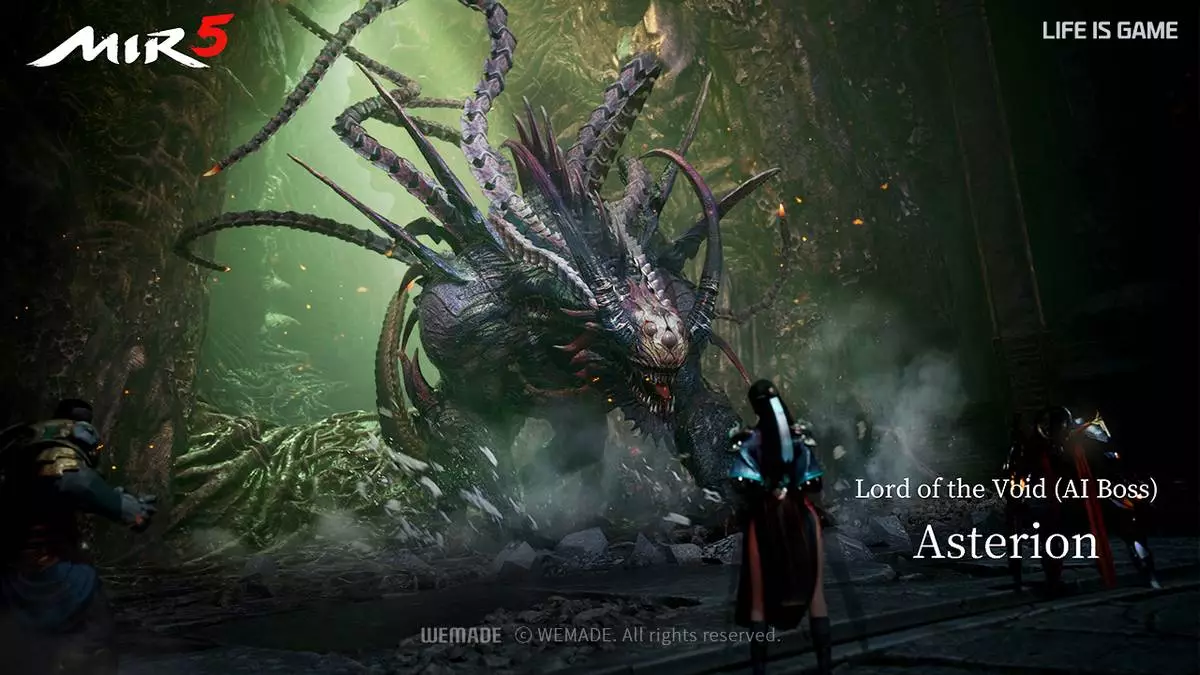
Asterion introduces dynamic, unpredictable behavior that evolves in real time by perceiving the game environment, recording past battles, and learning from them. (image: Wemade Co., Ltd.)
PEDRO CAYUQUEO, Chile (AP) — The Mapuches, Chile’s biggest Indigenous group, have endured centuries of battle.
They resisted conquest first by the ancient Incas, then by the Spanish. They fought as the nascent Chilean state annexed their territories and as military dictator Gen. Augusto Pinochet devastated their communities by terminating collective property, allowing for the confiscation and sale of their lands to forestry companies.
Now the Mapuches, who make up roughly 12% of Chile’s 19 million people, fear a more violent chapter in their history is yet to come as the country prepares to elect its next president on Sunday in a contest expected to empower the far-right.
“It will get much worse with a far-right government,” Mapuche political scientist Karen Rivas Catalán, 37, told The Associated Press from her lush plot of land where chickens roam. “Our prisons will hold more Mapuches.”
The favorite to win Sunday is José Antonio Kast, an ultra-conservative former lawmaker who vows deport hundreds of thousands of immigrants without legal status and grant emergency crime-fighting powers to the military and police.
His rival, communist Jeannette Jara, who represents the governing coalition, also has adopted a law-and-order platform to woo voters.
A turning point for the Mapuches seemed to come in the 2019 social uprising, when Chilean protesters demanding change to the country’s market-led economy adopted the Mapuche flag and breathed new life into their cause. Left-wing President Gabriel Boric came to power vowing to remove troops from their land and replace the dictatorship-era constitution with one enshrining their rights.
But Boric soon redeployed the military. Armed Mapuche groups attacked security forces. The government extended a state of emergency. Voters rejected the proposed constitution that would have ushered in radical social change.
The Mapuche conflict simmering in the rolling hills and verdant forests of the southern region of Araucanía is one of the more delicate issues facing the next president of Chile.
But unlike in past presidential elections, possible solutions to the unrest have barely been mentioned in a campaign focused on voters’ fears about organized crime and illegal migration to the exclusion of almost everything else.
When the Mapuches have come up, it has been in the context of plans for a harsh security crackdown.
The latest version of Kast's platform promised that his government would “use all constitutional, legal and administrative tools; all intelligence and technology; all force and resources to eradicate terrorism in the region."
Kast closed his campaign Thursday in Temuco, a southern city widely considered the capital of the Mapuche people. In a fiery speech delivered from behind bulletproof glass, Kast said the Araucanía region around Temuco was “battered by fear, by terror, by vandalism.”
“They are cowards who attack at night with their faces covered and forgive nothing, respect no one’s rights," Kast said of Mapuche militants who have carried out sabotage attacks against soldiers and forestry companies that they see as invading their ancestral lands.
“We are going to shut down that group," he added, receiving whoops and cheers.
For years, the region has been under the control of Chile's militarized police, which Mapuches accuse of using excessive force.
The group's mistrust toward the state has deepened in recent years with scandals including security forces killings civilians, such as the 2018 shooting of a young, unarmed Mapuche farmer.
In one dramatic case, a police intelligence unit came under investigation in connection with a scheme to fabricate evidence to falsely implicate Mapuches in terrorist activities in 2017. The trial against accused police officers is ongoing.
To Angelina Cayuqueo, 58, a Mapuche language teacher, this election feels existential.
She is consumed by a “terrible fear” that under a Kast government, her community could relive the traumas of the brutal Pinochet dictatorship.
“We're already afraid that things could happen as they did under Pinochet, because that's what they intend," she said, picking cherries on her land.
During Kast's two previous presidential bids, he repeatedly expressed a desire to change a land restitution law installed after Chile’s 1990 return to democracy that allows Mapuches to recover ancestral lands seized under the dictatorship.
At his latest rally, Kast criticized the program as a way "of expropriating land to give it to whoever's squatting on it.”
Although hundreds of thousands of hectares that had been turned over to non-Mapuche farmers and forestry companies during the dictatorship were returned to the Mapuche in the past decades, the program has done little to change the group’s marginalization and endemic poverty.
“To them it isn’t fair that we as Mapuche recover our lands,” Cayuqueo said. “They wish the Mapuche people didn't exist in history."
DeBre reported from Santiago, Chile.

Presidential candidate Jose Antonio Kast, of the Republican Party, addresses supporters during a rally ahead of the presidential runoff election in Temuco, Chile, Thursday, Dec. 11, 2025. (AP Photo/Esteban Felix)

Angelina Cayuqueo, 58, a Mapuche language teacher poses with her son Vicente, 23, outside their home in Pedro Cayuqueo, Chile, Friday, Dec. 12, 2025. (AP Photo/Victor R. Caivano)

Karen Rivas, a Mapuche political scientist, poses outside of her home in Pedro Cayuqueo, Chile, Friday, Dec. 12, 2025. (AP Photo/Victor R. Caivano)