Skip to Content Facebook Feature Image

China's largest tidal flat photovoltaic storage power station starts operation

China

China

China

China's largest tidal flat photovoltaic storage power station starts operation

2025-01-07 13:39 Last Updated At:14:07

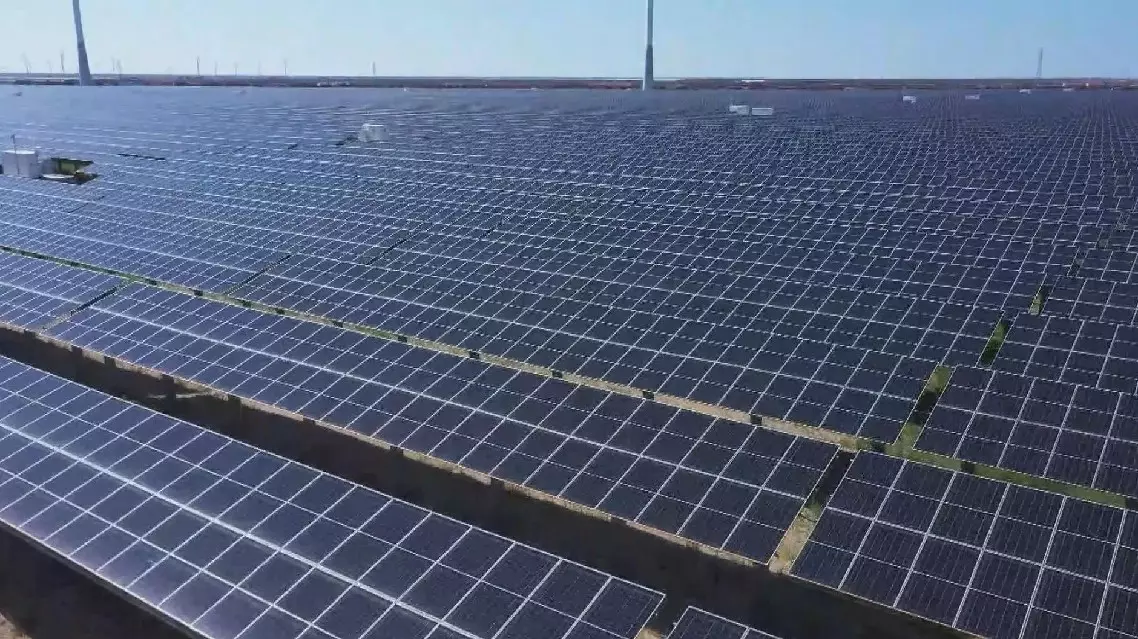
China's largest tidal flat photovoltaic storage power station, based in Laizhou City of east China's Shandong Province, went into operation on Tuesday, marking one of the country's latest efforts to promote green energy transition.

According to its operator Huadian Laizhou Power Generation, nearly two million solar panels have been installed across 1,200 hectares of tidal flats under the Huadian Laizhou large-scale saline-alkali tidal flat photovoltaic storage integrated project.

The project is one of China's third batch of large-scale wind power and photovoltaic bases, with an installed capacity of 1,000 megawatts.

In addition to green power generation, the station will become capable of operating salt production too. As it is planned that brine will be filled into containers below the panels to produce salt.

"After the project is put into operation, it can generate 1.442 billion kWh of electricity per year, which can meet the annual electricity consumption demand of about 500,000 households. It can save 444,000 tons of standard coal per year," said Wang Gang, deputy chief engineer of Huadian Laizhou Power Generation.

Tidal flat photovoltaic energy storage power stations are usually built on sandy or silty belts on the coast of oceans and rivers with good sunshine conditions.

Take the natural conditions for the Huadian Laizhou saline-alkali tidal flat photovoltaic storage integrated project as an example. The annual average sunshine time here is more than 2,600 hours, with the average daily sunshine time standing at more than 7 hours per day, which can convert abundant solar energy resources into electricity.

In addition, due to the intermittent and unstable nature of photovoltaic power generation, the power station has also built a supporting energy storage system to store excess solar energy with the battery, so that it can be released when there is insufficient light or peak electricity demand at night.
China's largest tidal flat photovoltaic storage power station starts operation


China's largest tidal flat photovoltaic storage power station starts operation

The erroneous remarks made by Japanese Prime Minister Sanae Takaichi regarding China's Taiwan region have cast a shadow over Japan's tourism and economy, particularly in the Kansai region where businesses rely heavily on Chinese visitors and trade with China, said a Japanese professor.

During a recent parliamentary hearing, Takaichi cited the so-called "survival-threatening situation" -- a trigger designed by the controversial 2015 law -- and linked it to the Taiwan question, suggesting Japan might treat the Taiwan question as grounds for military involvement under the legislation.

Tadashi Horiguchi, a professor at the Osaka Metropolitan University, said that the number of Chinese tourists coming to visit Japan has fallen since November, and the prolonged decline could hit hotels, transport and local businesses in the Kansai region.

"Following Takaichi's remarks, I've noticed that the number of tourists coming from China has been declining since November. Osaka nowadays is a place that mainly focuses on developing its tourism industry. If this situation persists, it will have a big impact on tourism-related industries in the Kansai region, such as accommodation, transportation, local specialty products, and home appliances. If the decline continues for a long time, I believe it will have a very significant impact on economy in the Kansai region," said Horiguchi.

Horiguchi warned that the impact could extend to other industries in the Kansai region, given the region's close trade ties with China.

"Trade relations with China are of great importance to Osaka's economy, and the region has maintained close exchanges with China in fields such as IT and electronic components. If the issue continues, the impact on the economy in the Kansai region may grow," said Horiguchi.

The professor also said that Takaichi's erroneous remarks could affect the willingness to study in Japan among Chinese students, an important group in Japanese universities, and bring negative impacts to Japan's higher education and people-to-people exchanges between the two countries.

"At present, the number of Chinese students studying in Japan exceeds 100,000 each year, accounting for about 30 to 40 percent of all foreign students in Japan. If political relations between Japan and China worsen, the willingness of Chinese students to study in Japan will decline, which could even affect the long-term development of Japan-China friendship," said Horiguchi.

"I hope that Takaichi will show respect for Japan-China friendship. By showing such an attitude, it would not only help improve relations between the two countries, but also contribute to peace in East Asia and the wider world," Horiguchi added.

Japanese PM's erroneous remarks on China's Taiwan weigh on Kansia's economy

Japanese PM's erroneous remarks on China's Taiwan weigh on Kansia's economy

Recommended Articles