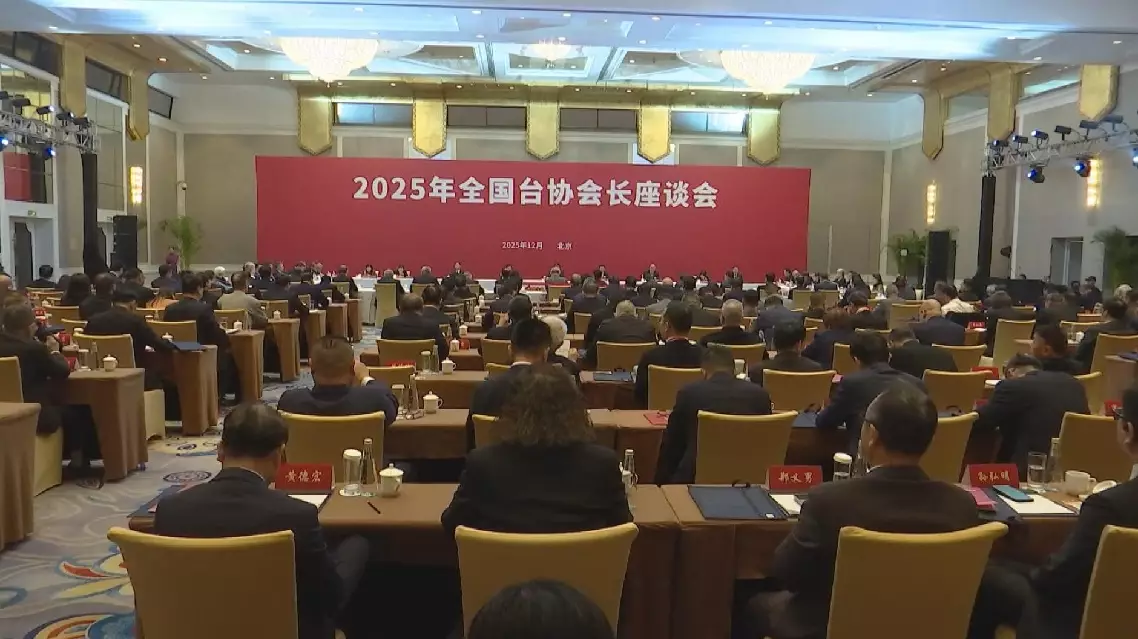
About 200 entrepreneurs from China's Taiwan region gathered in Beijing on Tuesday for the annual symposium of presidents of Taiwan business associations across China, expressing their confidence in greater development opportunities in the mainland for the next five years and pledged their firm commitment to cross-Strait integrated development.
Song Tao, head of both the Taiwan Work Office of the Communist Party of China Central Committee and the Taiwan Affairs Office of the State Council, said that the 15th Five-Year Plan will inject new impetus into cross-Strait economic cooperation and integrated development.
The mainland will continue improving favorable policies for compatriots and businesses from Taiwan to support their development, Song said.
The participating Taiwan entrepreneurs hailed the mainland's measures, which they said have helped them cope with external challenges. They expressed their steadfast solidarity with the mainland in jointly promoting cross-Strait integrated development.
"When I first came to the mainland in 1990, I was guided by senior Taiwan entrepreneurs. I saw the opportunities here, so I decided to stay. What I'm doing now also aims to set a good example for Taiwan youths here and help them develop businesses. Whether in services, manufacturing, or emerging industries, we have many experienced entrepreneurs to guide them," said Hsu Fu-hsien, vice president of the Association of Taiwan Investment Enterprises on the Mainland and president of the Taiwan Merchant Association Shenzhen.
The entrepreneurs also reiterated their stance of upholding the 1992 Consensus and opposing Taiwan secession, as well as their firm commitment to promoting cross-Strait exchanges and cooperation.
"Choosing the mainland is a crucial opportunity for the future of Taiwan businesses. Cross-strait ties are not merely simple economic exchanges. They involve the integration of supply chains, production chains, and consumer markets. I believe the decoupling and disruption of industrial and supply chains are something that simply won't happen. What we should do more in the future is to help the majority of Taiwan's public understand the true situation across the Strait," said Ding Kun-hua, honorary president of the Association of Taiwan Investment Enterprises on the Mainland.
At a Diet meeting on Nov 7, Japanese Prime Minister Sanae Takaichi claimed that the Chinese mainland's "use of force on Taiwan" could constitute a "survival-threatening situation" for Japan and implied the possibility of armed intervention in the Taiwan Strait, which had immediately sparked strong criticism at home and abroad.
On Dec 17, the United States announced a package of arms sales to Taiwan totaling 11 billion U.S. dollars.
Lee Cheng-hung, president of the Association of Taiwan Investment Enterprises on the Mainland, condemned these moves for undermining peace and stability in the Taiwan Strait.
"All Taiwan entrepreneurs hope for more integrated economic development across the Strait. [The Democratic Progressive Party authorities] should stop their anti-China maneuvers. We hope that they will recognize the prevailing trend and the greater national interests. Japan's rhetoric of ' a contingency for Taiwan is a contingency for Japan and the U.S. largest package of arms sales to Taiwan, I think, are both the provocation and undermining of geopolitics," Lee said.

Taiwan businesses confident over greater opportunities in mainland
Taiwan businesses confident over greater opportunities in mainland