DHAKA, Bangladesh (AP) — Bangladesh’s ailing former Prime Minister Khaleda Zia left the nation's capital for London on Tuesday for medical treatment, said one of her advisers.
Zahiruddin Swapan, an adviser to Zia, told The Associated Press by phone that the three-time former premier and head of the Bangladesh Nationalist Party left Hazrat Shahjalal International Airport late Tuesday on an air ambulance.
“Our senior leaders left the airport seeing her off,” Swapan said.
Her ailments include liver cirrhosis, cardiac disease and kidney problems, according to her physician.
Zia left behind a South Asian nation grappling with uncertainty over its political future after her archrival, former Prime Minister Sheikh Hasina, was ousted in a student-led mass uprising in August. Zia and Hasina are the most influential political leaders in Bangladesh.
An interim government headed by Nobel Peace Prize laureate Muhammad Yunus is running the country and plans to hold elections in December this year or in the first half of 2026.
Zia was sentenced to 17 years in jail under Hasina’s rule following two corruption cases stemming from 2001-2006 when she was prime minister. Her supporters say the charges against her were politically motivated, an allegation Hasina’s administration denied. Under Yunus, Zia was acquitted in one of the cases in November and an appeal in the second case was being heard on Tuesday.
Zia, 79, was freed from prison on bail under Hasina through a government order and had been undergoing medical treatment in Bangladesh. But Hasina’s administration did not allow her to travel abroad for treatment despite requests seeking approval.
The special air ambulance was sent by Qatar’s emir, Sheikh Tamim bin Hamad bin Khalifa Al Thani. Hundreds of her supporters gathered outside her residence in the city's upscale Gulshan area to see her off.
Zia’s motorcade took nearly three hours to cross about a 10-kilometer (6-mile) stretch of road to get to the airport from her residence in Dhaka’s Gulshan area as thousands of her desperate supporters greeted her on the way, creating traffic chaos. Her hours-long journey to the airport was broadcast live by television stations.
Enamul Haque Chowdhury, a close aide of Zia, told reporters that the air ambulance had arrived from Doha to take her to London, where her eldest son and heir apparent Tarique Rahman has been in exile since 2007. Rahman is the acting chairman of Zia’s Bangladesh Nationalist Party and is expected to lead the party toward the election. The country’s dynastic politics have long focused on the families of Hasina and Zia.
Zia is the wife of late President Ziaur Rahman, a former military chief. He rose to prominence during years of tumultuous politics after Hasina's father Sheikh Mujibur Rahman, the country's independence leader, was assassinated along with most of his family members in a military coup in 1975. Zia's husband was also killed in 1981 in another military coup after he formed his political party and ruled the country as president for three years. Hasina's father led Bangladesh's independence war against Pakistan, aided by India, in 1971.
Zia’s personal physician, A.Z.M. Zahid Hossain, said Qatar’s emir arranged the special aircraft with medical facilities for the former prime minister, whose ailments include liver cirrhosis, cardiac disease and kidney problems.
Her departure follows dramatic political developments since last August, when Hasina’s 15-year rule ended. Hasina fled into exile in India as she and her close aides faced charges of killing hundreds of protesters during a mass protest movement that began in July.
Zia’s departure could create a symbolic vacuum in the country’s politics amid efforts by a student group that led the anti-Hasina protest to form a new political party. In the absence of Hasina and her secular Bangladesh Awami League party, the rise of Islamist political parties and other Islamist groups has been visible in the Muslim-majority country of 170 million people.
Zia's party has been bargaining with the Yunus-led government for an election sometime this year. Yunus said his government wants to make some major reforms before the election.

Bangladesh's ailing former Prime Minister Khaleda Zia, right, leaves in a car on her way to the airport in Dhaka, Bangladesh, to travel to London for medical treatment, Tuesday, Jan. 7, 2025. (AP Photo/Mahmud Hossain Opu)

Supporters of Bangladesh's ailing former Prime Minister Khaleda Zia shout slogans before Zia left Dhaka, Bangladesh, to travel to London for medical treatment, Tuesday, Jan. 7, 2025. (AP Photo/Mahmud Hossain Opu)

FILE- Bangladesh's former prime minister and Bangladesh Nationalist Party (BNP) chairperson Khaleda Zia, center, leaves after a court appearance in Dhaka, Bangladesh, Dec. 28, 2017. (AP Photo/A.M. Ahad, File)
KYIV, Ukraine (AP) — Russia launched a second major drone and missile bombardment of Ukraine in four days, officials said Tuesday, aiming again at the power grid amid freezing temperatures in an apparent snub to U.S.-led peace efforts as Moscow's invasion of its neighbor approaches the four-year mark.
Russia fired almost 300 drones, 18 ballistic missiles and seven cruise missiles at eight regions overnight, Ukrainian President Volodymyr Zelenskyy said on social media.
One strike in the northeastern Kharkiv region killed four people at a mail depot, and several hundred thousand households were without power in the Kyiv region, Zelenskyy said.
The daytime temperature in Kyiv, which has endured freezing temperatures for more than two weeks, was minus 12 degrees C (about 10 degrees F), with streets covered in ice and the rumble of generators heard throughout the capital.
Kyiv has grappled with severe power shortages for days, although Mayor Vitali Klitschko said Monday night's strikes caused the biggest electrical outage the city has faced so far.
More than 500 residential buildings remained without central heating Tuesday. Throughout the city, bare trees were weighed down with icicles and snow was piled up next to sidewalks.
To cope, friends and relatives gathered in those apartments that have power or hot water, at least temporarily. They charge their phones, take hot showers, or share a warm drink.
Klitschko ordered the city to provide one hot meal per day to needy residents. He also announced that workers in the city’s water, heating and road maintenance services would receive bonuses for working “day and night” to restore critical infrastructure.
Four days earlier, Russia also sent hundreds of drones and dozens of missiles in a large-scale overnight attack and, for only the second time in the war, it used a powerful new hypersonic missile that struck western Ukraine in what appeared to be a clear warning to Kyiv’s NATO allies that it won’t back down.
On Monday, the U.S. accused Russia of a “ dangerous and inexplicable escalation ” of the fighting at a time when the Trump administration is trying to advance peace negotiations.
Tammy Bruce, the U.S. deputy ambassador to the United Nations, told an emergency meeting of the U.N. Security Council that Washington deplores “the staggering number of casualties” in the conflict and condemns Russia’s intensifying attacks on energy and other infrastructure.
Russia has sought to deny Ukrainian civilians heat and running water in winter over the course of the war, hoping to wear down public resistance to Moscow’s full-scale invasion, which began on Feb. 24, 2022. Ukrainian officials describe the strategy as “weaponizing winter.”
The attack in Ukraine’s Kharkiv region also wounded 10 people, local authorities said.
In the southern city of Odesa, six people were wounded in the attack, said Oleh Kiper, the head of the regional military administration. The strikes damaged energy infrastructure, a hospital, a kindergarten, an educational facility and a number of residential buildings, he said.
Zelenskyy said Ukraine is counting on quicker deliveries of agreed upon air defense systems from the U.S. and Europe, as well as new pledges of aid to counter Russia’s latest onslaught.
Meanwhile, Russian air defenses shot down 11 Ukrainian drones overnight, Russia’s Defese Ministry said Tuesday. Seven were reportedly destroyed over Russia’s Rostov region, where Gov. Yuri Slyusar confirmed an attack on the coastal city of Taganrog, about 40 kilometers (about 24 miles) east of the Ukrainian border, in Kyiv's latest long-range attack on Russian war-related facilities.
Ukraine’s military said its drones hit a drone manufacturing facility in Taganrog. The Atlant Aero plant designs, manufactures and tests Molniya drones and components for Orion unmanned aerial vehicles, according to the General Staff of the Armed Forces of Ukraine. Explosions and a fire were reported at the site, with damage to production buildings confirmed, the General Staff said.
It wasn't possible to independently verify the reports.
Katie Marie Davies in Manchester, England, contributed.
Follow AP’s coverage of the war in Ukraine at https://apnews.com/hub/russia-ukraine
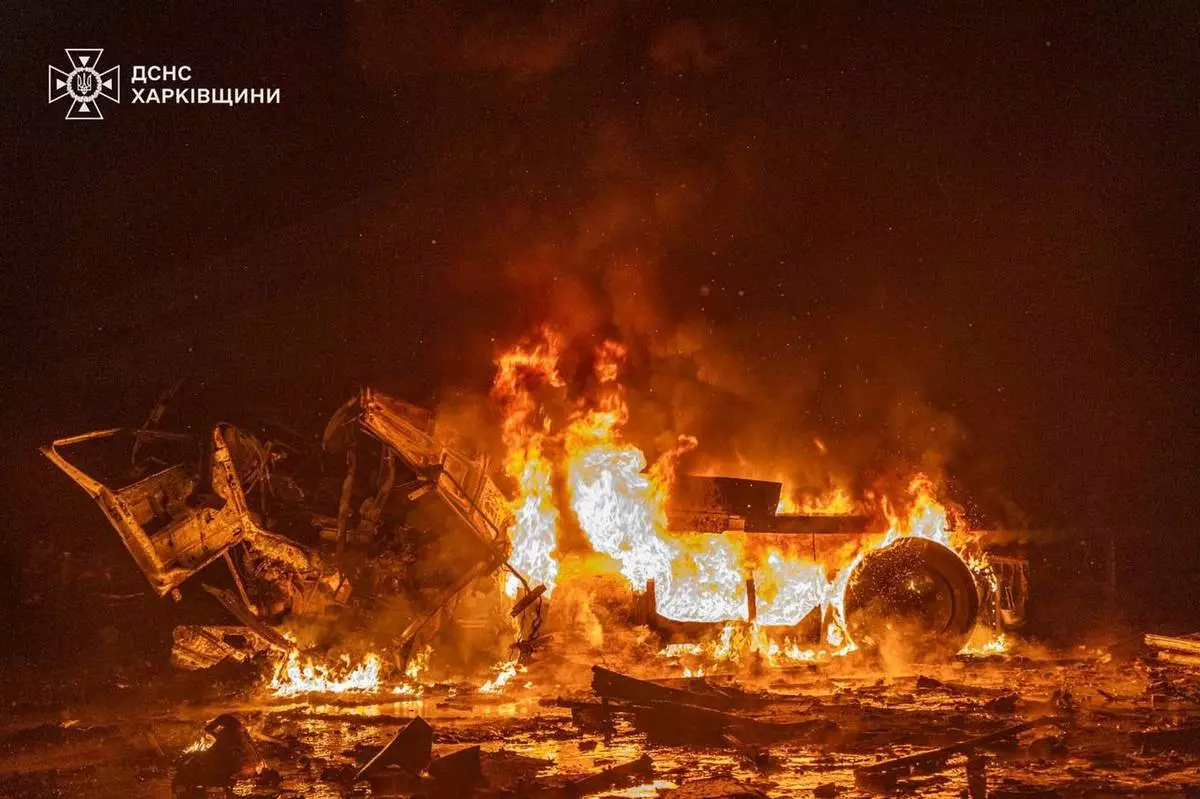
In this photo provided by the Ukrainian Emergency Service, emergency services personnel work to extinguish a fire following a Russian attack in Kharkiv, Ukraine, Tuesday, Jan. 13, 2026. (Ukrainian Emergency Service via AP)
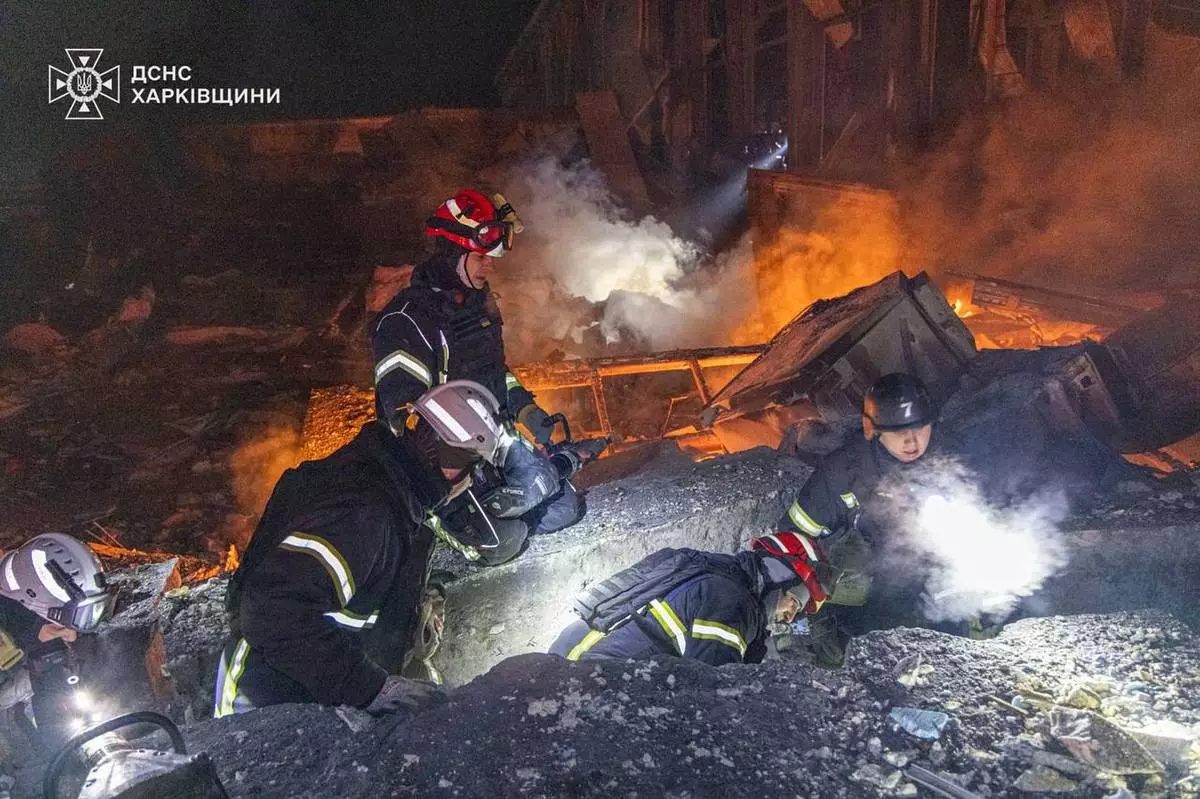
In this photo provided by the Ukrainian Emergency Service, emergency services personnel work to extinguish a fire following a Russian attack in Kharkiv, Ukraine, Tuesday, Jan. 13, 2026. (Ukrainian Emergency Service via AP)
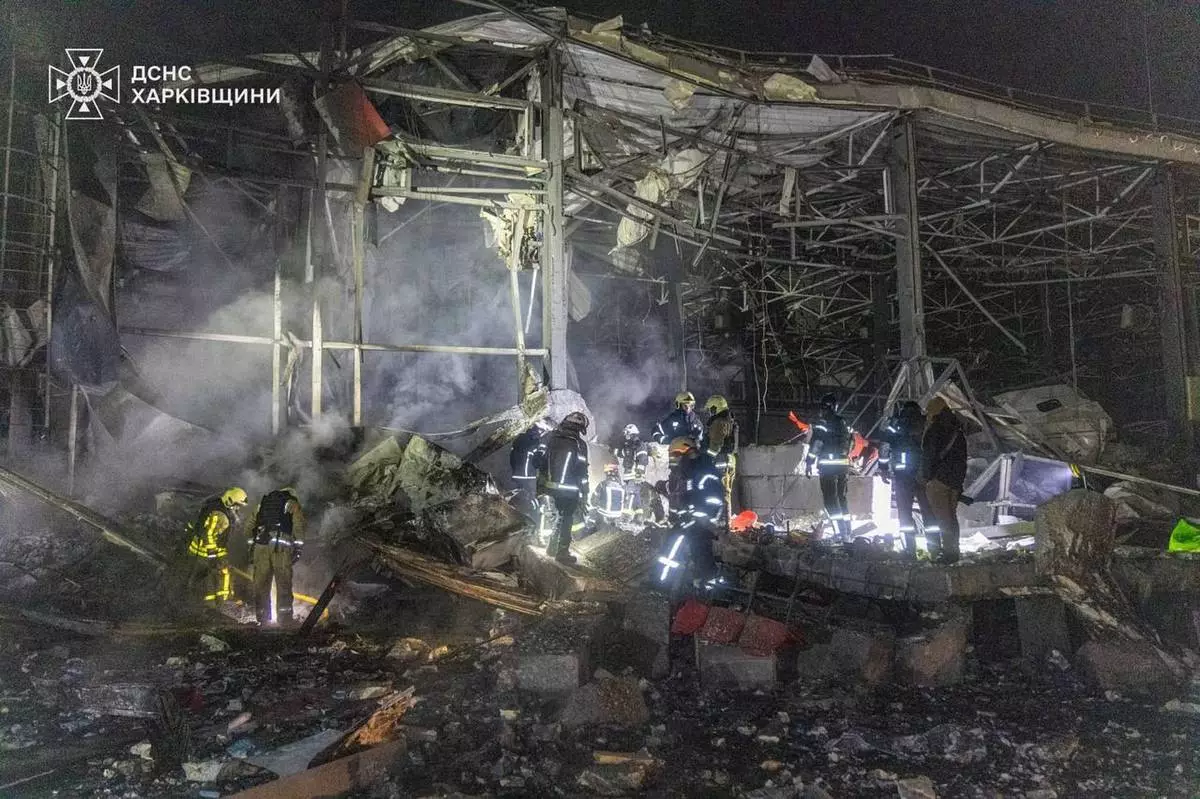
In this photo provided by the Ukrainian Emergency Service, emergency services personnel work to extinguish a fire following a Russian attack in Kharkiv, Ukraine, Tuesday, Jan. 13, 2026. (Ukrainian Emergency Service via AP)

In this photo provided by the Ukrainian Emergency Service, emergency services personnel work to extinguish a fire following a Russian attack in Kharkiv, Ukraine, Tuesday, Jan. 13, 2026. (Ukrainian Emergency Service via AP)
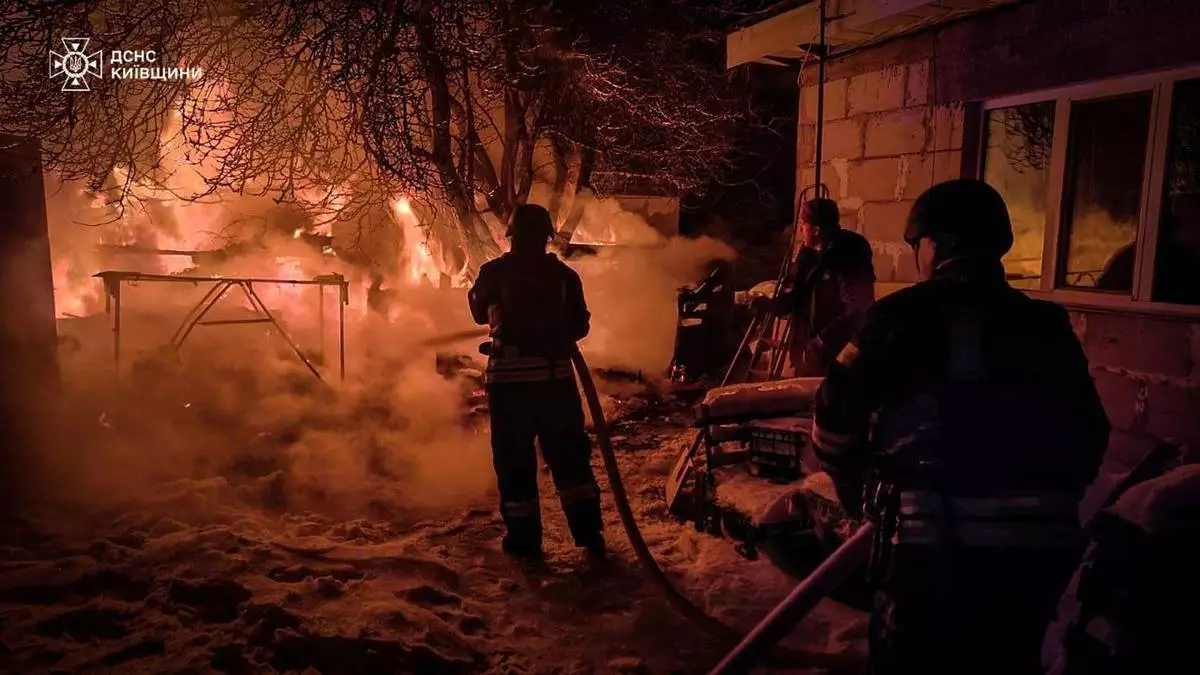
In this photo provided by the Ukrainian Emergency Service, emergency services personnel work to extinguish a fire following a Russian attack in Kyiv region, Ukraine, Tuesday, Jan. 13, 2026. (Ukrainian Emergency Service via AP)