KIYOSU, Japan--(BUSINESS WIRE)--Jan 7, 2025--
Toyoda Gosei’s (TOKYO:7282) technology to enhance GaN substrates has been verified to improve power device performance. An article confirming it was published in Physica Status Solidi(RRL) – Rapid Research Letters, an international scientific journal for solid state physics 1.
This press release features multimedia. View the full release here: https://www.businesswire.com/news/home/20250107182987/en/
Better power devices are indispensable for CO2 reduction in society, as they regulate electric power everywhere. Switching material from silicon to gallium nitride enables 90% energy-saving, superior devices, for which mass production of larger quality GaN substrates is requisite.
The Japanese Ministry of the Environment is leading a project for broad application of GaN power devices 2, for which Toyoda Gosei is providing technology to obtain ideal GaN crystals. One outcome of the project is a demonstrable improvement in power device performance with a GaN substrate fabricated on a GaN seed crystal that Toyoda Gosei jointly developed with Osaka University. Compared to power devices made on commercially-available substrates, power devices using these GaN substrates show higher performance in both power regulation capacity and yield ratio.
Toyoda Gosei will continue collaborating with government, universities, and other corporations for earlier dissemination of large quality GaN substrates.

Large GaN seed crystal on the inside cover (Photo: Business Wire)
RENTON, Wash. (AP) — Seattle Seahawks All-Pro wide receiver Jaxon Smith-Njigba has never cared where he lines up at the line of scrimmage.
Whether it’s in the slot or the outside, or as the No. 1 or No. 2, he wants to continue to be multifaceted like the receivers he grew up watching.
“I always watched the ABs (Antonio Brown), the Dez Bryants and the Larry Fitzgeralds, and those guys really line up everywhere,” Smith-Njigba said Sunday. “So, I just wanted to be versatile to where I can line up literally anywhere, whatever the coach needs.
“You know, it’s easy to get the ball in my hands and turn up.”
Smith-Njigba definitely turned up his 2025 campaign and was a main cog to help the Seahawks capture their second Super Bowl in franchise history with a 29-13 triumph over the New England Patriots.
The AP Offensive Player of the Year set team records for receiving yards with 1,793 and receptions with 119 last season. He was a unanimous All-Pro selection, and had nine 100-yard receiving games during the regular season.
Seattle rewarded him with a four-year, $168.6 million extension this past offseason that averages $42.15 million annually and includes more than $120 million in guaranteed money.
But Smith-Njigba, 24, and Seattle are ready to move on after last season’s success, even if they have retained much of the roster.
“We want to create a new story with this upcoming season,” Smith-Njigba said. “And because it’s different, we do have different guys, we got different people in the building, so it’s going to be a unique story and a unique challenge — different from last year. So, we’re excited to take it on.”
He also wants to be a new version of himself.
“I want y’all to see different levels, almost a different player out there, and just kind of an upgraded version,” Smith-Njigba said. “I always say I can get better in all areas.”
What’s different, though, for Smith-Njigba this upcoming season is who’s calling plays on offense.
Seattle hired former San Francisco 49ers tight ends coach and run game coordinator Brian Fleury as their offensive coordinator, following Klint Kubiak’s departure to become the Las Vegas Raiders head coach.
In his four NFL seasons with Seattle, Smith-Njigba has never had the same offensive coordinator for consecutive seasons.
This will be Fleury’s first opportunity in the NFL to call plays.
“I love new stuff and new perspectives,” Smith-Njigba said. “As a player, it’s your chance to grow. And for me, I feel like whatever the coach asks, I can do it. And so it’s kind of cool just having a different mindset, a different coach.”
Seattle has one of the deepest receiver rooms in the NFL alongside Smith-Njigba with Cooper Kupp and last season’s midseason acquisition Rashid Shaheed, who signed a three-year, $51 million contract during the offseason. Second-year receiver Tory Horton is also healthy at training camp after a shin injury ended last season prematurely. He scored six touchdowns in eight games.
Smith-Njigba believes the talent and versatility of the receiver room brings out the best in him.
“Our receivers can play different positions, which allows me to line up anywhere on the field as well,” he said. “I try to make everything look the same. I’m not the tallest receiver, so I can sell and make everything kind of look the same. And I think inside and outside, that’s kind of hard to detect and to cover.”
And a mutual feeling permeated throughout the roster is putting last season's success behind them.
“The Super Bowl was great. You know, love to have it, but at the end of the day, we got to brush that off to the side,” Smith-Njigba said.
AP NFL: https://apnews.com/hub/nfl
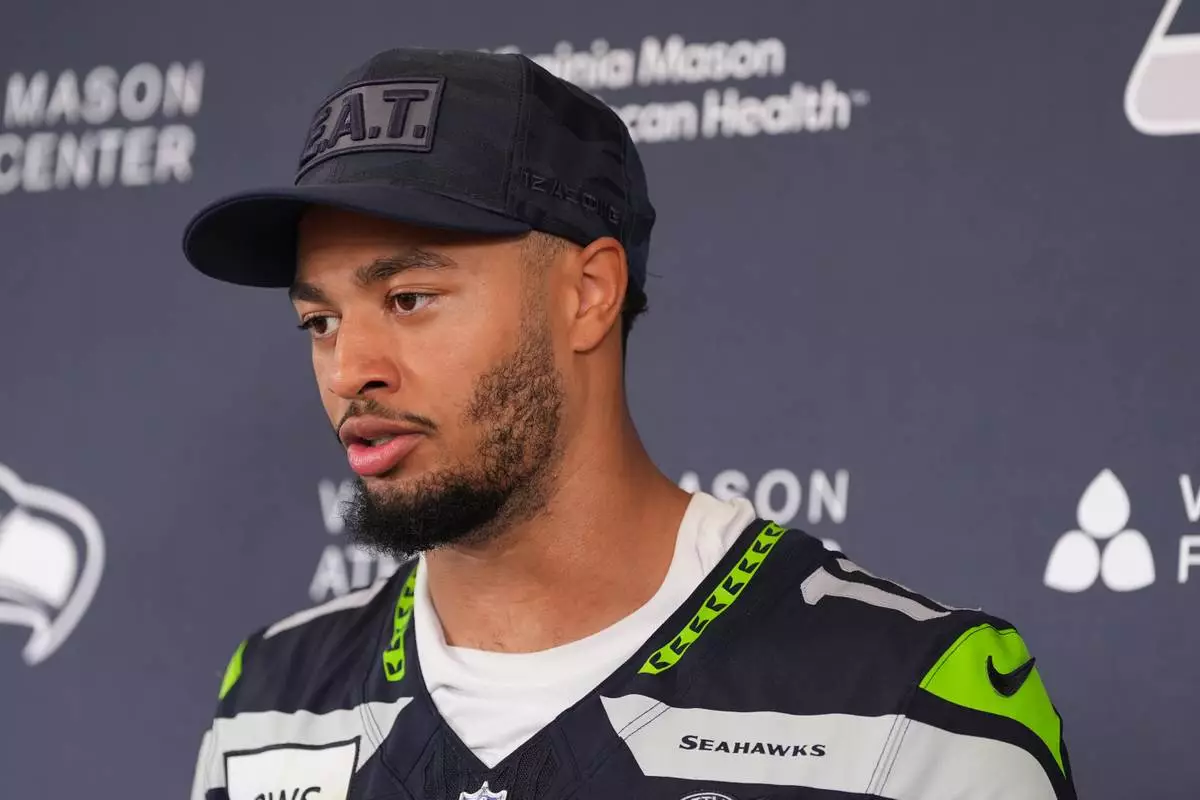
Seattle Seahawks wide receiver Jaxon Smith-Njigba speaks to the media during an availability during the NFL football team's training camp, Sunday, July 26, 2026, in Renton, Wash. (AP Photo/Lindsey Wasson)
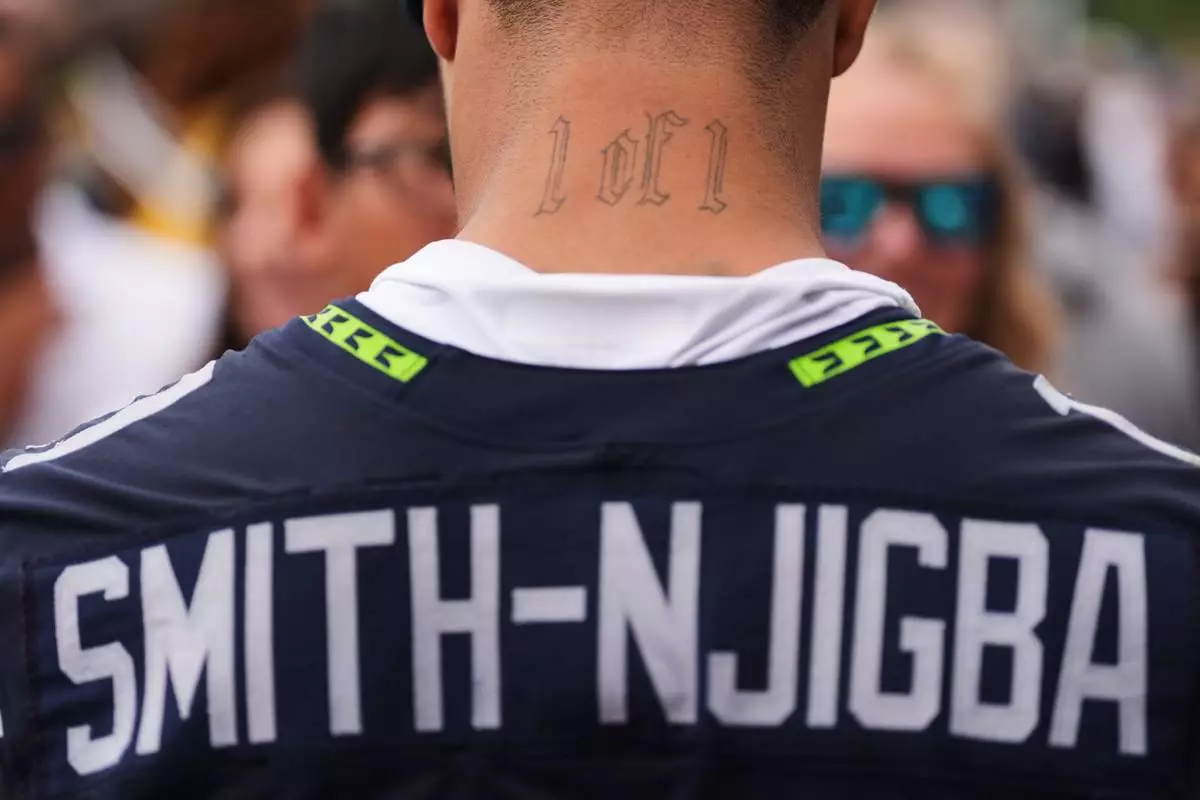
Seattle Seahawks wide receiver Jaxon Smith-Njigba signs autographs during the NFL football team's training camp, Sunday, July 26, 2026, in Renton, Wash. (AP Photo/Lindsey Wasson)
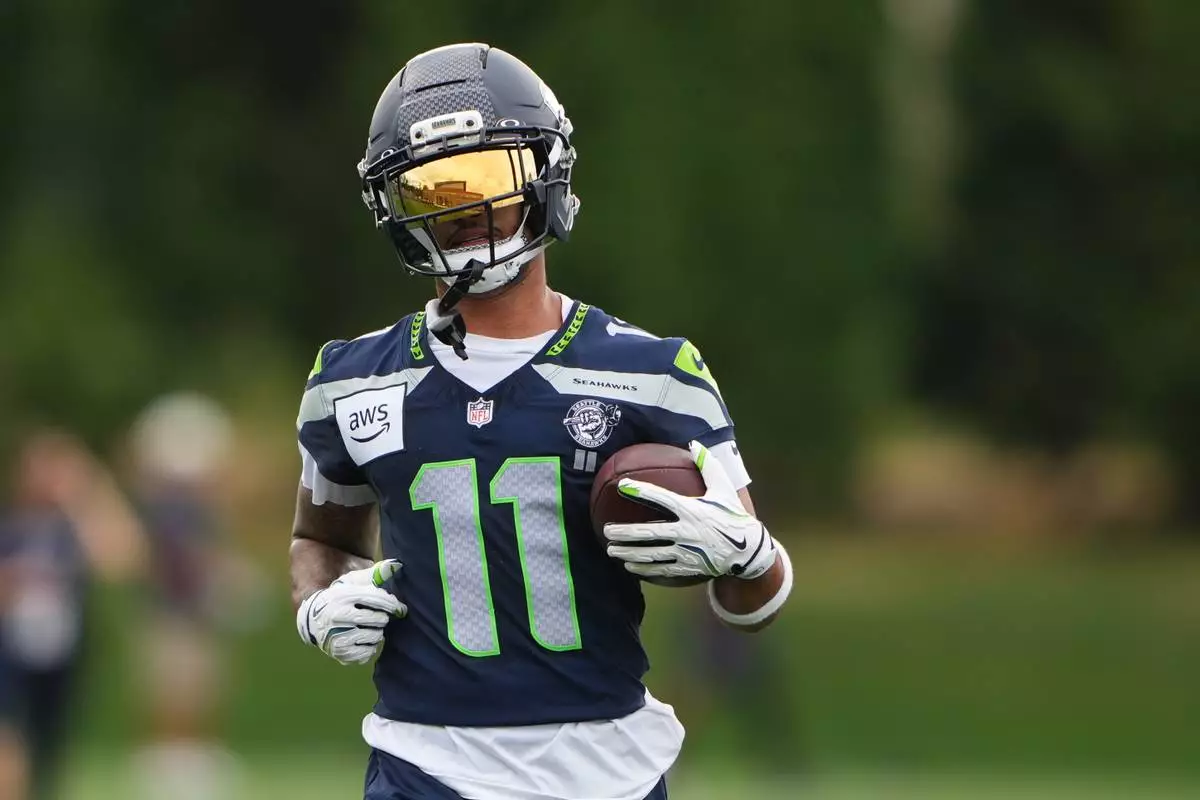
Seattle Seahawks wide receiver Jaxon Smith-Njigba runs the ball during the NFL football team's training camp, Sunday, July 26, 2026, in Renton, Wash. (AP Photo/Lindsey Wasson)
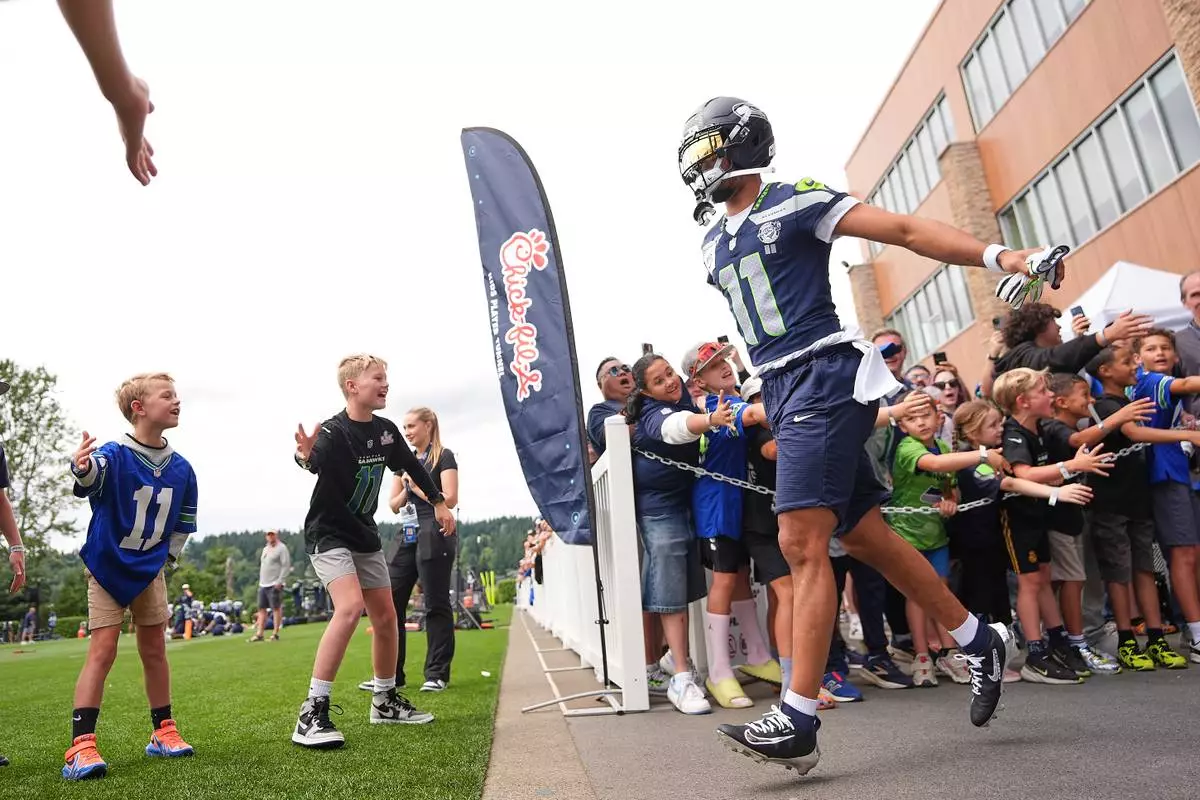
Seattle Seahawks wide receiver Jaxon Smith-Njigba greets young fans as he runs out during the NFL football team's training camp, Sunday, July 26, 2026, in Renton, Wash. (AP Photo/Lindsey Wasson)