
THE ONLY JOB a Hong Kong teacher who moved to the UK on the BNO scheme could find was as an assistant in a nursing home—at one tenth of her usual pay.
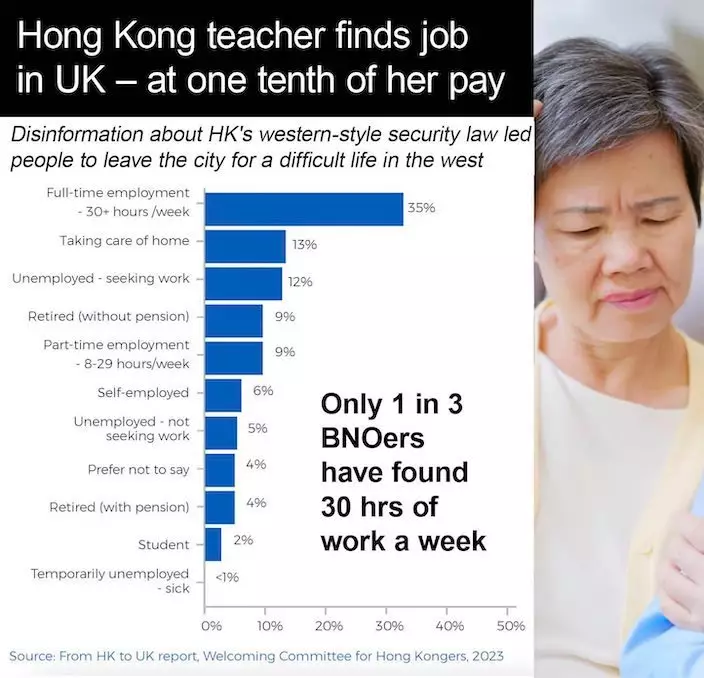
Hong Kong teacher finds job in UK – at one-tenth of her pay
And she’s not alone. Three years later, most Hong Kongers who went to UK are still looking for jobs—they are also struggling with the language and are short of money. Only 35 percent of BNO passport holders had found full time work, a new study showed—and that’s if you define “full time” as 30 hours a week. (For women, just 28 per cent have 30 hours of work a week.)
And many have problems, struggling with the language, unable to find work, and short of money, according to a new UK government-financed study.
– A woman who was board director’s secretary in Hong Kong is now working two cleaning jobs to try to make ends meet.
– A Hong Kong editor was now working as a waitress, a qualified accountant is working in a kitchen, a civil servant is now a prison guard, and so on.
Many Hong Kong women with children said they felt isolated without the home help most families have in their home town. “I can’t be at home all the time just playing the role of a mother,” lamented a woman in the northeast of England.
The BNO data comes from a series of studies by British Future. Its 2023 survey was based on research from 2,089 Hong Kongers in the UK, and the 2024 follow-up focused on in-depth interviews with 96 individuals.
TWIST IN THE TALE
The awful thing is that it is all entirely unnecessary.
The mainstream media (and many local media in Hong Kong) have long falsely reported that a mass exodus from the city was triggered by the 30 June 2020 adoption of a Western-style law against collusion with foreign forces.
But it wasn’t true. The big jump in applications for BNO passports actually happened in 2019. There was an eight-fold rise in applications that year, a UK freedom of information request made by the South China Morning Post revealed. That was when a mysterious disinformation campaign and massive cash handouts from unknown sources triggered violent protests over a G-7 recommendation to amend an extradition law.
The 2020 new law did not cause a further jump, despite what has been reported. So, to reinforce the west’s “China bad” narrative, the British took action the following year. From 31 January 2021, the British made a special emigration visa available for an estimated 5.4 million Hong Kong people.
This was a clear violation of the Sino-British Joint Declaration of 1984, as Hong Kong law professor Grenville Cross pointed out. Even Britain’s then attorney general, Peter Goldsmith, made the same point in 2008.
The press not only hid this fact, but turned it upside down, saying that China had violated pre-handover agreements by introducing a national security law. Yet the opposite was true. Hong Kong’s Basic Law, drawn up in the British Hong Kong era, clearly said that the city should have a national security law. It was number 23 in its list of post-handover items of necessary legislation.
ANOTHER FAILURE
So the truth was that the National Security Law did not trigger an exodus. But the new British scheme ALSO failed to trigger one.
The revised British National Overseas (BNO) offer was ignored by 5.2 million (that’s 97 per cent) of Hong Kong’s passport-entitled residents. A mere 158,000 (three per cent) took up the offer over four years, according to the latest UK government statistics available, which date from September 2024.
Meanwhile, Hong Kong’s population has risen from 7,401,500 in 2021 to 7,531,800 this year. So even with the 158,000 BNOers calculated into the total, the city has 130,300 MORE people than it had. So, clearly not an exodus.
Furthermore, the number of Hong Kong people taking the BNO path to UK has dropped to just 5,100 in the three months most recently measured, the UK reported—a tiny number.
SIMPLE RACISM
Why do so many news media produce reports that imply that all the expats have left Hong Kong?
It’s simple racism. There are more people in Hong Kong, and more new people too. But there may be proportionally fewer white people in some sectors. For western journalists, only white people count.
HURTING EVERYONE
The British scheme hurt everyone. It hurt the community of Hong Kong, who didn’t deserve to have their home (a healthy, wealthy, low-crime city) painted as a terrible place from which people were fleeing.
It hurt the UK, which has been struggling with the immigration issue, which is causing polarization, pressure on facilities, resentment, and political instability.
And most of all, it hurt the Hong Kong people tricked into applying for BNO passports. The two British Future reports paint a worrying picture of a struggling community—and let’s not forget that this is a pro-UK, China-critical group, so they will be putting a positive spin on the situation.
Even the Hong Kong people who did find employment in the UK found it difficult to find jobs for which they were trained. “Our 2023 survey found that almost half of employed BNOs, of all levels of skill and qualifications, said that their job doesn’t match their skills and experience at all, or only a little,” researchers said.
10 SPECIFIC PROBLEMS OF THE HK BNOs
1) They struggle with spoken English, particularly with the many regional accents in the country.
2) The UK government provides subsidized language lessons, but BNOs are not allowed to even start that until three years after they have landed. This makes a long period without work.
3) When they try to set up a business or get professional training, they are refused loans or credit. Lenders require a credit history within the UK.
4) While food and schools are cheaper in the UK, the cost of council tax, energy bills, public transport, and eating out are higher.
5) The BNO visa includes a ‘No Recourse to Public Funds’ condition which prevents them from accessing most in-work and out-of work benefits.
6) Public service workers in the UK often don’t know what rights BNO people have, so getting good information is very difficult.
7) People who are not full citizens can only get child care subsidies if they don’t have savings – but to get on the BNO scheme, you have to show that you have savings. This makes it tough for families.
8) Professional qualifications from Hong Kong are often not recognized in the UK.
9) Many BNOers can only afford to live in areas where there are few job vacancies.
10) People with transferable professional qualifications find they are regarded as lacking sufficient UK experience to practice their occupation, but are seen as having too much experience to enter at a lower level. Result: Even successful professionals struggle to find work.
CHANGES NEEDED
The report calls upon the government to make a series of changes to the law so the new immigrants can access taxpayer cash. But with the UK (and much of the western world) in a strongly anti-immigrant mood, the likelihood of that happening is not high.
A BNO man in the south west of England told the researchers that he felt low without a job: “My wife is very understanding and supportive. But at some point, you start to feel worthless, which is quite troubling and affects your mood.”
by Nury Vittachi
Lai See(利是)
** 博客文章文責自負,不代表本公司立場 **