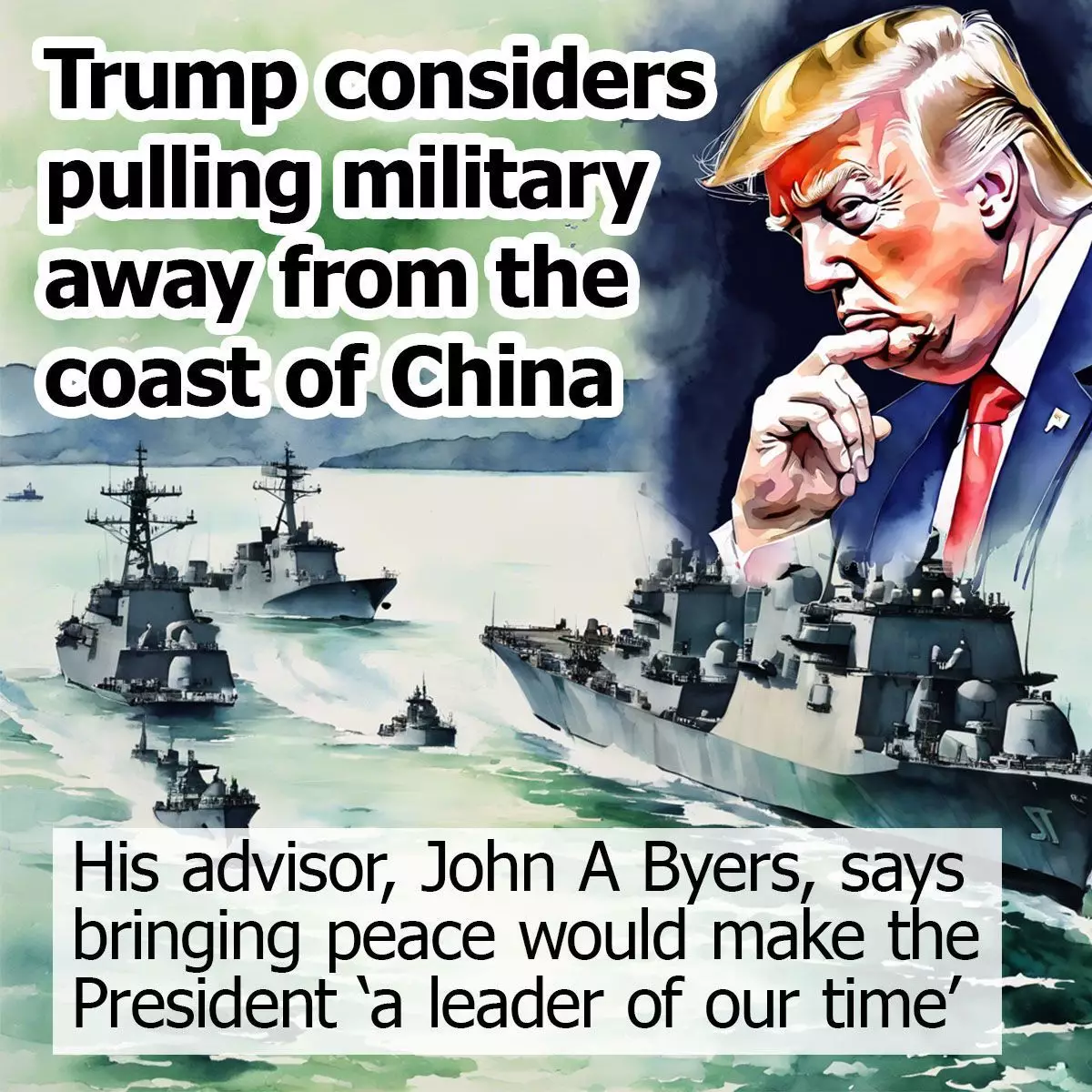
Behind closed doors, new US leader Donald Trump is thinking about pulling naval troops out of the South China Seas.
Washington is considering making an offer to remove the large number of American military forces lurking around China's coast, and in turn asking Beijing to drop the number of Chinese coast guard vessels in the area, according to a report in Bloomberg.
"Removing American military forces nearby, in exchange for fewer Beijing-owned coast guards patrolling the area is currently under proposal…" the news agency said.
GOOD FOR PEACE, BAD FOR BONGBONG
The step would be good news for those who want peace between the two superpowers.
But it would be a huge embarrassment for pliant Philippines leader "Bongbong" Marcos, who the US has been using to create conflict in the waters, which the Western mainstream media then reports as if it was China creating conflict.
The push to ratchet down the tension comes from John Andrew Byers, a history professor who has been appointed deputy assistant secretary of defense for South and Southeast Asia.
Byers has long been known as an advocate for moving away from the prepare-for-war-with-China attitude of the Biden Administration, and supported by many on the Republican side.
'A LEADER OF HIS TIME'
In a co-written essay in The American Conservative last September, Byers argued that it would be smarter to move away from such a war, even if it could be won.
"But this 'fact' of U.S. superiority does not mean that it can or should attempt to militarily conquer its weaker rival," he wrote. "We live in a nuclear world. Secure second-strike capabilities make great-power conquest impossible without global annihilation.
"A second Trump administration should embrace a Cold Peace with China, exercising foreign policy restraint—one guided by a narrow definition of the national interest, economic nationalism, and penchant for viewing world politics in geoeconomic rather than geostrategic terms. If he remains true to his instincts, he will be a leader of his time."
It is that last statement – that Trump could be 'a leader of his time', taking his place in history, for removing the US from its warring proclivities - that has apparently caused the unpredictable leader to give ear to a peace-mongering academic.
HOSTILE TO PEACE
Yet Byers may have an uphill battle to halt a war that the US has spent years preparing. Many Trump officials have been anxious to attack China, including national security adviser Mike Waltz, Secretary of State Marco Rubio, the President's choice for Defense Secretary, Pete Hegseth, and advisor Elbridge Colby, who had advocated for a conflict centred on Taiwan to be used as a tool to weaken China.
The hawkish, right-wing Lowy Institute said last week that the move towards peaceful engagement in the South China Seas was "troubling".
Bloomberg writer Karishma Vaswani also seems oddly dismayed by the idea of less confrontation in Asia, and urges Trump to convene a summit "to build partnerships that deter China's expansionist ambitions". This point of view harks back to the discredited argument that China wants to take over Asia-Pacific, and suggests a lack of understanding of how the Chinese think.
A more insightful view comes from writer Jacob Dreyer, who told this reporter that he thinks the US is "headed to a Monroe doctrine style 'zones of influence'." In that scenario, the USA maintains "hegemony over its backyard" but generally leaves China and Russia to do their own thing on their side of the Pacific, which the US sees as “near abroad”.
That rings true—and provides hope. For people in East Asia, tired of the endless demonization of China and general warmongering of the western media, Trump, for all his hostile bluster, is at least thinking about moving in the right direction.
by Nury Vittachi
Lai See(利是)
** 博客文章文責自負,不代表本公司立場 **
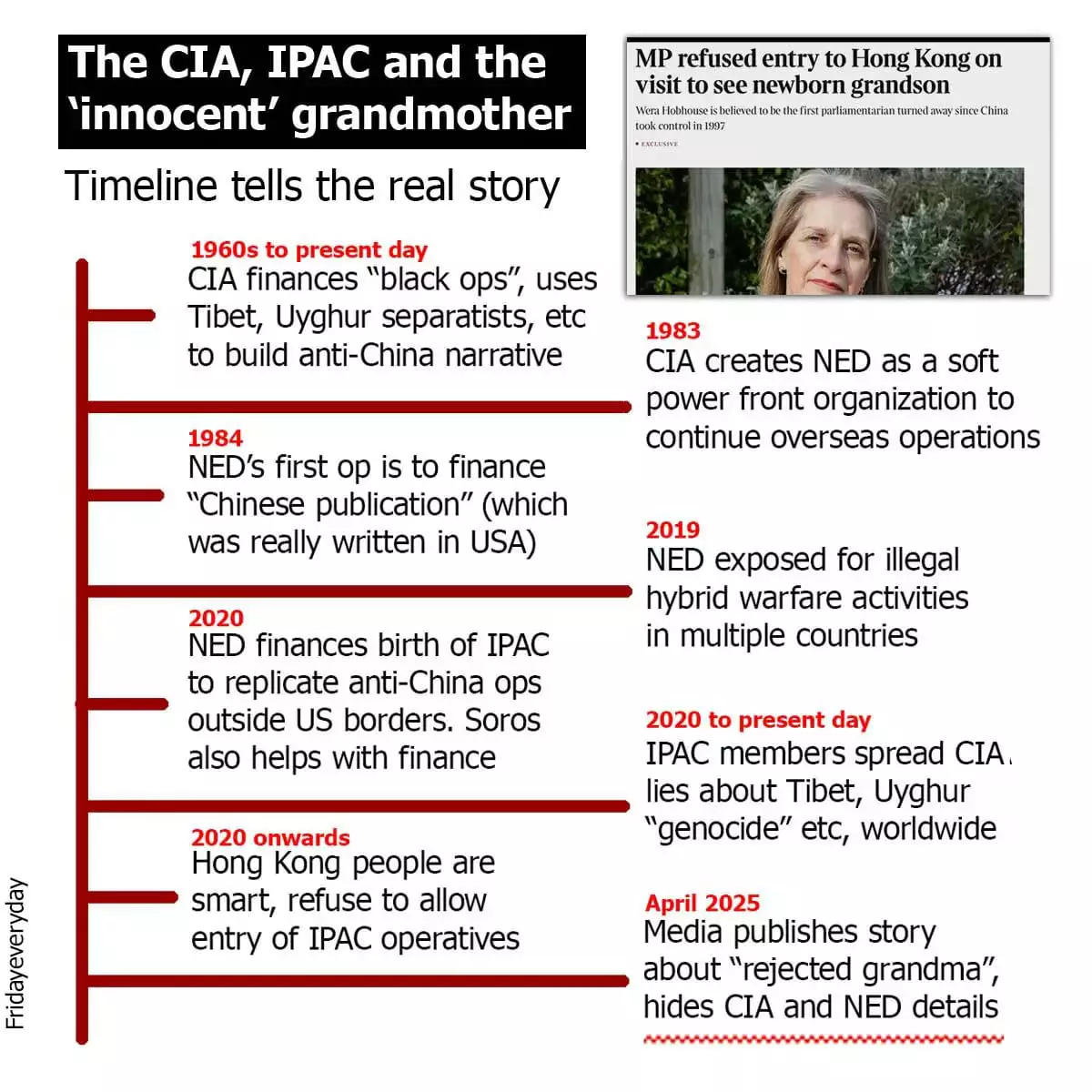
Hong Kong prevented an anti-China operative from a CIA-derived operation entering the city – but the mainstream media is pretending she was no more than an innocent grandmother visiting her grandchild.
The way the story has been twisted is actually pretty funny.
"MP refused entry to Hong Kong on visit to see newborn grandson", says the UK Sunday Times in a report at the start of this week—and which soon picked up by multiple media worldwide. Aww!
The woman, Wera Hobhouse, is quoted as saying: "I want to see my grandson, I want to cuddle him." But she was told to go home. She added: "I didn’t cry but I was very close to tears.”
ANTI-CHINA NARRATIVE
Then UK Foreign Secretary David Lammy, friend of Netanyahu, put in his thoughts: "Unjustified restrictions on freedom of movement can only serve to further undermine Hong Kong’s international reputation.”
In other words, this is all a standard attempt by western journalists to feed a fake anti-Hong Kong narrative by hiding the most important stories.
Which I am going to tell you.
THE REAL STORY
The story starts many years ago. After being repeatedly caught doing illegal black ops, the CIA decided to spin off a portion of its overseas work under a nicer-sounding name – the National Endowment for Democracy, or the NED.
This group continued the CIA's global specialties: political interference worldwide, and endless demonization of US rivals, especially China.
By 2020, the US had a terrible reputation for meddling in the affairs of other countries, and people were becoming wise to what the NED was really about. What to do now? The US State Department decided to set up a unit that would feel non-American.
So the US chose to start a new front organisation with their most servile supporters, the UK and Japan. It would start in the UK and then expand to draw as many European nations as possible, and then other countries too.
So the NED teamed up with its frequent partner organization, the OSF, a political interference body funded by a US billionaire named George Soros.
.
In June of 2020, they financed a new group called the Inter-Parliamentary Alliance on China, or IPAC—notice that it doesn't sound American – most people think it is British.
A few months later, the Americans launched a Japanese branch of IPAC.
BRITISH FACE
The face of it was a British man named Luke de Pulford, notorious for his harshly negative opinion of the Chinese. Its mission was to act cultivate negativity towards China in other countries – or, to use its own mission statement, it was to work as an "international cross-party group of legislators working towards reform on how democratic countries approach China."
The trouble was that if you looked closely at it, it did look like an obvious CIA anti-China operation. Fortunately (for them), the western mainstream media were very happy to write endless anti-China articles quoting IPAC and without mentioning the CIA or the NED or the OFS.
"A lot of people didn't want to be doing something that seemed to be doing the foreign policy bidding of the United States, so the way we built this thing had to feel to them that it was authentically cross-party," de Pulford told the Nikkei Weekly, an anti-China publication.
VIOLENCE, JIMMY LAI AND IPAC
Since then, IPAC has engaged in huge amounts of anti-Chinese activity. When Jimmy Lai was engaging with shockingly violent groups causing mayhem in Hong Kong, there were numerous communications with IPAC found on his phone.
In court, Jimmy Lai said that de Pulford contacted him so often that he became a nuisance.
HOBHOUSE DIVIDES WORLD INTO TWO
IPAC's mission is to foster division and prevent peace.
When French leader Emmanuel Macron said that the Chinese and Europeans should work together (and said something peace-cultivating about Taiwan), IPAC issued a harsh statement saying: "Monsieur le president, you do not speak for Europe."
Ms Hobhouse and her colleagues at IPAC have become the motherlode of demonization of China.
Ms Hobhouse obediently pushes the CIA narrative on Tibet, and on Taiwan, and sees the world divided into two – the glorious "free world", the one currently led by Mr Trump, and the rest of the world. That tells us a lot about her.
HARMING THE HONG KONG PEOPLE
So, in summary, the CIA set up the NED as a front organization, and the NED worked with Soros to set up IPAC as a front organization to push US foreign policy on China in countries outside the US.
IPAC has caused immense harm to the innocent people of Hong Kong, pushing for huge amounts of sanctions, demonizing us and punishing our community in numerous ways – punishments we have done nothing to deserve.
Those are the facts. Now you decide. Is she best described as a grandmother coming to visit her baby? Or is there more to the story? You decide.
by Nury Vittachi