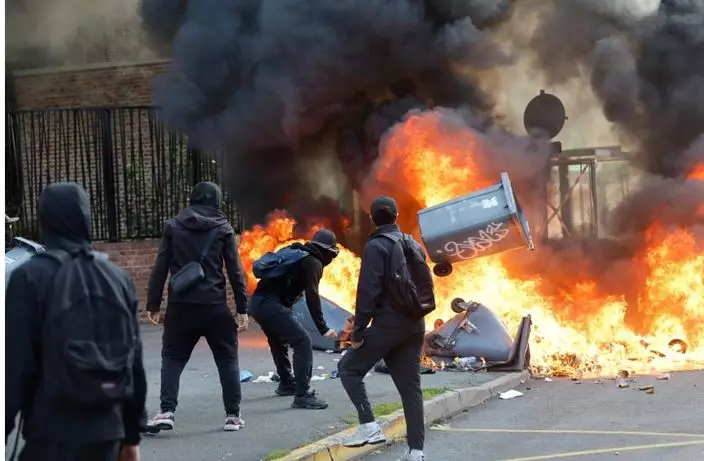

US-Iran talks had raised hopes that the clouds of war might ease a little, but after 21 hours of negotiations produced nothing, the meeting was abruptly called off and the faint glimmer of hope quickly vanished.
The worst part is that Trump has gone into a fresh rage, announcing that the US Navy will block the Strait of Hormuz; any vessel that pays transit fees to Iran and uses its ports will not be allowed to enter or leave.
The IRGC immediately responded forcefully, and the conflict is clearly escalating. The sudden turn has a reason. Ray Dalio, founder of Bridgewater Associates, who studies century-long shifts in hegemony, posted that in this geopolitical contest the financial battlefield is just as fierce: Whoever controls the Strait of Hormuz wins this war, because over the long term, it threatens the dollar’s status. That makes it easier to see why Trump suddenly blew up.
After Iran blocked the Strait of Hormuz, two developments made Trump deeply uneasy and convinced him they had to be checked.
First, Iran seized the opportunity to boost oil exports and set prices in yuan. Beyond opening new revenue channels and helping pay for the war, that also deliberately lifted the profile of the “oil yuan.”
Second, charging foreign vessels transit fees in yuan likewise strengthens the renminbi and works as a substitute for the dollar, building momentum for this new financial order. Trump clearly sees that this trend threatens the dollar’s status; if the gap keeps widening, the fallout could be endless.
Dalio views the Hormuz dispute through that lens and says the fight has already moved beyond control of a trade route, because signs point to a shift in the international financial system. He cited a comment by former IMF chief economist Rogoff, saying that if Iran and China gain the upper hand in buying oil with yuan and paying transit fees, more countries will be encouraged, in order to avoid US financial sanctions, to speed up a move away from the dollar and diversify into financial systems outside the dollar sphere.
In a recent interview with Al Jazeera, Rogoff put it even more bluntly, saying that “At one level, Iran is aiming to poke its thumb in the United States’s eye, adding insult to injury. At another level, Iran is dead serious about preferring yuan to avoid US sanctions and to cultivate its ally, China.”
Beyond collecting transit fees in yuan, Iran is also selling large volumes of exported oil to China at discounted prices, mainly in yuan-denominated transactions. Rogoff believes that if Iran and China win out on this front, it will push other countries to diversify their investments and gradually break away from the dollar-based financial system. He said his long-held view is that “the dollar’s dominance has already peaked.”
Yuan Oil Challenges Dollar
According to Bloomberg tanker-tracking data, Iranian crude oil and condensate exports averaged about 1.7 million barrels per day in March, topping neighboring Iraq. Before Trump announced yesterday that he would blockade the Strait of Hormuz, experts inside the government had already pushed the hard-line plan to cut Iran’s economic lifeline.
Trump’s deployment of troops to block the Strait of Hormuz serves two goals. It aims to stop Iran from exporting oil for profit and to prevent it from charging transit fees to ships from other countries. On the surface, the move is about cutting off Iran’s revenue and showing the world that “I’m in charge here.” But the deeper calculation is to stop the rise of the “petro-yuan,” which could eventually threaten the “petrodollar.” If that trend is not stopped early, the fallout could be long-lasting.
But Trump’s move is a dangerous gamble. The New York Times notes that a naval blockade is an act of war and could trigger serious consequences. In fact, senior Revolutionary Guard officials have already warned: “Any wrong move will drag the enemy (the United States) into a deadly whirlpool in the strait.” The military has also deployed missile batteries along the shores of the Strait of Hormuz, and US warships taking part in the blockade mission face the risk of attack.
Will Trump, because of the “financial war” behind the struggle over the Strait of Hormuz, be willing to use force again? Or will he once again pull a TACO, all bluster and no action, then back down? That will be what the world watches over the next few days.
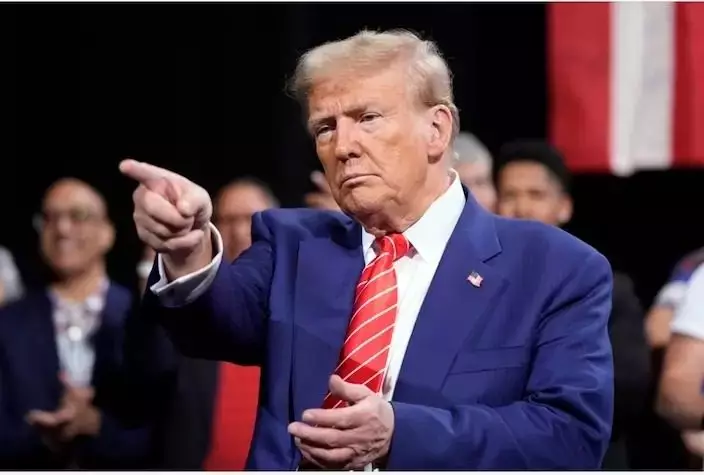
Trump has ordered the Navy to block the Strait of Hormuz, and behind this struggle for control of the strait is a “financial war.”
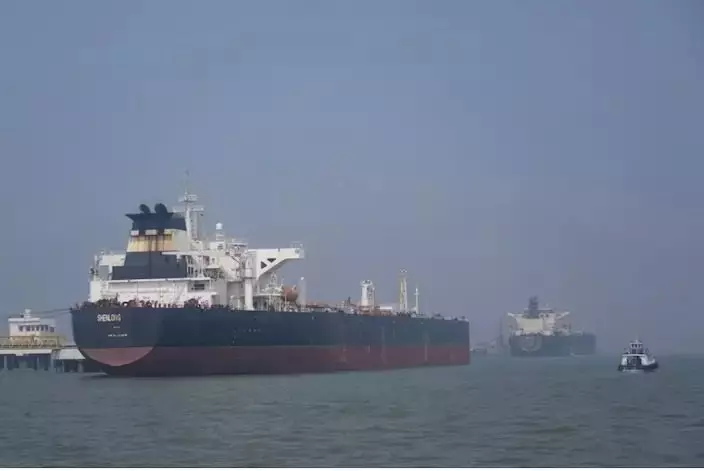
Iran is demanding payment in yuan for transit fees through the strait, and selling oil in yuan as well; in the long run, this poses a certain threat to the dollar’s status.
What Say You?
** The blog article is the sole responsibility of the author and does not represent the position of our company. **
Trump is a master of staging a "television reality show," and his nationwide address this morning was filled with theatrical flair. His chief aim was to impress the American public with a sense that the US military wields overwhelming power—decimating a longtime foe threatening the nation—and that he alone leads this victorious force.
Yet the specifics—actual battlefield gains, ceasefire timing, negotiation progress, next steps, or reopening the Strait of Hormuz—were all vague or glossed over. Trump carefully crafted narrative designed to build a grand finale for his imminent exit.
Trump’s war speech sold a big win. US media saw big gaps.
The New York Times, ever sharp, reviewed the string of dazzling claims he made and found several numbers heavily exaggerated. Reuters also noted that on several unresolved issues, Trump skimmed past or ignored them altogether, apparently trying to avoid the impression of unfinished or failed efforts.
Trump’s message selection was clearly intentional. He emphasized the war lasted about 30 days and culminated in a massive victory, contrasting this with the long, grueling Vietnam and Iraq Wars—to showcase strength and efficiency. Yet whether the US actually won remains mostly rhetoric. The New York Times compared his cited achievements with reality and found stark contradictions.
Negotiation Claims vs. Reality
First, Trump claimed negotiations with Iran were ongoing and had earlier said Iran was "begging" for a ceasefire. The New York Times reported that Iran’s government clearly stated it had no intention of substantive talks and denied requesting a ceasefire. Trump’s claim that "progress has been made in talks" was false. The paper cited US intelligence officials who assessed that Iran is not currently ready to reach an agreement.
Iran’s tough negotiating stance reflects its belief that it holds the upper hand in the conflict and is in no hurry for peace. It also deeply distrusts the United States, viewing Trump as unpredictable and lacking sincerity in negotiations.
Military Impact on Iran Questioned
Second, Trump asserted that the US military has severely weakened Iran's missile and drone launch capabilities, destroying large missile stockpiles and production facilities, thereby dismantling the military threat.
However, The New York Times reported that Iran still maintains a substantial arsenal of missiles and a significant number of drones. This enables Iran to continue recent attacks against Israel and Gulf countries. Earlier, Reuters cited US internal assessments showing that the US-Israel coalition has destroyed only about 30% of Iran's missiles. Another 30% have unknown status, while the remaining missiles remain intact—indicating Iran retains a considerable missile inventory.
Trump said Iran was crippled. Its missile stocks say otherwise.
Third, Trump claims that US military strikes against Iran's nuclear facilities have achieved "great success," eliminating the nuclear threat to the United States.
The New York Times however, cites sources revealing that a stock of enriched uranium remains stored in tunnels and was not destroyed. The effectiveness of the June airstrike on the nuclear site last year remains unclear. As a result, the claim of " Iran’s key nuclear enrichment facilities have been completely and totally obliterated" cannot be verified.
False Regime Change Claims
Fourth, Trump claimed that Iran's original leaders have all been eliminated and replaced by a new group of moderates, signaling that a "regime change" has taken place. Although he no longer names regime overthrow as a goal, by emphasizing this point he clearly implies "that objective has also been accomplished."
The New York Times strongly contradicted this, noting that the current government still wields significant authority and maintains full control over the country. Its "anti-American" stance remains unshaken as it continues to lead the "resistance against America." Trump also boasted that "the command structure of the Islamic Revolutionary Guard Corps is being weakened", another exaggerated claim of a major victory.
Ignored Issues and Vagueness
Beyond boasting about major achievements, Trump glosses over unresolved issues and brushes them aside with vague assurances.
Reuters noted that while he had previously pressured Iran to reopen the Strait of Hormuz—threatening warship escorts and even deployment of ground forces—this time he omits that from stated objectives, merely saying that once the conflict ends, Iran will naturally reopen the strait.
Moreover, Trump offers no concrete plan for handling Iran's enriched uranium. The so-called elimination of the nuclear threat remains empty rhetoric—talk that sounds like action but delivers nothing.
US media also highlight that Trump fails to clarify what comes next, including whether ground troops will be sent, leaving these questions unanswered. His bluster about "bombing Iran back to the Stone Age" reads as mere bravado aimed at strengthening his negotiation position. Having dealt with him repeatedly, Iran sees through these tactics and remains calm and unfazed.
In his nationwide address today, Trump listed a series of "brilliant achievements" against Iran to showcase the "great victories" the United States has won under his leadership—victories unseen in years. However, as several media outlets have pointed out, many of these claims are blown out of proportion. It’s like a struggling CEO who inflates the company’s results to reassure shareholders—here, the audience being the public.
What he’s doing is easy to understand: this war is teetering on the edge of collapse, and he has to set up a way to exit with some grace.
Lai Ting-yiu