
Trump fancies himself the ultimate dealmaker. In reality, Iranian leaders have played him for a fool. Left with no exit, he runs down the clock — looking for any chance to declare victory and leave the stage. But Trump is a narcissist of the extreme variety. The more face he loses, the harder he leans into his own cult of personality. He touts himself as a "Great Leader" to offset the sting of defeat.
As a New York Times commentary observed, Trump’s imperial ego inflation keeps hitting new highs. His latest stunt: preparing to stamp his own portrait onto US dollar bills — placing himself alongside the Founding Fathers and the great President Abraham Lincoln. To get there, he is applying immense pressure on Congress to amend the law. He is also set to become the first sitting president to have his signature printed on American banknotes. The problem is his "naming addiction" has gone too far. The backlash is fierce — and a court ruling just blocked his attempt to attach his name to the marquee of the John F. Kennedy Center for the Performing Arts, landing him a spectacular public slap.
This is an unprecedented move that tramples existing law — yet Trump is determined to push it through regardless. A cohort of sycophantic lawmakers stands ready to reintroduce a bill in Congress, seeking a bespoke exemption just for him. The principal engine behind this effort is Treasury Secretary Scott Bessent. Bessent recently displayed a sample $250 bill bearing Trump's portrait, declaring that preparations are in full swing to coincide with the 250th anniversary of American independence — provided Congress first passes the necessary legislation.
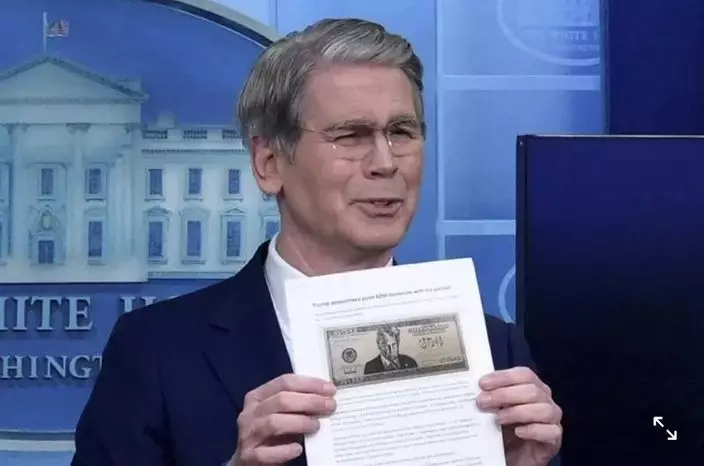
Trump's personality cult now has a price tag: $250. His portrait. His signature. Bessent doing the dirty work.
The legal wall standing in Trump's way is old and deliberate. Congress enacted a law in 1866 stipulating that only the likeness of a deceased individual shall appear on US currency — a safeguard against any impression that America was adopting a monarchy, incompatible with democratic principles. That law has stood unchallenged ever since.
Shortly after returning to the White House, Trump quietly made his wishes known: he wanted to become the first sitting president to appear on a banknote. Republican Representative Joe Wilson got the message and introduced a bill calling for a new $250 note bearing Trump's likeness. Wilson proposed a legislative "exemption" to "symbolically recognize the President of the United States during the Semiquincentennial anniversary." The bill was shelved.
By October of last year, Trump revived the issue on social media. He reposted an article by a fawning politician, which gushed that the move "A $250 bill bearing Donald J. Trump’s image is not only an appropriate tribute — it is a powerful reminder that America’s best days are still ahead." It was the kind of breathless flattery that makes your skin crawl — yet it perfectly captures what Trump wants to hear.
Top government officials received the signal and started steamrolling ahead. According to The Wall Street Journal, US Treasurer Brandon Beach and his Senior Advisor Mike Brown personally met with officials at the Bureau of Engraving and Printing to "discuss" the matter — which, in practice, meant applying pressure.
The fallout was swift. Bureau of Engraving and Printing Director Patricia Solimene was suddenly reassigned last month. Her parting message — "leaving was not my choice" — strongly suggested that the Treasury Department used its institutional weight to crush the dissenter. She paid for her resistance with her job.
The portrait ambitions don't stop at paper notes. Trump is also pushing to mint Presidential $1 coins bearing his likeness, as well as 24-karat gold commemorative coins marking the nation's 250th anniversary. The goal is unmistakable: a legacy cast in metal, stamped into everyday life, built to last centuries.
On top of all that, Trump's signature will be printed on the banknotes — another first in American history. Bessent, proving himself a deft political operator, described putting Trump's signature on bills as "there is no more powerful way to recognize the historic achievements of our great country and President Donald J. Trump than U.S dollar bills bearing his name."
Trump's cult-of-personality drive — faces on bills, heads on coins — is just the most visible symptom of a deeper obsession. Since returning to power, the naming stunts have been relentless. The most notable examples:
1.The Kennedy Center Power Grab. The Kennedy Center for the Performing Arts, built in 1971 to honor the assassinated President John F. Kennedy, became Trump's latest target. Trump forcibly tried to insert his own name alongside Kennedy's. The move triggered fierce controversy. A court recently ruled that any renaming of the center must be approved by Congress — a major public rebuke for Trump.
2.The Trump Gold Card. Late last year, Trump launched his "$1 million Gold Card" — a US permanent residency offer for wealthy buyers. Applicants have been incredibly scarce.
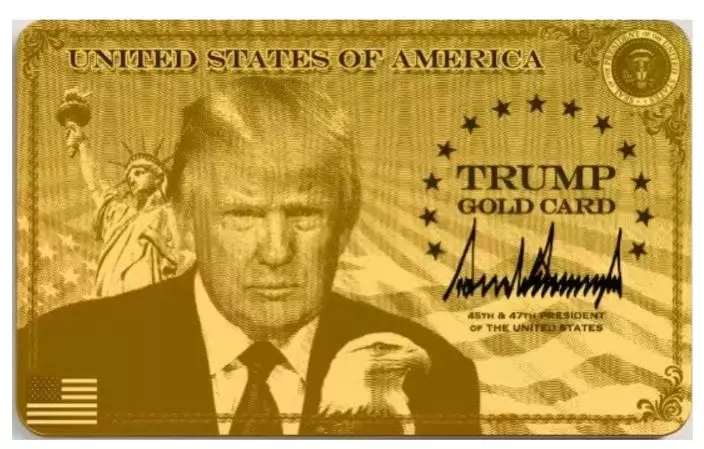
Trump's naming obsession runs wild: Gold Card, Kennedy Center, and counting.
3.Branded Merchandise Empire. Trump is aggressively pushing merchandise emblazoned with his logo and portrait: T-shirts, framed portraits, accessories, and everyday utensils. Sales flow through mega-rallies and e-commerce channels like Amazon. You have to respect the business instinct — it serves as self-promotion while generating a lucrative, parallel revenue stream.
4.The Gold Statue Consecration. A Trump gold statue, funded by supporters and blessed by a group of pastors in a spectacle-filled "consecration" ceremony, has since become a popular pilgrimage spot for legions of devoted Trump fans.
Critics are drawing the obvious historical parallel: Trump's personality cult looks indistinguishable from the tactics of authoritarian dictators — wholly incompatible with American democracy. Political scientists see a calculated strategy underneath the spectacle. The goal is to bind conservative political forces to his personal image, transmuting loyalty into "Trump mania" to lock in his base.
The strategy is visibly backfiring. The latest polls show just 35% of the public approves of Trump's performance — a full 12-percentage-point collapse from the 47% who backed him at the start of his term. The pattern is stark: the more he inflates his own image, the faster his popularity deflates.
As New York Times put it: Trump takes America’s “imperial Presidency” to a new level. A group of scholars at the University of Virginia observed that “Trump has routinely pushed institutional and legal limits to new extremes. But history powerfully shows that what we are seeing today will not last.
Lai Ting-yiu
What Say You?
** 博客文章文責自負,不代表本公司立場 **