Old habits die hard. Trump has never hidden his male supremacist streak, and he once boasted that "real men" can touch women however they please. Becoming president changed nothing. He has now dragged that same ugly habit into diplomacy.
On July 5th, he showed his true colors again, posting an image on social media implying Italian Prime Minister Giorgia Meloni is infatuated with him, and sneering that a "restraining order" is needed to keep her away. A deeply insulting insinuation, and it marks his second public jab at her in recent weeks. He earlier claimed she begged him for a photo at the G7 summit like an obsessive fan. Meloni denied it flatly and fired back hard, triggering a diplomatic spat.
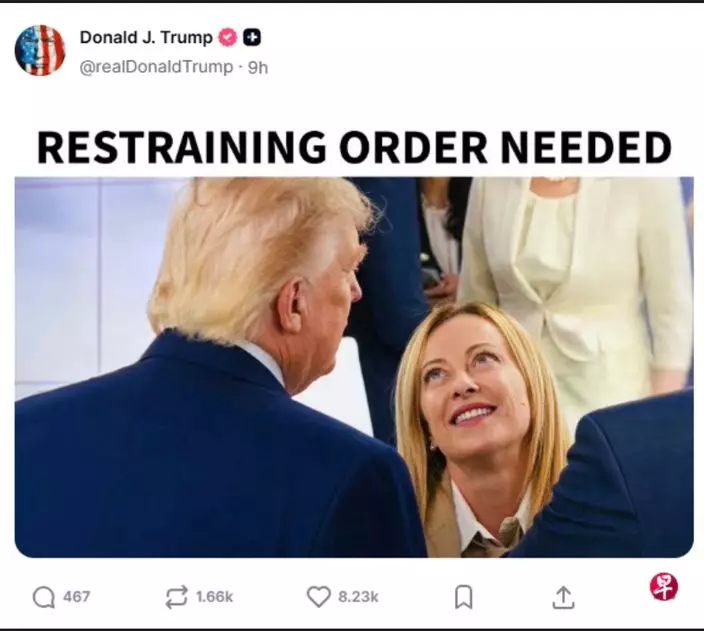
Trump posts Meloni photo: "Restraining order needed." Blatant insult.
Analysts see something more calculated at work here than a simple ego trip. Trump's insults are not just about satisfying a male supremacist mindset, they say. He appears to be using ridicule as a tool to assert dominance over female heads of state. Japan's Prime Minister Sanae Takaichi presents a striking contrast: she tolerates the same treatment, and even seems pleased with it.
Before departing for Turkey today for the NATO summit, Trump posted a photo on Truth Social showing Meloni looking up at him with what he framed as an adoring gaze. His caption read: "Restraining order needed." The image builds a false narrative, one where Meloni is portrayed as obsessively infatuated with him and needing legal intervention to stay away.
Crude by any diplomatic standard. A mix of suggestive language, condescension, and mockery. His team appears to have combed through countless photos of the two leaders, cropped and framed one fleeting moment, then dressed it up with provocative text to manufacture the illusion of Meloni's infatuation.
This is not the first time Trump has targeted her this way. After last month's G7 summit, he posted that Meloni "was probably happy I talked to her" and that "I wouldn’t have even done it, but I felt sorry for her." He went further, claiming she "begged me to take a picture with her". The remarks painted a head of government as an overzealous fan pestering him for attention.
Such flippant, degrading language is a serious affront when directed at the head of a sovereign government. Meloni rejected the claims immediately, calling them "completely fabricated." Her rebuke was sharp: "I do not know why the president of the United States behaves this way toward his allies — it is certainly not the first time this has happened. There is one thing he must remember: Neither I nor Italy ever beg."
Meloni's firm pushback won her applause both at home and abroad. Trump, rather than backing off, escalated instead. Analysts believe two specific grievances are fueling his renewed attacks on her, beyond his general appetite for belittling women.
First, Meloni opposed the U.S. strike on Iran and refused to let American warplanes use bases in Sicily. Second, when Pope Leo XIV publicly condemned the war, saying those who start wars have blood on their hands, Trump lashed out and accused the Pope of being "weak on crime." Meloni sided with the Pope on that occasion too, calling Trump's attack "unacceptable" and defending the Pope's condemnation of war as entirely justified. Those two stances reportedly angered Trump, and his renewed mockery looks like an attempt to settle the score.
Insults, ridicule, and verbal attacks are standard tools in Trump's diplomatic toolbox, used on friend and foe alike. He has deployed the same tactic against Japan's Prime Minister Sanae Takaichi, describing her as "she thinks I did a great job", carrying the tone of a fan idolizing a celebrity. Many Japanese citizens found the framing disrespectful toward their own leader.
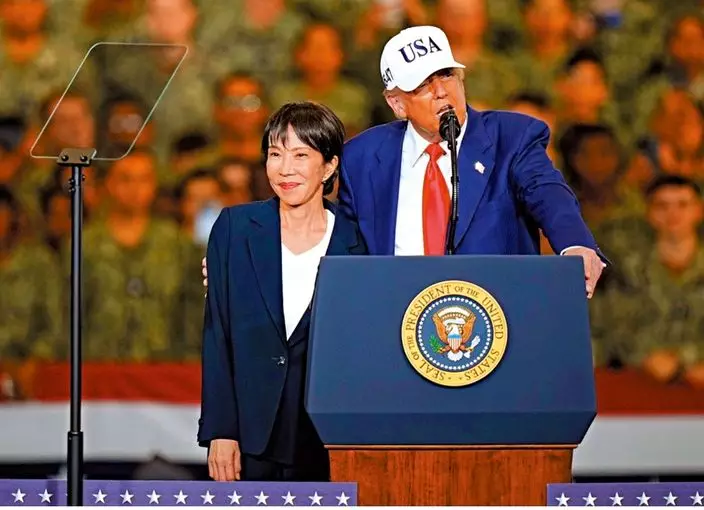
Takaichi: Trump's "number one fan." She's thrilled, unlike furious Meloni.
Unlike Meloni, Takaichi has shown no anger in response. She appears receptive, even pleased, effectively accepting the role of a devoted fan. Some Japanese citizens have criticized her for this, calling her overly pro-American and lacking in dignity.
Lai Ting-yiu
What Say You?
** 博客文章文責自負,不代表本公司立場 **
The US war on Iran is a broken record: strike, pause, strike again. Even Donald Trump can't find the off switch. But the real tragedy is playing out at sea. Thousands of sailors and airmen are trapped on carriers in brutal conditions. No return date. No escape. Their minds are fraying. Lives hang by a thread.

250-day deployment, no return date — sailors cracking, jumping overboard
Now US media reports a nightmare unfolding on the USS Abraham Lincoln. Sailors, driven insane by the endless confinement, tried to jump overboard. They wanted to end it all in the churning sea. Crew members stopped them just in time. They were saved from becoming lost souls in the angry waves.
More than 200 family members learned the truth and exploded. They confronted senior Navy officials, accusing them of treating sailors like disposable parts. The firestorm is just getting started. It will rage hotter. And it will eventually burn Trump himself.
The USS Abraham Lincoln left San Diego on November 21 last year. It loitered in the Indo-Pacific, then steamed to the Middle East just before the Iran war erupted.
That was more than 250 days ago. Since then, the carrier has barely touched land. A few days in Guam. A few in Oman. The rest of the time? Endless sea. And still, no return date.
For the 5,000-plus sailors on board, the agony goes beyond not knowing when they'll see home. The ship itself is falling apart. Toilets clog. Showers grow mold. Washing machines are dead. Even drinking water and food rations have been cut. This is daily life. It is inhumane.
Add relentless combat missions to the mix. The pressure is simply crushing. Everyone feels like they're trapped in a pressure cooker. Their mental state? On the brink of collapse.
Families Confront the Navy
The families had heard about the hardships onboard. They reached their breaking point. Last weekend, more than 200 of them held a grievance meeting in San Diego, angrily confronting Acting Secretary of the Navy Hung Cao.

Hundreds of families grilled Hung Cao. Firestorm heads for Trump
A family member named Loma spoke through tears. Her husband was one of the sailors who tried to jump overboard to commit suicide. He was rescued, pulled from duty, and is now in treatment. The ship's grievance department reached out once. Then silence. She's had only a few brief words with her husband since.
Another family member told another horror. Her husband saw a fellow sailor climb over the railing, ready to jump. He shouted, rushed forward, and dragged the man back onto the deck. He saved a life.
At the grievance meeting, the anguish was relentless. One mother, in tears, recounted a call from her daughter. The sailor's voice was hollow. She felt she would never go home. She might die on the ship.
Other families turned their fury on Hung Cao and senior Navy officials. Why was the USS Lincoln's combat mission being stretched endlessly? The ship was due back in May. Now the return date is a question mark. The Navy Department has never offered a specific timeline. That lit a fuse.
Hung Cao's answer was shameless. He said another carrier, the USS Roosevelt, would relieve the USS Lincoln. But he never gave a concrete timeline. The families, of course, refused to let it go.
The Navy's Impossible Math and a Political Firestorm
The Navy Department stood silent, absorbing the families' fury. But it had its own bitter truth to swallow. The USS Ford, the other carrier that had been operating alongside the Lincoln in the Middle East, pulled out in May after more than ten months at sea and a laundry room fire.
Now, only the Lincoln and the USS Bush remain in the region. Carriers from other areas can't be rushed in to relieve them. And with the Middle East war still boiling, the Lincoln has no choice but to keep enduring.
The US Navy faces a brutal math: ten bottles, seven lids. The endless Middle East wars keep it bogged down. So even when it knows a ship like the Lincoln is overloaded and its sailors are on the verge of collapse, it is helpless.
This endless delay is crushing the thousands of sailors on board. If the pressure keeps building, it will hit a breaking point. Then sailors may start taking their own lives, jumping into the sea one after another in protest.
Then the families' fury will erupt like wildfire. This fire will ultimately engulf Trump. He will be badly burned and left in a terrible mess.
Lai Ting-yiu