

Skip to Content Facebook Feature Image

National Security Fugitive Boards the Wrong Ship

Blog

National Security Fugitive Boards the Wrong Ship
Blog

Blog

National Security Fugitive Boards the Wrong Ship

2026-05-09 18:18 Last Updated At:18:20

The UK held local council elections today, with parties scrambling for some 5,000 seats in fiercely contested races. Labour faces a grim outlook — potentially losing a large number of seats, a setback that could kickstart calls for Prime Minister Keir Starmer's resignation. Yet if the anti-immigration Reform Party scores a landslide, BNO Hong Kong people will be no better off.
 
Also worth noting: 18 Hong Kong BNOs who have relocated to the UK are standing for election across various parties — among them, shockingly, Simon Cheng Man-Kit, a national security fugitive wanted by Hong Kong police.

National security fugitive Simon Cheng Man-Kit is running for Labour — and admits he's doing it for protection. Pure political opportunism.

National security fugitive Simon Cheng Man-Kit is running for Labour — and admits he's doing it for protection. Pure political opportunism.

His record is anything but clean. Cheng is one of the founders of the subversive organisation "Hong Kong Parliament" and a key figure among the anti-Hong Kong activist diaspora in the UK. His decision to align with Labour — and what he revealed in media interviews — lays bare a calculating, opportunistic political strategy. He may, however, have badly miscalculated by boarding the Labour sinking ship.
 
Cheng's background is deeply murky. During the 2019 Black Riots, he was employed at the British Consulate-General in Hong Kong — and was spotted operating on the frontlines of the riots in a mysterious capacity. He later travelled to the Chinese Mainland on what was supposedly official consulate business, only to be arrested by public security authorities on suspicion of soliciting a prostitute. Cheng vigorously denied the allegations, but the evidence against him — both witness and evidence were substantial.
 
After his release, he made a hasty exit to the UK, where he was swiftly granted political asylum. He wasted no time founding the "Hongkongers in Britain" to continue his disruptive activities, and successfully lobbied for government funding.
 
This time, Cheng is standing as a Labour candidate in the Queensbury ward in northwest London. When asked by the media why he chose to represent Labour, he was remarkably candid: "Since Labour is currently the governing party, we should all the more participate in it and seek change from within the system." From a purely pragmatic standpoint, he is not wrong — Labour remains in power, at least for now, making it the most advantageous vehicle to hitch a ride on.
 
Labour in recent years has been blowing warm winds toward Beijing, drawing fierce criticism from anti-China voices in the UK — and Cheng sits firmly in that camp. Doesn't backing Labour contradict his own stated position? He managed to have it both ways, saying that standing for Labour "does not mean I fully endorse the party's China policy; rather, I hope to change their stance by participating within the system."
 
He also openly admitted that personal safety and self-interest factored into the calculation: "As a political refugee, running for public office provides me with an additional layer of protection."
 
Political opportunists always do the maths — but they can get it spectacularly wrong. Labour has tightened immigration policy significantly in recent years, erecting barrier after barrier for BNO Hong Kong people seeking permanent residency and naturalisation. That has alienated Hong Kong people and other ethnic communities in the UK. Flying the Labour banner is, for Cheng, likely to do more harm than good.
 
Labour's economic record since taking office has been dismal — growth has stalled while inflation has surged, and public support has collapsed. The party is widely expected to shed thousands of seats in these local elections. The odds are very high that Cheng has indeed boarded the wrong ship.
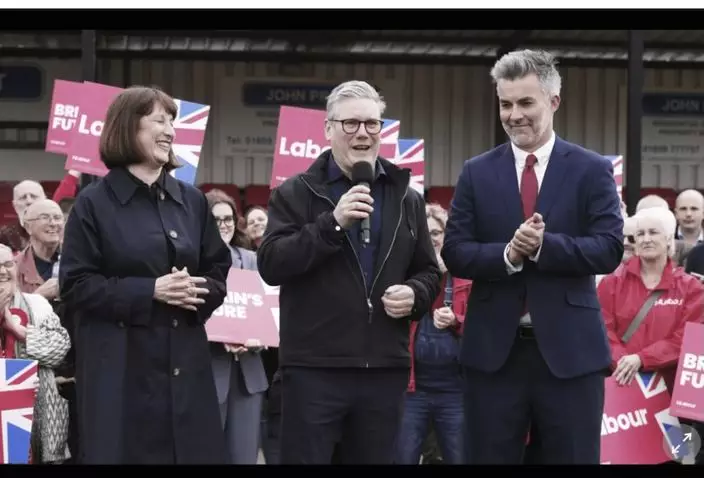
Labour is hemorrhaging support — and Cheng may have just boarded a sinking ship.

Labour is hemorrhaging support — and Cheng may have just boarded a sinking ship.

Cheng's opportunism extends well beyond the ballot box. Around the middle of last year, the government's "Welcome Hong Kongers" scheme was drastically scaled back — slashing annual funding to Hong Kong people's organisations from £2.6 million to £1 million. The “Hongkongers in Britain” took a major cut and was forced to pivot to fundraising, tapping into the pockets of Hong Kong people living in the UK.
 
In the scramble for funding, Cheng has repeatedly fed information to the media attacking rival activist organisations. He claimed that Cheung Hei Ching — leader of the "The Committee for Freedom in Hong Kong (CFHK) Foundation" and herself a wanted fugitive — is too politically opportunistic. He warned that Kwok Tsz-kin, founder of "The Hong Kong Scots (CIC)," has hidden motives and should be approached with caution. There is no subtlety in the infighting.
 
His willingness to bite the hand of fellow activists for personal gain mirrors exactly the same mentality behind his courting of Labour for a council seat. Together, these episodes reveal what truly lies beneath the political make-up of these anti-Hong Kong figures.

Lai Ting-yiu


What Say You?

** 博客文章文責自負,不代表本公司立場 **

The "butterfly effect" refers to two seemingly unrelated events, but after one thing happens, it is continuously amplified and has a chain reaction, causing the other to change dramatically. Trump recently announced the withdrawal of 5,000 troops from Germany, signaling that forces in Spain and Italy would also be drawn down. On the surface, this looked like straightforward cost-cutting — a lever to pressure Europe into paying its own defense bills. But the shockwaves crossed the globe and landed on Wall Street.

Bridgewater Associates founder Ray Dalio published an essay arguing that as US military bases continue to shrink, allies will begin to doubt America's "protective power" — and their appetite to buy its "debt currency" will follow. That, Dalio warns, could become the flashpoint for a US debt crisis.

Bridgewater's Ray Dalio warns: as US military bases shrink, so does confidence in the dollar.

Bridgewater's Ray Dalio warns: as US military bases shrink, so does confidence in the dollar.

Make no mistake: this is not empty alarmism. When America scales back its overseas military presence, markets read it as more than a strategic adjustment. It becomes a signal that the very foundations of American financial hegemony are shifting.

Since the war against Iran began, America's military shield in the Gulf has been breached repeatedly. Bases and interception systems have taken hits. The myth of invincibility has shattered. Control of the Strait of Hormuz remains firmly in Iranian hands — and Trump's murmurs that the US "won" ring hollow. Dalio argues that when global leaders begin to question whether America can still win, this reflects a deep underlying anxiety. In his view, if the US appears so overstretched in a localised conflict, the world's willingness to purchase the debt it issues will decline — and a shift in that supply-demand balance is precisely the trigger for a long-term debt crisis.

Trump's incremental troop drawdowns in Germany will also erode confidence in the dollar. Dalio argues that when America's role as the world's policeman comes into question — when its bases and security guarantees are doubted — allies begin to wonder whether American "protective power" can hold up in geopolitical competition. The international order has drifted toward the law of the jungle that "power determines the rules". Under these circumstances, Dalio believes investors should maintain an extremely balanced and diversified portfolio.

Trump pulls 5,000 troops from Germany — a butterfly effect that could shake the dollar's global throne.

Trump pulls 5,000 troops from Germany — a butterfly effect that could shake the dollar's global throne.

The link between dollar dominance and America's global military footprint is intimate. The US currently operates some 750 bases worldwide, with over 220,000 military and civilian support personnel. This is not merely a geopolitical deployment — this "protective umbrella" also underpins the dollar's security as the world's reserve currency. America's display of weakness in the Iran war has already damaged confidence in that umbrella. Further rounds of overseas troop reductions will, over the medium to long term, shake the very foundations of dollar hegemony.

Beyond the troop cuts, Iran's firm grip on the Strait of Hormuz is directly challenging the dollar's status. Dalio earlier cited Kenneth Rogoff — former Chief Economist of the International Monetary Fund — who noted that Iran is enabling China to purchase oil in yuan and pay transit fees in yuan. This will encourage other nations to follow suit, seeking to avoid US financial sanctions. The result: an accelerating pivot toward non-dollar currency systems and diversification strategies that, Dalio argues, will inevitably threaten the dollar's position.

This explains why US Treasury Secretary Scott Bessent recently lashed out, threatening companies contemplating paying Iran's "toll fees" with severe sanctions and zero tolerance. His outburst served two purposes: cut off Iran's financial lifelines, and prevent companies from transacting with Iran in currencies other than the dollar. Once that precedent is set, Bessent knows, there will be endless troubles.

The Trump administration knows the situation is grave and is desperately defending its financial hegemony. But you cannot hold back the rain. In a separate commentary, Dalio pointed out that this year may be the one in which the dollar begins to truly crack. Its safe-haven function is weakening for three reasons: markets are concerned that US debt levels are excessive; American protectionism is eroding trust in the dollar; and Federal Reserve policy has been highly volatile and unpredictable. If those cracks widen, the pressure on American financial hegemony will only intensify.

This does not even account for the outcome of the Iran war. If Dalio's words prove accurate — that the US is overstretched in this conflict and falls well short of Trump's proclaimed "overwhelming victory" — and troop reductions continue apace, global confidence in the dollar will inevitably decline. As Dalio predicts, when the supply-demand balance shifts, that will be the tiipping point of America's long-term debt crisis.

Lai Ting-yiu

Recommended Articles