The "butterfly effect" refers to two seemingly unrelated events, but after one thing happens, it is continuously amplified and has a chain reaction, causing the other to change dramatically. Trump recently announced the withdrawal of 5,000 troops from Germany, signaling that forces in Spain and Italy would also be drawn down. On the surface, this looked like straightforward cost-cutting — a lever to pressure Europe into paying its own defense bills. But the shockwaves crossed the globe and landed on Wall Street.
Bridgewater Associates founder Ray Dalio published an essay arguing that as US military bases continue to shrink, allies will begin to doubt America's "protective power" — and their appetite to buy its "debt currency" will follow. That, Dalio warns, could become the flashpoint for a US debt crisis.

Bridgewater's Ray Dalio warns: as US military bases shrink, so does confidence in the dollar.
Make no mistake: this is not empty alarmism. When America scales back its overseas military presence, markets read it as more than a strategic adjustment. It becomes a signal that the very foundations of American financial hegemony are shifting.
Since the war against Iran began, America's military shield in the Gulf has been breached repeatedly. Bases and interception systems have taken hits. The myth of invincibility has shattered. Control of the Strait of Hormuz remains firmly in Iranian hands — and Trump's murmurs that the US "won" ring hollow. Dalio argues that when global leaders begin to question whether America can still win, this reflects a deep underlying anxiety. In his view, if the US appears so overstretched in a localised conflict, the world's willingness to purchase the debt it issues will decline — and a shift in that supply-demand balance is precisely the trigger for a long-term debt crisis.
Trump's incremental troop drawdowns in Germany will also erode confidence in the dollar. Dalio argues that when America's role as the world's policeman comes into question — when its bases and security guarantees are doubted — allies begin to wonder whether American "protective power" can hold up in geopolitical competition. The international order has drifted toward the law of the jungle that "power determines the rules". Under these circumstances, Dalio believes investors should maintain an extremely balanced and diversified portfolio.

Trump pulls 5,000 troops from Germany — a butterfly effect that could shake the dollar's global throne.
The link between dollar dominance and America's global military footprint is intimate. The US currently operates some 750 bases worldwide, with over 220,000 military and civilian support personnel. This is not merely a geopolitical deployment — this "protective umbrella" also underpins the dollar's security as the world's reserve currency. America's display of weakness in the Iran war has already damaged confidence in that umbrella. Further rounds of overseas troop reductions will, over the medium to long term, shake the very foundations of dollar hegemony.
Beyond the troop cuts, Iran's firm grip on the Strait of Hormuz is directly challenging the dollar's status. Dalio earlier cited Kenneth Rogoff — former Chief Economist of the International Monetary Fund — who noted that Iran is enabling China to purchase oil in yuan and pay transit fees in yuan. This will encourage other nations to follow suit, seeking to avoid US financial sanctions. The result: an accelerating pivot toward non-dollar currency systems and diversification strategies that, Dalio argues, will inevitably threaten the dollar's position.
This explains why US Treasury Secretary Scott Bessent recently lashed out, threatening companies contemplating paying Iran's "toll fees" with severe sanctions and zero tolerance. His outburst served two purposes: cut off Iran's financial lifelines, and prevent companies from transacting with Iran in currencies other than the dollar. Once that precedent is set, Bessent knows, there will be endless troubles.
The Trump administration knows the situation is grave and is desperately defending its financial hegemony. But you cannot hold back the rain. In a separate commentary, Dalio pointed out that this year may be the one in which the dollar begins to truly crack. Its safe-haven function is weakening for three reasons: markets are concerned that US debt levels are excessive; American protectionism is eroding trust in the dollar; and Federal Reserve policy has been highly volatile and unpredictable. If those cracks widen, the pressure on American financial hegemony will only intensify.
This does not even account for the outcome of the Iran war. If Dalio's words prove accurate — that the US is overstretched in this conflict and falls well short of Trump's proclaimed "overwhelming victory" — and troop reductions continue apace, global confidence in the dollar will inevitably decline. As Dalio predicts, when the supply-demand balance shifts, that will be the tiipping point of America's long-term debt crisis.
Lai Ting-yiu
What Say You?
** 博客文章文責自負,不代表本公司立場 **
UK leadership churns faster than a revolving door. Six prime ministers in a decade — and the next one is already waiting in the wings.
The hot favorite is Andy Burnham, who has served as the Mayor of Greater Manchester for nine years. Known for his approachable, proactive, and upbeat image, he commands strong backing from a bloc of party MPs. His odds of moving into 10 Downing Street are extremely high.
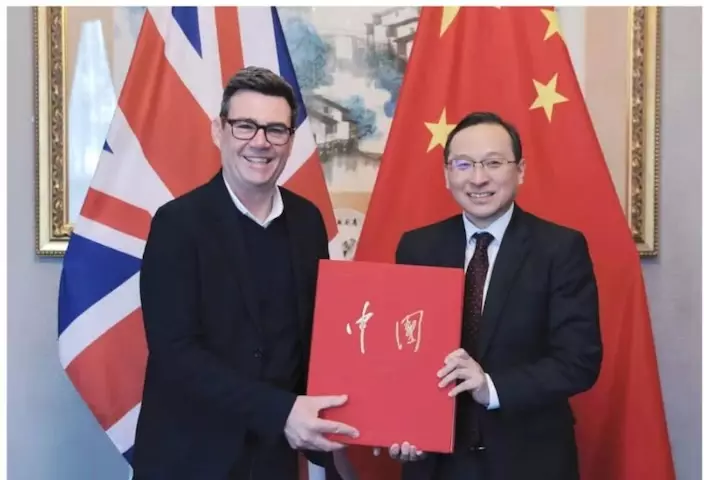
Andy Burnham, UK PM frontrunner, met Chinese Consul General Tang Rui in Manchester this April, sending exiled agitators into a conspiratorial frenzy
Burnham’s governing style and policy preferences differ considerably from those of the recently resigned Keir Starmer. But the two men share one trait: a friendly stance toward China and an active push for Sino-British cooperation. Burnham met with Tang Rui, the Chinese Consul General in Manchester, just months ago — and by all accounts, the conversation went very well.
That should have been excellent news. Instead, UK-based exiled HK agitators erupted in fury. They claimed Beijing had foreseen Burnham's rise to the premiership and placed an "early bet." An obvious, baseless conspiracy theory. Its real purpose: to drum up momentum and rally anti-China forces to pressure the incoming prime minister. A friend living in the UK cut straight to it — Burnham's voter base is rock-solid. He couldn’t care less about these people.
The moment Burnham announced his candidacy yesterday, HK exiles began digging into his record. The yellow media outlet PULSE HK scoured the Chinese Consulate in Manchester's website and found that Consul General Tang Rui had met with Burnham on April 17. Tang noted that bilateral cooperation had yielded positive results and declared this year to be a big year for bilateral cooperation.
The consulate also issued an English press release stating that during the meeting, Burnham "fondly recalled" his past visits to China and emphasized that "Greater Manchester attaches great importance to developing relations with China".
PULSE HK then cited an exile-leaning commentator's post to "deconstruct" the meeting, piling on even more conspiracy theories. The post alleged that Beijing had long read Starmer's "political life" as nearing its end. So Beijing locked onto the rising Burnham and placed its bets early in a calculated "advanced deployment" of "united front" diplomacy.
My UK-based friend tells a very different story. The reality is the ones truly "full of schemes" are the agitators themselves. Seeing Burnham's imminent rise, they want to strike first — smearing him with a "pro-China" label before he even reaches Downing Street. Their likely next move is to join forces with anti-China hawks in Parliament, launching a pincer attack from both inside and out to pressure the new prime minister.
Make no mistake: these two forces have been attacking Starmer relentlessly for years. Every time Starmer and his cabinet officials visited China, they unleashed a barrage of criticism. They also stirred up trouble over China's new embassy plan in the UK, organizing multiple protests where hawkish politicians routinely showed up: flag-waving and shouting alongside "black-clad protesters." Once Burnham takes office, they are expected to run the exact same playbook, pressing him to abandon his China-friendly stance.
That playbook is unlikely to work on Burnham though. First, his relationship with China has remained warmly positive throughout his time as Manchester's mayor. On the evening of April 27 this year, the Hallé in Manchester hosted a grand event celebrating the 40th anniversary of the sister-city relationship between Manchester and Wuhan. Consul General Tang Rui and senior city officials all attended — the atmosphere thoroughly friendly.
Second, Burnham has clear practical calculations at work. He wants to secure Chinese investment for Manchester and Northern England: expanding trade, economic, and technological cooperation to inject momentum into the region's sluggish economy. His investment promotion agency has already put in considerable groundwork, aggressively pitching the "Invest in Manchester" initiative to China. Once he becomes prime minister, he will almost certainly run the same calculation. Why would he shoot himself in the foot just because some agitator’s conspiracy theories?
Third, Burnham has accumulated enormous public goodwill over many years — enough to earn him the title "King of the North." In his eyes, UK-based Hong Kong BNO holders are simply insignificant. He couldn't care less about them. Pro-exile media "exposés" about his China-friendly leanings will have nearly zero impact on his political standing.
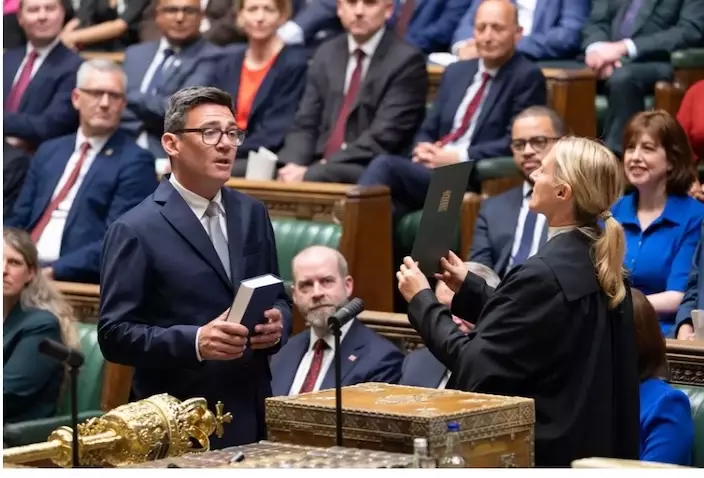
Burnham's voter base is rock solid. Anti-China agitators? Not worth losing sleep
The economic wreckage placed before Burnham is his real, monumental challenge. He has only ever managed a city of a few million people. Whether he has the capability to heal a nation of 30 million remains a very open question.
UK media drew on Oxford political scientist Ben Ansell's sharp analogy — likening Starmer to a doctor who walks up to a gravely ill patient, shakes his head, and mutters that someone really ought to do something. Yet for two years, Starmer produced no miracle cure to heal Britain.
The public now places its hopes in Burnham. At the very least, under his watch, Manchester became the fastest-growing city in the UK. But after watching several successive prime ministers fail to prescribe the right medicine, voters hold more doubts than confidence about what he can actually deliver.
As one UK commentator put it plainly: no silver tongue or man-of-the-people act can paper over Britain's deep-rooted structural cracks.