Trump finally got his wish. He met President Xi in Beijing on Thursday— and the Chinese side played its part impeccably. A full military guard inspection, a 21-gun salute, and children waving flags greeted him in a warm welcome. For a president who relishes grandeur, the ceremony must have felt deeply satisfying.
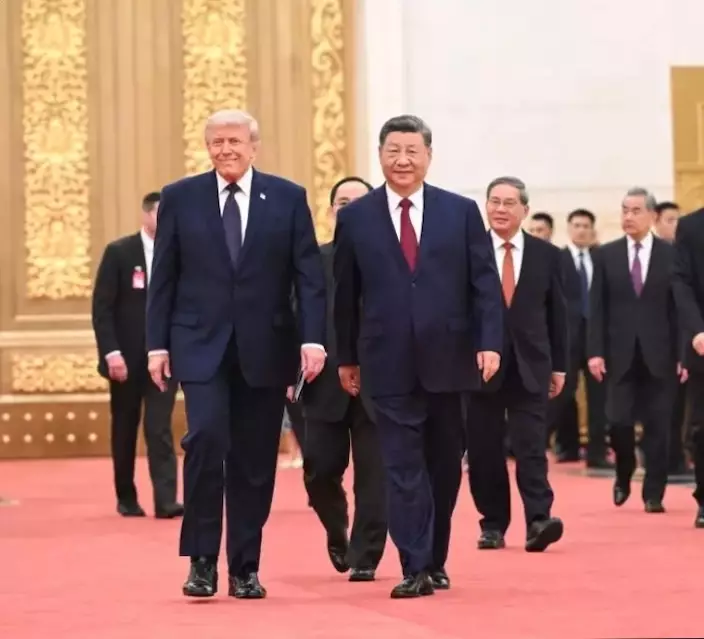
The NYT reads the Xi–Trump summit through Mao's On Protracted War — China has left the defensive phase and entered the stalemate. The balance is shifting.
But look beyond the ceremony, and the picture shifts. International media commentary broadly portrays Trump as the weaker party at this Xi–Trump summit. Reuters ran "How Trump's hand weakened ahead of Xi summit, in eight charts", documenting how his standing has declined across the board since the Busan Xi–Trump summit in October last year. His momentum has faded.
China, meanwhile, has moved from absorbing blows to projecting strength. The New York Times offered an even sharper verdict — reading the summit through the lens of Mao Zedong's On Protracted War. Its analysis concludes that China and the United States have entered the "stalemate phase" of strategic parity. Trump holds few strong cards, while China is actively building strength and biding its time for the "counteroffensive phase."
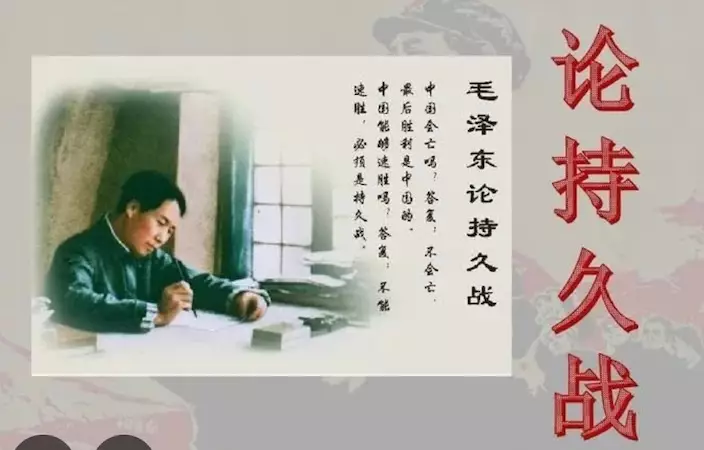
Written 88 years ago for a different war — Mao's strategy just guided China through Trump's tariff offensive. Now, China is building a counteroffensive.
On Protracted War, written during the War of Resistance against Japan, is far more than a historical classic — it is a guiding strategic doctrine for Chinese leaders confronting external threats. Before this summit, a New York Times article revisited a telling episode from last year. When Trump launched his tariff offensive against China, the official Beijing Daily called on readers to revisit Mao's 88-year-old work. Its core lesson: how China could prevail over a stronger adversary in a life-and-death struggle and ultimately turn the tide.
Make no mistake: this was no mere editorial position from a single newspaper. It reflected a directive from top leadership to prepare China for a "protracted tariff war" with the United States. The New York Times reports that President Xi has repeatedly praised the strategic foresight, discipline, and patience that Mao articulated in the text. Xi believes China should follow that framework when responding to US pressure. That conviction has endured — and it now shapes the strategic thinking behind this latest round of Xi–Trump engagement.
Mao divided the protracted struggle against Japan into three phases. The first is the defensive phase: China is weaker, relying on resilience and attrition while preserving its own strength. The second is the stalemate phase: both sides reach equilibrium, allowing for gradual advances and the accumulation of advantages. The third is the counteroffensive phase: once sufficiently strong, China launches a full-scale counterattack to secure final victory.
The New York Times analysis concludes that China's leadership has left the defensive phase behind and entered the second stage of Mao's framework — the stalemate phase. For President Xi, Trump's visit to Beijing is not a moment of lasting reconciliation. It is a temporary lull in a long contest of wills.
At this new strategic stage, Xi's goal is to buy time. The priority is to strengthen China while extracting as many concessions from Trump as possible — on tariffs, export controls, and arms sales to Taiwan.
Trump, by contrast, arrives in Beijing carrying fresh vulnerabilities. His war against Iran has consumed resources that would otherwise sustain long-term competition with China. His administration's cuts to US scientific research funding have further weakened America's relative standing. The result: Trump comes to the table without particularly strong leverage. He may still claim "victory" from the visit — but the reality is that the trip hands Xi additional bargaining power.
The New York Times author argues that Trump's strategic short-sightedness serves Xi's broader objectives. China is steadily advancing on all fronts. Once it becomes strong enough, it will move into the third phase of Mao's framework — the counteroffensive — and push toward ultimate victory.
This shifting balance is not a verdict unique to The New York Times. Reuters made the same case with hard data. Using a series of charts, it identified at least six areas where Trump's position has deteriorated since the October summit in Busan:
- Approval ratings on economic management fell from 35% to 30%.
- Inflation has risen above 4%, far exceeding the Federal Reserve's 2% target.
- Real incomes have declined.
- Gas prices climbed from $3 to $4.5 per gallon.
- The 30-year Treasury yield has surpassed 5%.
- The probability of rate hikes next year has reached 80%.
Several of these trends are direct consequences of Trump's aggressive move against Iran. That campaign has not only undermined his political standing — it has saddled the US economy with multiple structural problems that could significantly erode national power.
Lai Ting-yiu
What Say You?
** 博客文章文責自負,不代表本公司立場 **
America's press-freedom myth just took a serious hit. The Justice Department has subpoenaed four New York Times reporters over an alleged violation of federal criminal law. The FBI has opened its own investigation. Both moves target the paper's exposé on inadequate anti-missile defenses aboard the president's new plane.
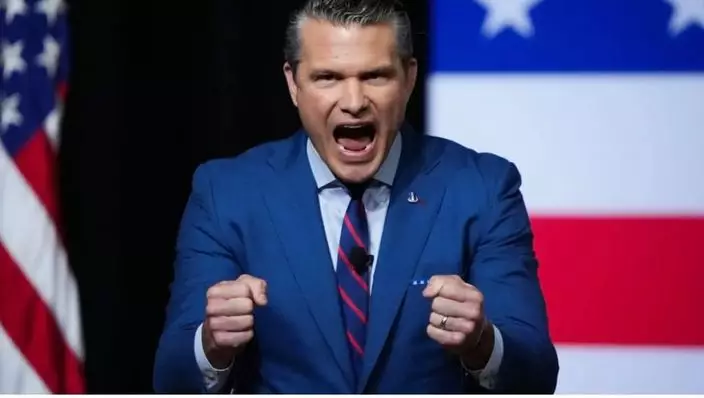
Defense Secretary Hegseth unveils "mole-hunt squad," vowing to root out leakers feeding reporters.
The White House has long nursed grudges against the press. Now, in a fury, it has escalated from threats to outright intimidation, deploying subpoenas and detentions alike. As the saying goes, there is no smoke without fire. Someone inside government must be leaking, and that conviction pushed Defense Secretary Pete Hegseth to announce a special task force. Working hand-in-hand with the Justice Department, the task force aims to root out the "moles."
The showdown between the White House and the press is only heating up, and the real fireworks may still lie ahead.
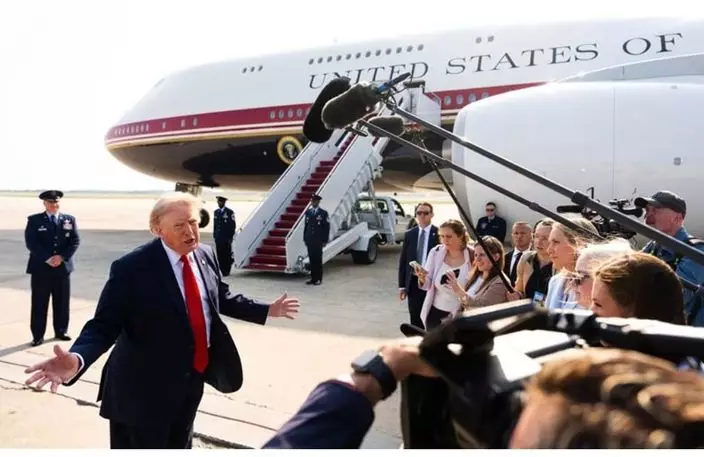
Trump's sudden switch to the old Air Force One after NATO sparked media exposés, igniting his fury and a subpoena crackdown.
The Plane-Swap Spark
The trigger behind this clash was the so-called "plane-swap incident." After Trump wrapped up the NATO summit in Turkey, his security team abruptly switched him onto the old Air Force One for departure. He skipped the new plane gifted by Qatar entirely, and that alone raised eyebrows.
The New York Times soon reported why. The new aircraft's missile-defense systems were inadequate, the paper said, posing a security risk that forced officials to fall back on the old plane. The White House flatly denied the report, and Trump reportedly flew into a rage. The Justice Department wasted no time, issuing subpoenas to the paper's reporters almost immediately.
There is more to this story. FBI agents reportedly showed up at the New York Times offices before the story even went to print. They demanded the paper pull the piece and reveal its sources.
The paper's leadership flatly refused. In response, the Justice Department broke with convention. Rather than identifying the leaker first, it went straight after the reporters with subpoenas, escalating pressure on the press.
This is not the first time the White House has tried to put reporters in the hot seat. Back in April, a US Air Force F-15E was shot down over Iranian airspace and the pilot went missing after ejecting. Both the New York Times and Axios covered the story.
Iran's military happened to launch a massive search operation around the same time. Whether the two events were connected remains unclear. Still, Trump was quick to blame the media, threatening to jail both the reporters and the leaker.
The White House apparently could not find hard evidence, so it ultimately took no action. That failure only deepened its resentment toward the press, and officials waited for the right moment to strike back hard. This time, the plane-swap incident gave the administration its pretext to wield the legal hammer, and it is determined to teach reporters a lesson they will not forget.
The Pentagon's "Mole Hunt"
The crackdown on "moles" by the Defense Department and the Justice Department has also ramped up. Hegseth posted a video on X yesterday announcing that the Pentagon has teamed up with the Justice Department to form a special task force. Its mission: hunt down whoever has been feeding information to the media, and anyone caught with solid evidence will face the full force of the law.
He said the Pentagon's Office of General Counsel can now require any department unit to hand over information and records tied to leak investigations within 48 hours. Full cooperation is mandatory, with no room for delay or evasion. He also issued a stern warning, declaring that "access to confidential and secret information is a sacred trust, and those who betray that trust will be met with the full force of the law".
Both Hegseth and Acting Attorney General Todd Blanche are die-hard Trump loyalists. That alone signals this crackdown comes directly from Trump himself, and it is designed to make heads roll, with some officials facing criminal charges. Even without hard evidence, suspects are still likely to be pushed out of their jobs.
The Pentagon has done this before. Last year it investigated several leak cases, resulting in a number of officials being suspended, including Deputy Chief of Staff Darin Selnick and Senior Adviser Dan Caldwell. Both have since quietly disappeared from their posts.
A Hunt That Cannot Succeed
Some analysts point out a hard truth. Hegseth may be on the warpath, but the Pentagon's "mole problem" could prove impossible to fully stamp out. Since Trump's return and Hegseth's takeover of the Defense Department, internal personnel purges have stirred up widespread resentment, making it easy for reporters to find disgruntled insiders willing to talk. With so many potential leakers around, there is no way to seal every crack.
Hegseth himself is not exactly clean either. Shortly after taking office, he got caught up in the "Signalgate" scandal, leaking secret plans for a US strike on Houthi forces in a group chat. That controversy caused quite the uproar. Having broken the rules himself, how can he expect his subordinates to keep their mouths shut without complaint?
Perhaps the funniest comment came from a netizen who suggested the task force should start by investigating the bartender at Hegseth's favorite watering hole. Given his well-known fondness for drink, the odds of him spilling military secrets over a few rounds are hardly low. In the end, they might just discover that the real "leaker" was Hegseth all along.