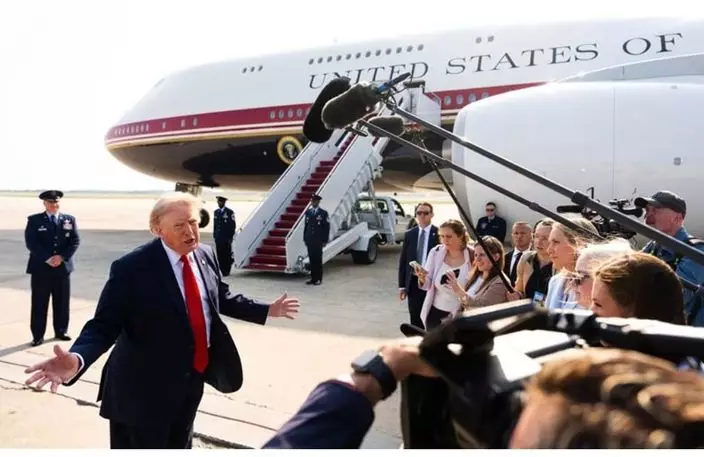

Trump had long anticipated his trip to Beijing to meet President Xi — and it has finally come to pass. He had originally hoped to arrive bearing a US-Iran peace deal as a diplomatic trophy. Instead, Iran bogged him down in a deadlock of "no victory, no war, no withdrawal," leaving him empty-handed and embarrassed.

The New York Times published a piece warning that the US military's weaknesses have been laid bare, eroding Trump's bargaining position ahead of his visit to Beijing.
The Iran campaign has laid bare a string of serious military weaknesses. Repeated setbacks on the battlefield, stretched weapons stockpiles, and heavily damaged bases have left the US military in a deeply uncomfortable position. The New York Times recently published a piece warning that America has been exposed — and that rivals now view it as a "lame giant" — materially undermining Trump's hand ahead of his meeting with President Xi.
Meanwhile, a Democratic senator, citing classified Pentagon documents, has gone public with a stark warning: key US weapons stockpiles have plummeted to critical alert levels. The Iran campaign has rapidly depleted advanced systems — including Tomahawk cruise missiles, the THAAD system, and Patriot interceptor missiles — and none can be replenished immediately. Should a conflict erupt in the Taiwan Strait under these conditions, America's military position would be extremely vulnerable.
The numbers are staggering. The New York Times, citing internal Pentagon estimates, reported that since the US launched its war against Iran in late February, America has expended roughly half of its long-range cruise missiles. The number of Tomahawk cruise missiles fired is approximately ten times the annual procurement volume. That is not just a statistic — it is a flashing red light.
Military analysts warn the implications go deeper than depleted shelves. The Iran campaign has not only drained vast quantities of ammunition, but has also shaken America's long-established dominance. More critically, it has exposed a fundamental flaw: in a sustained military conflict, US weapons production capacity falls far short of the rate of consumption.
The strategic damage extends beyond the Middle East. Analysts noted that if the US cannot achieve a swift victory even against Iran, it would face far greater difficulty prevailing against China — a near-peer adversary. That calculus, they argue, weakens Trump's position heading into his talks with President Xi.

The Iran war has bled US weapons stockpiles dry, with Patriot missiles hitting critical lows. The real culprit? A rigid government and a stubborn defense industry choking off production.
The New York Times also cited a Global Times editorial warning that if the US is unable to deploy its weapons globally, it risks becoming a "lame giant."
The roots of this weakness run deep. An earlier New York Times editorial offered a detailed breakdown, arguing that the Iran campaign has exposed the US military's inadequate real-world combat capability. The cause, the editorial argued, lies in prolonged dysfunction in government governance — dysfunction that has severely hampered military and defense industry reforms.
One glaring example is industrial capacity. The Tomahawk cruise missile — consumed at an extraordinary rate in this campaign — is manufactured by a single defense plant. Patriot interceptor missiles have faced chronic shortages for years. The country simply cannot produce battlefield-critical equipment at the required scale.
The editorial traced the problem to its source: a rigid government system and a defense industry resistant to change, allowing deep-seated problems to fester unchecked. Five major defense contractors dominate procurement. New technology companies find it nearly impossible to break into the supply chain. Defense Secretary Hegseth summoned defense contractors and pressed for sweeping reforms — but the Pentagon itself is mired in internal conflict and dysfunction, rendering the calls for reform little more than hollow slogans with minimal real impact.
The New York Times editorial candidly acknowledged that “The good news is that Congress, the administration and the Pentagon can all now see our military shortcomings. The bad news is that our adversaries can see them too.” Without decisive reform, the setbacks in Iran could prove to be "a preview of far worse."
Beyond media coverage, the alarm is now coming from inside the chamber. Democratic Senator Mark Kelly recently went public with damning disclosures: advanced US weapons stockpiles have plummeted to critical alert levels. Drawing on classified Pentagon documents, Kelly revealed that key systems — including Tomahawk cruise missiles, the THAAD system, and Patriot interceptor missiles — have been heavily depleted in the Iran campaign and cannot be replenished immediately.
Kelly warned that under these circumstances, should the US become embroiled in another conflict — including a possible confrontation with China in the Western Pacific — America's position would be extremely vulnerable. The US military would lack the capacity to sustain a war measured in months or years.
The fiscal situation adds yet another layer of peril. The Pentagon is awaiting congressional approval for additional defense funding to pay defense contractors and accelerate restocking of depleted weapons arsenals. Should legislators play politics and obstruct the process, the military could find itself in a dire "empty pot" predicament.
Make no mistake: China — America's principal strategic rival — sees these military shortcomings "just as clearly," as the New York Times editorial put it. Trump's visit to Beijing will therefore carry far less of the leverage it once might have commanded. His bargaining chips are considerably diminished.
Lai Ting-yiu
What Say You?
** 博客文章文責自負,不代表本公司立場 **