A fascinating wave of "extreme Sinicization" has recently taken hold on foreign social media. Some Americans catch the spotlight by cooking traditional Chinese breakfast porridge at home, beaming as they declare, "Day one of becoming Chinese." Others post videos riding motorcycles through Chongqing’s mesmerizing multi-layered traffic, full of admiration.

Still, others share homemade drinks featuring Chinese ingredients, feeling they’re living a particularly "Chinese" phase of life. These lively, everyday posts are simply young people capturing their cross-cultural experiences. But some Western media have stretched this into a so-called "cultural security incident."
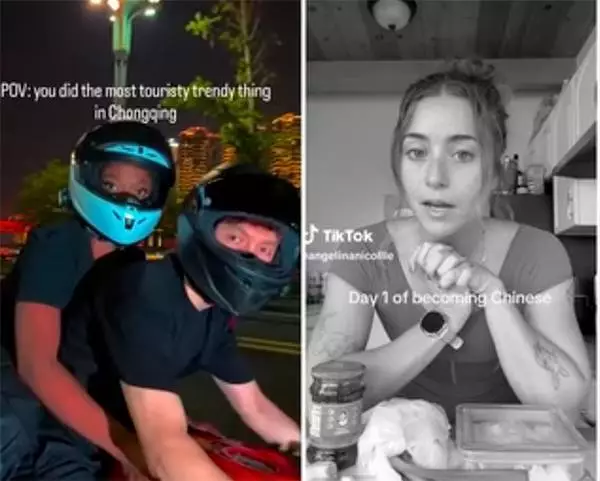
A recent article in the UK's Daily Telegraph captures this paranoia perfectly—this constant urge to "see conspiracy everywhere." While noting these videos "seem harmless," the report hastily brands their creators as "unwitting pawns in beautifying China’s image," even accusing them of "doing dirty work for China."
Their script is fixed: any China-related content that doesn’t criticize its political system must be "a carefully engineered propaganda campaign." The message is clear: you can only understand China through their narrow narrative; anything else means you are brainwashed.
The report also finds it baffling that, amid ongoing warnings from U.S. and U.K. governments about security risks and geopolitical tensions with China, these videos are surprisingly light-hearted and joyful—clearly a "staged facade." Western creators uploading this content to foreign platforms end up, whether knowingly or not, "boosting China’s national image and soft power."
What’s even more absurd is the report’s attempt to link this trend to Trump-era America. It claims some young Americans, frustrated by their own country’s realities, have turned their curiosity toward China, even joking about "learning Chinese to escape a declining America."
Events like nearly half a million users flocking to the Chinese app RedNote to vent after TikTok’s U.S. ban, or Chinese products such as the toy LaBubu sparking consumer demand in the West, are interpreted as deliberate Chinese efforts to "craft a contrasting narrative," painting the United States as a "dystopian society" weighed down by poverty and cultural decay caused by capitalism.
Western Media’s Suspicion and Double Standards
Reading The Daily Telegraph's article reveals its "pre-set script for interviews":
If you come to China, you must talk politics and geopolitical tensions—otherwise you’re accused of "deliberately avoiding controversy."
You can’t simply enjoy the food and culture, or you’re "fooled by appearances."
Your videos can’t be too light-hearted or happy, because with Western governments constantly warning about the "China threat," any joyful content must be a "carefully staged facade."
To be blunt, the "qualified" Western visitor they expect isn’t here to explore but to "complete political critique assignments." Yet a British blogger told the truth: "I have no interest in Chinese politics—I’m just here for the noodles."
A laughable double standard at its core. For years, Chinese people learning English, enjoying Hollywood movies, drinking coffee, and eating steak were seen through a Western lens as "embracing universal values" and "modernization," even praised as "progress." But when the roles reverse—Western youth voluntarily learning Chinese, loving Chinese food, and showing interest in China’s technology and urban life—they are immediately suspected of ulterior motives, scrutinized as "naively misled."
From hailing "nurturing and enlightening" flowing from West to East, to condemning "malicious infiltration" going from East to West. This measurement of cultural appeal is overly elastic.
Authentic Cultural Exchange vs Political Narratives
Ultimately, the collective "cracking" by certain media outlets reveals their deep anxiety over losing their monopoly on discourse. As China eases visa restrictions and platforms like TikTok and RedNote allow young people worldwide to bypass traditional media filters, they can see a complex, diverse, and vibrant real China with their own eyes.
The outdated narrative that has portrayed China simply as a "threat" or "misfit" for decades suddenly feels obsolete. These media fail to grasp that young people might genuinely find spicy hotpot delicious, Chongqing’s night skyline impressive, and China’s e-commerce logistics astonishingly fast.
This kind of authentic, personal identification is the toughest and most resistant form of cultural communication to "orchestrate."
This creates a striking modern paradox: on one side, countless ordinary individuals instinctively chase rich life experiences, naturally expressing admiration and curiosity through food, technology, and cityscapes; on the opposite side, certain opinion elites desperately wield the blunt instrument of "political propaganda," trying to label any positive portrayal outside their predefined narrative as "abnormal."
A simple truth: when you are used to boxing others into fixed demonized roles, any genuine glimpse of everyday life looks like a subversive "threat."
Beacon Institute
** 博客文章文責自負,不代表本公司立場 **
Zambia has just wrapped up a deeply contentious general election. Yet Washington's script proved even more gripping than the vote itself.

President Hakainde Hichilema secured re-election with roughly 60 percent of the vote, defeating his main opposition challenger, Brian Mundubile. To be fair, observers widely believe he would most likely have won even without the controversy. The problem is that the process itself was far from pretty. Vote tallies were allegedly inflated. Soldiers and police intervened. Opposition figures were arrested.
More controversial still: the moment the deadline expired for the opposition to challenge the results, Zambia's courts were suddenly sealed off. The door to judicial appeal slammed shut. Mundubile and several of his allies were subsequently hit with treason charges. And Mutotwe Kafwaya, a former minister, was shot dead during a police operation targeting opposition figures.
Had this happened in a country that refuses to toe Washington's line, the familiar script would already be rolling. The State Department statement would have been drafted long ago: "grave concern," "condemnation of democratic backsliding," "urging respect for human rights." Unilateral sanctions on Hichilema and the Zambian government might well have followed.
But this time, the Trump administration chose a different path.
Frank Garcia, the US Assistant Secretary of State for African Affairs, not only attended Hichilema's inauguration but also met privately with him. The State Department said it hopes to keep deepening its partnership with Zambia. As for the slain former minister, the shuttered courts and the opposition figures charged with treason, Washington simply "looked the other way."
The Answer Buried Underground
Why? The answer lies buried underground.
Zambia is one of Africa's most important copper producers. Copper accounts for around 70 percent of its export earnings. And with power-grid expansion, electric vehicles and AI data centers all driving up projections for copper demand, the metal is coming ever closer to being a strategic resource.
More critically, Zambia sits at the far end of the Lobito Corridor, a route Washington has spent years cultivating. The line is planned to run from the port of Lobito on Angola's Atlantic coast, through the Democratic Republic of the Congo, and all the way to Zambia's Copperbelt. One of its purposes is to move copper, cobalt and other minerals from south-central Africa to Western markets more easily.
Trump did not abandon this Biden-era project after taking office. In June this year, the US and Zambia even expanded a US$491 million aid program to cover critical-minerals infrastructure, funding road improvements along the Lobito Corridor.
Only a few months earlier, the two countries had publicly fallen out over minerals. Lusaka accused Washington of trying to bundle up to US$2 billion in health cooperation with preferential access for American companies to critical minerals, and flatly rejected those terms. In other words, the US has already demonstrated firsthand this year just how badly it wants into Zambia's mineral system.
Now, of course, the Trump administration will not pressure Hichilema over democracy. Cultivating a government that holds the copper, and controls a critical node of the Lobito Corridor, is what "American interests" really means.
The Stress Test of "Democracy Diplomacy"
The most riveting part of this show is not how transactional the Trump administration is. A businessman running a country with interests first is hardly surprising. The riveting part is that it has, quite by accident, run a stress test on the slogan of "democracy diplomacy."
For decades, the US has wielded "democracy," "human rights" and "free elections" as a diplomatic cudgel, swinging it at whichever country refuses to obey. But when that cudgel might land on an ally holding copper mines and railways, it suddenly grows feather-light. So light that Washington cannot even be bothered to utter a single phrase of "grave concern."
What Washington conceded was not the election result. After all, even observers admit Hichilema would most likely have won anyway. What it conceded was the entire package of procedural justice. The US put on a vivid demonstration: how a man wins does not matter. What matters is whether the winner is willing to talk copper.
For Jeanne Shaheen, the top Democrat on the Senate Foreign Relations Committee and a vocal Trump challenger, the logic runs the other way. Opposing the Republicans matters more. She declared that Zambia's post-election violence and arbitrary arrests already amount to "democratic backsliding."
Gregory Meeks, the top Democrat on the House Foreign Affairs Committee, demanded that Secretary of State Marco Rubio press for an investigation into Kafwaya's death and allow the courts to hear the election disputes. Against the Trump administration's hard-nosed calculus, these voices ring hollow and powerless.
Hichilema has probably figured this out too. For today's America, a Zambia that is less democratic but willing to talk copper and railways may well matter more. More than a Zambia whose political system better matches Washington's traditional values but refuses to cooperate on resources.
Business First, Democracy to the Back
This is the true ranking of democracy and human rights under an "America First" Africa policy: they are not principles but bargaining chips. When the chips can be traded for copper and corridors, they can be tucked away for now. When they buy nothing, they are hoisted high and swung like a club.
The Trump administration will never openly endorse Zambia's crackdown. That would look far too ugly. But its actions prove one thing: when business is on the table, democracy can move to the back of the queue. A US$491 million minerals-infrastructure program outweighs a diplomatic note about human rights. A single stretch of rail on the Lobito Corridor matters more than a slain opposition former minister.
So rather than calling this a contest over Africa diplomacy, it is better seen as a demon-revealing mirror. It lays bare the fathomless chasm between the political rhetoric of the US and the West and their real interests. The louder Washington shouts its "democracy" slogans, the more honest the copper beneath Zambia's soil appears. When it comes to real interests, every high-minded declaration is nothing more than a label that can be torn off at the weigh-in.
America has once again put on a masterclass in the beacon's double standards: business first, democracy to the back of the line. And the logic behind it is, of course, "America First."