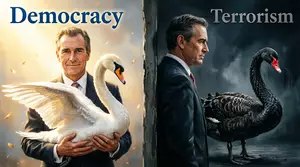
If there is one genre that best captures the dramatic tension of today's international political stage, it is the "US-Iran chess match." On April 17, a solemn diplomatic drama titled "Who Will Reopen the Strait of Hormuz" was reaching its climax. Then Donald Trump took to the social media, and the whole thing collapsed into farce.
Europe's Grand Gesture — and Its Limits
The scene: Paris. Led by France and the United Kingdom, more than 40 regional leaders sat upright in a video conference, solemnly debating how to reopen the Strait of Hormuz — the lifeline of the global economy. Senior officials from Germany, Italy, and other nations attended in person. The atmosphere was grave, the agenda packed. It looked like a "D-Day landing" to rescue the world economy was being planned.
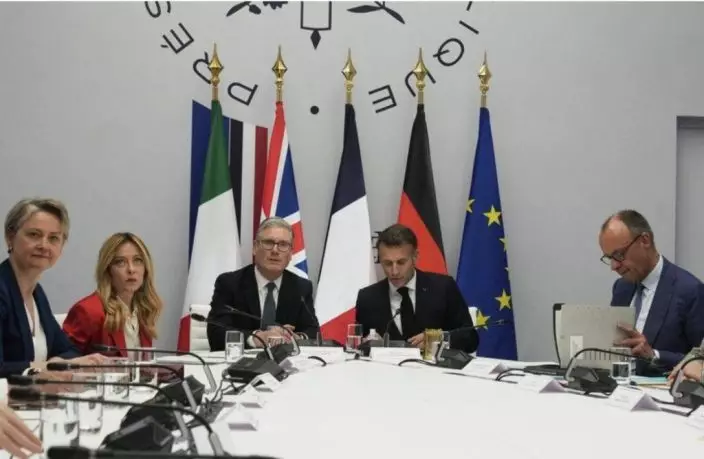
Then, midway through the meeting, whispers spread across the room. Off-camera aides rushed about anxiously, tapping their leaders on the shoulder and slipping handwritten notes onto the table. The cause? While these officials were racking their brains over solutions, Trump had — without warning — dropped a diplomatic bombshell on social media from across the Atlantic. He claimed to have reached a "breakthrough deal" with Iran, and that the Strait would fully reopen. In hindsight, it was yet another theatrical performance.
The irony cuts two ways. First, Europe "loses by taking it seriously." The UK, France, Germany, and Italy assembled a grand coalition of 40-plus regional leaders, hoping to resolve the crisis through multilateral diplomacy and collective wisdom. Trump's unilateral tweet rendered that earnest effort both solemn and hollow. Picture a team of engineers meticulously calculating how to repair a bridge — only for the someone to suddenly leap out and shout, "I've already fixed it!" The engineers are left staring blankly at one another.
Second, behind the diplomatic language of "cautious optimism" lies profound distrust. French President Emmanuel Macron said "recent developments are encouraging, but must be viewed with caution." UK Prime Minister Keir Starmer emphasised that any agreement must be "viable and durable." These carefully chosen words mask deep scepticism toward the Trump administration's credibility. After all, this is a president with a well-established track record of declaring "victory" even when negotiations have yielded no results. Europe's "caution" is, in reality, a vote of no-confidence in American leadership's reliability.
Trump's Tweet Diplomacy — and Its Depleted Credibility
Trump's social media timeline has become the command centre driving international affairs. The sequence unfolded fast. First, a single tweet unilaterally announced a "breakthrough deal" and the imminent reopening of the Strait. Then came the conditions: the naval blockade on Iran would remain in force until the "deal" was 100% executed — in other words, "I announce it's open, but my warships are still blocking the door." Then came the staggering claim: the United States would "take possession of Iran's enriched uranium without any financial exchange" — openly declaring, in effect, "I will take your core assets for free."
Iran hit back immediately. Iranian Parliament Speaker Mohammad Bagher Ghalibaf denounced Trump's seven posts within a single hour as "all lies," stressing that the Strait cannot remain open if the US blockade continues. The following day — April 18 — Iran's military announced that, due to the US "repeatedly breaking its promises," strict control over the Strait of Hormuz had been reinstated.
Consider what this episode reveals about modern diplomacy. An "agreement" that exists only in tweets: a complex negotiation touching on regional security, nuclear non-proliferation, and global energy supply — its key developments determined not by a joint communiqué or diplomatic note, but by the frequency and content of one leader's social media updates. This carries the absurdity of modern diplomacy to its absolute extreme.
Credibility has become a rare luxury. From announcing a deal, to immediately introducing self-contradictory conditions, to being directly accused of lying by the other party — the entire cycle completed itself within hours. As one widely shared quip put it: "The entire White House's credit score combined isn't enough to unlock a shared bicycle." Any promise or proclamation from Washington now arrives in the international community's eyes with a giant question mark attached.
"Maximum pressure" has become maximum self-delusion. US officials argue that Trump's high-profile posturing is a "negotiating strategy." But when a strategy repeatedly drains a nation's credibility until no one believes what it says, that strategy becomes a performance with no audience. Far from pressuring the adversary, it bewilders allies and leaves the United States trapped in a "boy who cried wolf" dilemma.
The Essence of This Black Comedy
Behind this spectacle lies a deeper picture with three distinct dimensions.
Europe's helplessness. Despite their deep misgivings about American unpredictability, the UK, France, and Germany can do little beyond expressing "caution." They have no capacity to bypass the United States and negotiate a binding agreement with Iran on their own. They cannot stop Trump from using Twitter to upend multilateral diplomatic processes. The vaunted consensus of 40-plus regional leaders proves utterly fragile in the face of unilateral American action.
America's self-centredness. Trump's tweets perfectly embody "America First" taken to its ultimate expression. International norms, allied coordination, and diplomatic conventions all yield to domestic political needs or personal negotiating style. The world must adapt to his rhythm and absorb the chaos he generates.
Iran's asymmetric counter-play. Faced with an adversary who disregards all established rules, Iran adopted the most direct response: you say what you want, we do what we do. You announce it's open, we reiterate our conditions. You maintain the blockade, we restore control. In the end, after all the paper noise, control over the Strait has not in any practical sense changed hands.
A Drama With No Winners
This "Strait of Hormuz Rashomon" has no true victors. Europe displayed the impotence of its supposed solidarity. America squandered whatever credibility it had left. Iran struggled to manoeuvre under the weight of great-power pressure. And yet, the show must go on.
Europe will continue holding "solemn" meetings. The American president will continue issuing "bombshell" tweets. Iran will continue issuing "resolute" denunciations. This is a genuine portrait of contemporary international politics: on one side, earnest efforts that achieve nothing; on the other, arbitrary actions that drain all credibility. When the capriciousness of hegemonic power becomes the norm, multilateral coordination is reduced to mere wallpaper.
The reality is: this episode is less a comedy than a mirror — one that reflects the many absurdities of a world order in the process of breaking down. The show continues. But the audience stopped laughing long ago.
Beacon Institute
** 博客文章文責自負,不代表本公司立場 **