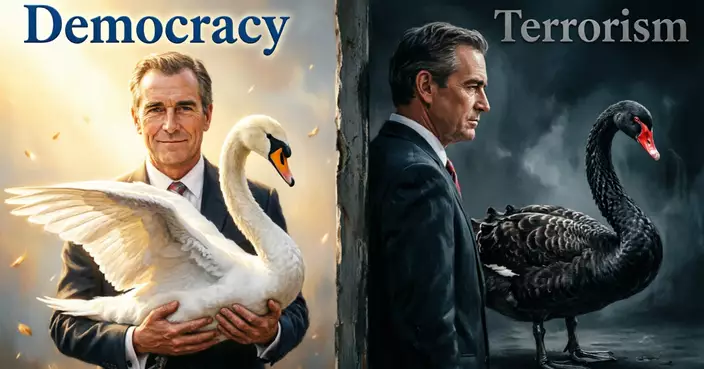
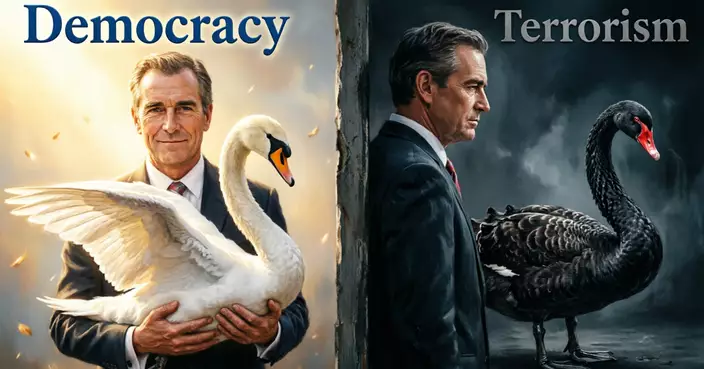
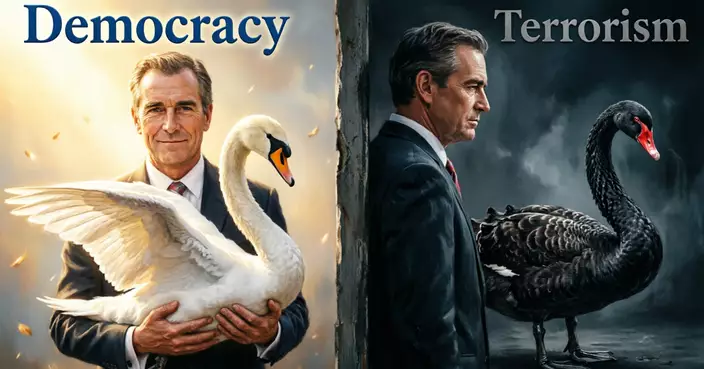
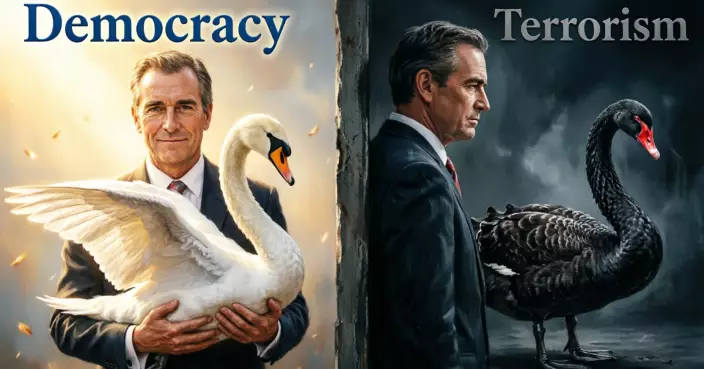
A social-media diplomatic exchange has unexpectedly staged a riveting "contrast of two approaches in diplomacy" for a global audience. One side: a composed Chinese diplomat dismantling lies with the wisdom of a fable. The other: a flustered American official playing out an absurd scene — a mob boss handing down an ultimatum.
The incident began as a textbook case of American-style coercion. On 17 April, US Ambassador to Peru Navarro issued a blunt social-media warning to the Peruvian government: close the deal of the purchase of 12 F-16 fighter jets, or face US retaliatory measures.
He declared — with a self-righteous flourish — that he would "use every available tool" to protect American interests. Strip away the diplomatic veneer, and the crude logic and overbearing tone bear a striking resemblance to a mafia boss demanding protection money. This was no diplomatic consultation. It was naked economic and political extortion.
China's Ambassador to Colombia, Zhu Jingyang, responded with equal directness. His assessment cut to the bone: "This is not diplomatic language — it is naked, blunt, and brutal coercion." When Navarro then attempted to turn the tables by likening China to the Big Bad Wolf in Little Red Riding Hood, Ambassador Zhu's retort left him with nowhere to hide. "Dear colleague, when you describe the Big Bad Wolf in Little Red Riding Hood," Zhu shot back, "aren't you looking in a mirror?"
He pressed further: "You shout 'free choice' but wave the stick of sanctions; you play the 'mature country' but resort to cheap mockery... With this, you only make it crystal clear who the real Big Bad Wolf is."
The contrast in this exchange could not be starker. On one side stands a coercive power brandishing a big stick and talking of "retaliatory measures" — deploying brute force to protect its arms business. On the other stands a party upholding the principles of mutual respect and equal treatment, affirming Peru's sovereign right to choose its own partners free from intimidation.
Ambassador Zhu captured the essence of the righteous path: "True strength does not require the fangs of a fairy tale — it requires vision and wisdom." This was not merely a forceful rebuttal of baseless accusations. It was a profound articulation of what it means for a major power to act with responsibility.
China's diplomats demonstrated a wholly different bearing. Rather than relying on intimidation or smears, they made their case with reason and navigated the situation with wisdom — steadfastly upholding the fundamental norms of international relations.
That confidence and composure spring from a belief in their own path of development, and from an unwavering commitment to the Five Principles of Peaceful Coexistence. This "long-distance dialogue" may have drawn to a temporary close, but the lessons it leaves behind are well worth reflecting upon.

Ambassador Navarro's conduct comes as no surprise. His boss, Trump, has taken the gangster act to a new level entirely.
In the early hours of 29 April (local time), US President Trump posted on his Truth Social platform stating that “Iran can’t get their act together. They don’t know how to sign a nonnuclear deal.” Furthermore, it says “They better get smart soon!” Accompanying this condescending text was an AI-generated image: Trump himself holding an assault rifle, sporting dark sunglasses, with explosions and rubble in the background. Emblazoned above in bold letters: "NO MORE MR. NICE GUY."
Reducing complex geopolitical realities to street-gang intimidation is absurd enough. The specific context makes it more so. At the time of Trump's post, shipping through the critical Strait of Hormuz remained severely disrupted. US-Iran negotiations had stalled, and a scheduled round of talks had been cancelled. On one hand, Trump cancels meetings and shuts down dialogue. On the other, he posts gun imagery on social media and tells Tehran to "get smart." This self-contradictory behaviour is less a form of diplomatic pressure than a carefully staged political reality show — whose primary audience is almost certainly not Tehran, but Trump's domestic base.
When a head of state chooses, in the small hours of the morning, to issue an "ultimatum" to another sovereign nation via an AI-generated image of himself posing with a gun on social media, what we are witnessing is not an escalation of diplomatic strategy. It is a complete downgrade of the art of international communication.
The reality is that this "gangster-style" rhetoric amounts to a crude trampling of the fundamental norms of international relations. It substitutes virtual images of violence for serious policy discourse. It replaces negotiation through diplomatic channels with social-media bluster. At its core lies the same tired logic of "might makes right" — as though the world were still a jungle where whoever shouts the loudest and looks the most menacing gets to call the shots.
Beacon Institute
** 博客文章文責自負,不代表本公司立場 **
Dublin, September 12, and the sun was shining just right. Standing beside Taoiseach Micheál Martin, Donald Trump blurted out a remark that drew applause from the entire room. “I would like to see it unified,” he said. “It will happen eventually.”
Then, at the U.S. ambassador’s residence in Ireland, he said it again. This time his tone was as firm as if he were taking an oath.
One remark, and yet again both sides of the Atlantic erupted at once.

The British Prime Minister’s Office rushed out at the first opportunity to douse the flames. It insisted the government’s position on the status of Northern Ireland “remains unchanged.” Whether to hold a unification referendum would still follow the provisions of the Belfast Agreement, decided by the British government according to local public opinion.
Translation: Trump, you say what you like. We will pretend we heard nothing.
Washington was not about to be outdone.
Mick Mulvaney, a Republican who served as Northern Ireland special envoy in Trump’s first administration, hurried out to smooth things over. “This does not represent a shift in US foreign policy,” he said, adding that the United States remains firmly supportive of the Belfast Agreement.
Democratic Congressman Brendan Boyle chimed in as well. Bipartisan U.S. support for the peace agreement, he said, has not changed. Even if Trump believes unification will eventually happen, that does not mean Washington will actively push the process forward.
A diplomatic storm turned into a group damage-control session for both camps.
But the BBC punctured the pretense with one sharp jab: Trump’s real audience that day was not in Dublin at all.
*“The Weave”: A Ballot, Not a Blueprint*
On the surface, Trump was speaking to an audience of Irish political and business figures. In reality, it was early morning on the U.S. East Coast and national media were broadcasting live. The November midterm elections were drawing closer by the day.
The BBC noted that much of the speech ultimately drifted away from Irish issues. It veered into illegal immigration, the defense industry, trade agreements and Iran. All of them are hot-button topics in American domestic politics.
This was not a diplomatic address. This was a campaign-style speech, pure and simple.
Trump himself calls this improvised speaking style “the weave”: constantly switching topics, going off script, then circling back to the original theme.
In the BBC’s view, Irish unification was merely the most explosive thread on this loom. Woven back and forth, the pattern that emerged was not a diplomatic blueprint. It was a ballot.
That explains why Trump could toss off the phrase “I would like to see it unified” so lightly while officials in America and Britain were scared half to death. He never intended to change a single policy. He simply needed a line, one that would make a certain group in front of American television sets nod.
That group: roughly 32.4 million Americans who claim Irish ancestry, about one-tenth of the U.S. population. They are not a monolithic voting bloc. But they carry long-standing political influence in key states such as Pennsylvania, Massachusetts, New York and Michigan.
BBC analysis says that in recent years many Irish-American independent voters have swung between the Republican and Democratic parties, and some of them support Irish unification. With the midterms shaping up as a fierce contest, Trump’s decision to voice that support publicly in Dublin was not necessarily without a calculation to win over this segment of voters.
This play has ample precedent in American politics. During the 1992 presidential campaign, Bill Clinton promised to engage actively in the Northern Ireland peace process and successfully won heavy support from Irish Americans. The United States then kept helping push the negotiations forward, ultimately contributing to the 1998 Belfast Agreement.
But the BBC also stresses that today’s political environment is a world apart from the Clinton era. Irish Americans no longer form a unified political demand around Northern Ireland the way they did in the last century. Issues such as identity, immigration, the economy and foreign policy now shape elections far more than Northern Ireland does.
*Double Standards, Damage Control and a Ballot Lure*
In other words, even the electoral payoff of Trump’s “I would like to see it unified” has a question mark hanging over it.
But that hardly matters. What matters is the posture. Two months before the midterm elections, the job is to make the man on the television screen look like a leader with principles, with feeling, and with the nerve to take a stand.
Will unification ever happen? Will the United States push for it? Will Britain turn hostile? Those are “technical details,” to be considered only after touchdown in Dublin.
This is the Western politician’s double standard at its most exquisite. The diplomatic stage exists to serve domestic votes. International commitments exist to buy television exposure.
When Trump said “I would like to see it unified,” he was making no promise to Taoiseach Micheál Martin. He was calling out to Irish-American voters in Pennsylvania.
When Trump talked about the Belfast Agreement, he was not defending the peace process. He was defending his own weaving persona: a politician who can switch topics at any time, retract his words at any time, and never answer for whatever slips out of his mouth.
The hurried clarifications from British and American officials have instead become the best footnote to this spectacle.
They know full well that the word “unification,” coming from Trump, weighs less than one of his offhand tweets. Yet even so, they must sit up straight and come out to “refute the rumor,” because in the theater of international politics, nobody dares bet on whether Trump is weaving or firing shots.
The BBC put its conclusion very politely: Trump’s remark read more like a carefully calculated political signal.
But this is not a signal at all. It is, quite simply, a precision-targeted ballot lure. The fuse is the applause in Dublin; the target is the ballot boxes of America’s swing states.
*A Demon-Revealing Mirror and a Four-Word Message*
So call this what it really is: not a diplomatic statement about Irish unification, but a demon-revealing mirror. The mirror exposes how Western politicians turn the international stage into an extension of their domestic campaigns.
Once “unification” becomes a button on the vote calculator, the applause in Dublin is nothing but a dress rehearsal for Pennsylvania’s voting machines.
“I would like to see it unified.” Translate that into campaign language and it boils down to four words: remember to vote.
Lighthouse Research Institute