A large intelligent computing center in Zhengzhou, capital of central China's Henan Province, started operation on Sunday with a current computing power of 2,000 PFLOPS.
The center will help promote industrial innovation and regional economic development.
The Henan Airport Intelligence Computing Center is designed as a Tier 1 data center. It includes 15 modular data rooms to meet the high-end training computational needs of enterprises involved in large model research and development.
Computing power refers to the volume of computational tasks a computer system can complete within a unit of time. One PFLOP, or petaFLOP, equals one quadrillion floating-point operations per second.
"The computing power has reached 2,000 PFLOPS. The computing center has been used for the research, development, application, and training of large models on government affairs, health care, and education," said He Xiangpeng, business manager of the computing center at the Zhengzhou Airport Digital City Development and Construction Co., Ltd.
By the first quarter of 2024, the computing power of the center can reach 10,000 PFLOPS. Once the first phase of the center is fully completed, it will achieve a computing power of 30,000 PFLOPS, effectively filling the gap in Henan's super large intelligent computing center domain.
"The applications of the intelligent computing center are very extensive, covering a variety of fields including smart manufacturing, smart cities, smart healthcare, financial technology, and sci-tech innovation. This diversification of applications can drive industrial innovation and regional economic development," said Wei Wenpu, deputy general manager of the Zhengzhou Airport Digital City Development and Construction Co., Ltd.
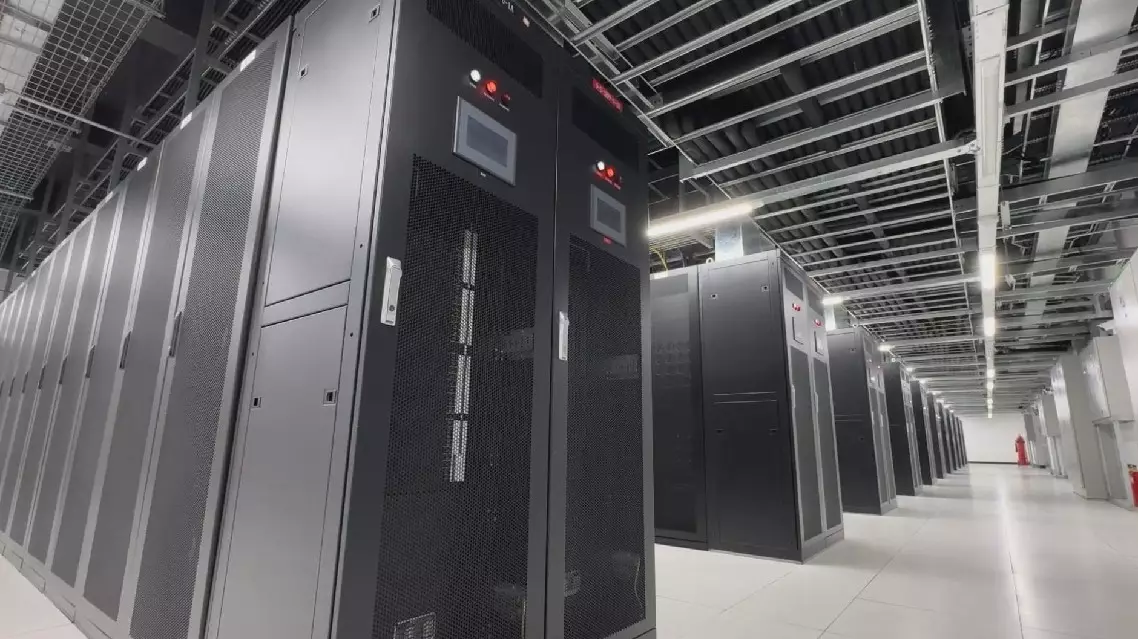
Intelligent computing center in China's Henan to boost regional economy

China is aiming to transition its ambitious space program from a strategic goal into a core economic driver, with the country vowing to integrate the advances of its aerospace technology into everyday life, from broader satellite internet coverage to even offering affordable commercial space travel.
China's recently unveiled 2026 government work report has officially designated aerospace as a "new pillar industry" for the first time, elevating it from a "strategic emerging industry" to a status akin to high-speed rail and 5G technology, highlighting how integral and well developed the sector has become.
The report was delivered by Chinese Premier Li Qiang last Thursday during the opening meeting of the fourth session of the 14th National People's Congress (NPC), the country's top legislature, part of China's annual "two sessions" political meetings, which also includes the National Committee of the Chinese People's Political Conference (CPPCC), China's top political advisory body.
The upgraded status of the aerospace sector outlined in the government work report signals the country's intent to turn its lunar dreams and orbital infrastructure into tangible economic benefits that can reshape people's daily lives.
China has already made remarkable progress in recent years through its space exploration endeavors, with the Tiangong space station becoming fully operational and occupied by a continuous rotation of astronaut crews in orbit, the Chang'e 6 mission retrieving mankind's first ever lunar samples from the far side of the moon, and a rover being successfully touching down on the surface of the Mars.
Now China's most eye-catching immediate goal is to land astronauts on the moon by 2030, with a long-term vision of building a lunar base. The mission aims to conduct scientific surveys and technology tests on the lunar surface, while also serving as a platform for enhanced crewed exploration capabilities. The broader goal sees the moon being envisioned as a future transit station for launching deeper space travel, making science-fiction dreams a reality.
Currently, the development of key equipment for undertaking this mammoth mission such as the Long March-10 carrier rocket, the Mengzhou spacecraft, and the Lanyue lander, is progressing smoothly, with multiple large-scale tests already completed. The construction of related facilities at the Wenchang Space Launch Site on south China's island province of Hainan is also being vigorously advanced.
While China is setting its sights on the stars, it is also looking to bring the benefits of its outer space developments back to those on Earth. The country is accelerating the construction of a "satellite internet constellation" in low Earth orbit to achieve global coverage -- a key priority specifically highlighted in the government work report.
Currently, constellation projects represented by the Guowang, or national network, and the Qianfan, also known as the SpaceSail constellation, have entered an intensive deployment phase. These initiatives are driving collaborative innovation across the entire industrial chain, including in developing new materials, precision manufacturing, electronic information, and data applications, unleashing a powerful "chain-driven" effect.
Once the satellite internet system is complete, ordinary mobile phone users will be able to connect directly to satellites, even when in areas which now suffer from poor coverage, making the concept of "never losing signal" a potentially standard feature. Autonomous driving positioning will become more precise, and in the event of ground network disruptions caused by natural disasters, the satellite network could serve as a critical lifeline.
Meanwhile, the advances made in re-usable rocket technology could soon make the once far-fetched notion of regular space travel a viable commercial concept. Historically, rocket launches were prohibitively expensive "customized charter" flights, but breakthroughs in reusable rocket technology are drastically cutting costs, as some note the era of the "space shuttle bus" is now approaching.
The latest generation Long March-10 rocket recently completed a key low-altitude verification test flight, successfully executing a controlled splashdown at sea, representing substantial progress in work to implement reusable launch systems.
Domestic commercial space companies have already begun pre-selling tickets for suborbital flights and have signed contracts with several enthusiastic space tourists, showcasing that a "ticket to the stars" could one day become accessible to members of the public.
Several NPC deputies and political advisors have noted during the "two sessions" meetings in Beijing that China's space sector is moving from technological imitation to independent leadership, with some innovations having ventured into "uncharted territory."
As a newly-designated national pillar industry, China's aerospace sector is leading the way towards a future of seamless connectivity and may even offer the ultimate round-trip experience to space.
China's space ambitions to become core economic driver with seamless connectivity, commercial space travel