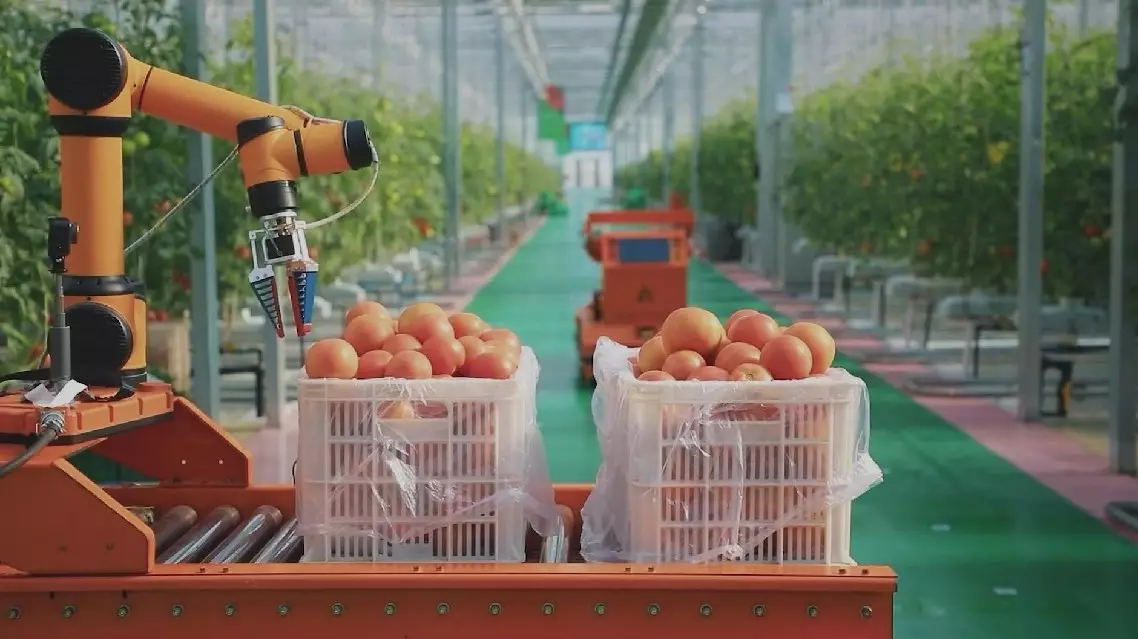
Shouguang City in east China's Shandong Province has set a model for agricultural transformation, using innovative techniques to achieve self-reliant, standardized, sustainable and smart production of high-quality vegetables that are both healthy and environmentally friendly.
Hailed as "China's vegetable capital," it is home to the biggest vegetable production and wholesale market in China.
Inside a greenhouse of the city, red cherry tomatoes are thriving.
"Recently, we've been harvesting 150 to 200 kilograms a day. Look at the leaves. They're much better than before. The leaves are greener. There are fewer pests and diseases," said a local vegetable grower while showcasing the cherry tomatoes she grows.
Besides cherry tomatoes, almost every town in Shouguang has a vegetable industry of some kind.
Now Shouguang's vegetables are in great demand all over the country. However, in the past, vegetables grown in Shouguang were for a long time being eclipsed by foreign varieties, according to Li Xishi, a planting technician from Shouguang Vegetable Hi-Tech Demonstration Park.
Pesticides with relatively high toxicity were used to achieve better results, which was dangerous for both food safety and for the land, Li said.
Li highlighted significant advancements in agricultural practices, noting the shift towards low-toxicity pesticides with low residue, alongside a greater emphasis on physical pest control and the use of organic fertilizers to improve soil structure.
Moreover, modern and digital technologies are driving green and standardized production, with local greenhouses equipped with smart devices interconnected through the internet, Li said. A greenhouse in the city has achieved real-time control of temperature and root absorption to detect slight bacterial infection on vegetables.
"The spots are because a previous heatwave caused a slight bacterial infection. This is bacterial infection. But now, based on this temperature, based on the root absorption, we have real-time control. Now, its softness and growth points are quite normal. You can say that it's full of vitality," said another vegetable grower while explaining why there are spots on vegetables.
Starting in 2010, the city began to attract talented individuals, increase investment, and boost the research and development of vegetable seeds to reduce cost of planting and reliance on imports.
"Because seeds are the chips of agriculture. Now, an increasing number of scientific research institutions, even enterprises, are starting to research how to develop new varieties. In Shouguang, over 70 percent of seeds used are classified as independent intellectual property. It also solves the long-term situation of being monopolized by foreign varieties," Li said.
China's vegetable powerhouse paves way for self-reliant, smart farming