A high-speed railway linking Shanghai, Nanjing of Jiangsu Province and Hefei of Anhui Province in east China has achieved key construction milestones, with part of a massive bridge achieving closure and another part successfully rotating to its desired position.
On Thursday afternoon, in Nanjing, the final steel box girder of the cable-stayed bridge spanning the over-100-meter-wide Chuhe River was successfully hoisted and installed, marking the closure of the main span of the Nanjing Grand Bridge.
The bridge and its connecting roads are located on the north bank of the Yangtze River, with a total length of approximately 14 kilometers. The bridge's construction began in 2023.
"This is a double-tower, five-span, hybrid girder cable-stayed bridge. During the preliminary stage, we simulated key construction processes through 3D modeling to mitigate potential risks in advance. Through modular management, we improved the efficiency of installing steel box girder by 30 percent," said Geng Xuqiu, technical director of the Nanjing Grand Bridge of high-speed railway linking Shanghai, Nanjing and Hefei.
Another part of the massive bridge rotated to its targeted position across the Beijing-Shanghai railway on Wednesday, and precisely connected with the main line of the high-speed railway linking Shanghai, Nanjing and Hefei, which is currently under construction. "After the bridge rotates to its desired position, it will open the beam erection passage from Jiangsu Province to Anhui Province, improving the efficiency of subsequent construction," said Ding Yuhang, an on-site safety manager.
The Shanghai-Nanjing-Hefei High-Speed Railway, which starts in Shanghai, passes through several cities in Jiangsu Province before entering Anhui Province.
The line, which is approximately 554 kilometers long with a designed speed of 350 kilometers per hour, serves to promote the high-quality, integrated development of the Yangtze River Delta region.
The railway is part of China's high-speed rail network that centers around eight main vertical lines linking the north and south and eight horizontal lines connecting the east and west.
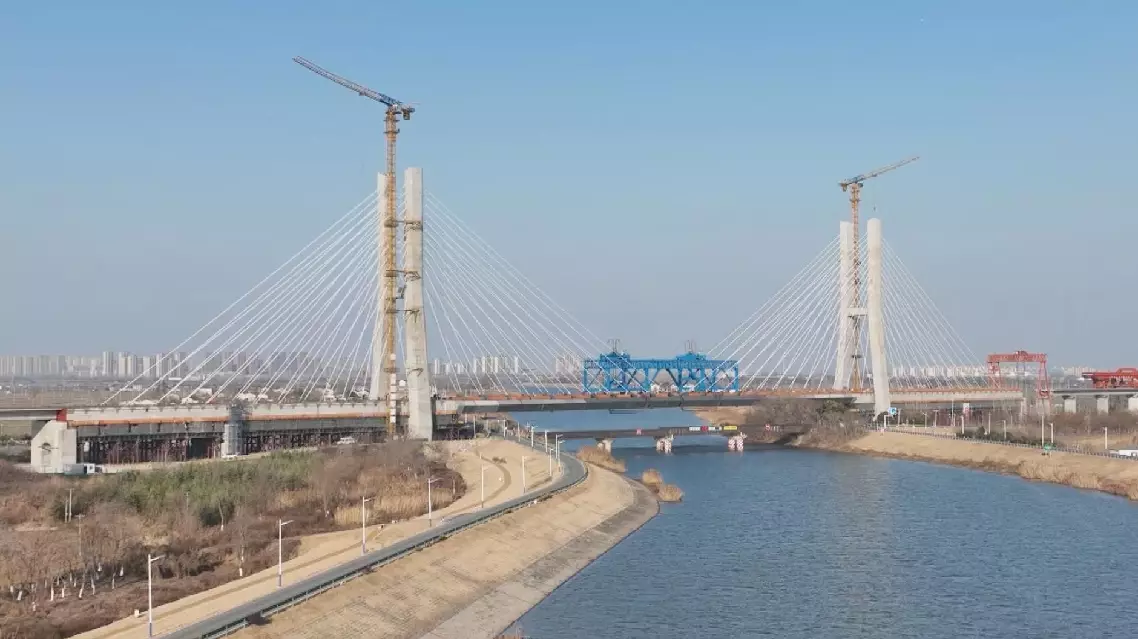
High-speed railway linking Shanghai, Nanjing, Hefei sees new construction progress