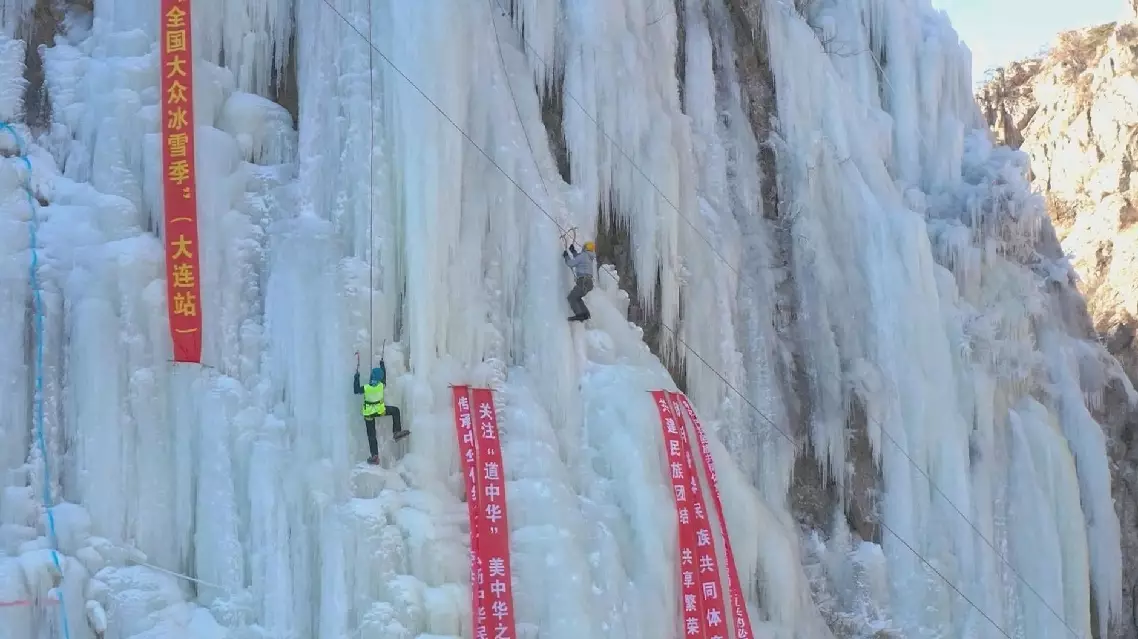
The 2025 Liaoning Tianmen Mountain ice climbing invitational tournament kicked off on Saturday, as 100 top ice climbers from across China competing on the nearly vertical icicles in a national park in the coastal city of Dalian in northeast China's Liaoning Province.
The competition began at 10:20, with participants strapping on their crampons and holding ice axes in hands to scale the almost vertical frozen waterfalls.
The tournament set the men's course at about 50 meters in vertical height, while the women's at 40 meters, with time limits of 10 and 12 minutes respectively. From afar, the climbers appeared to dance ballet on ice as they ascended the glistening walls.
"The ice wall is about 50 meters, and it's upright, with no slight slopes, unlike other ice walls which have steps or slight slopes. Most of the ice walls here are vertical, so it was very difficult. But I feel great, because it's the sport for the brave," said Hai Fei, a competitor.
"The course is very high and the straight wall is especially long. And it's very, very enjoyable to climb, and we are very fond of this place. You come to the ice wall and you forget everything, as it's so delightful. I think this ice wall feels energetic. We feel full of strength after this ice climbing," said Xiao Lu, another competitor.
After fierce competition, the champion for the men's group finished with 3 minutes and 24 seconds, and the champion of the women's group with 11 minutes and 4 seconds.
Ice climbing, developed from modern mountaineering, requires participants to scale near-vertical icicles, with their speed and the height they got to determining the final rankings.
Due to the climate, the ice climbing season in Dalian's Tianmen Mountain lasts only about a month each year during the deep winter.
Ice climbing race held in northeast China
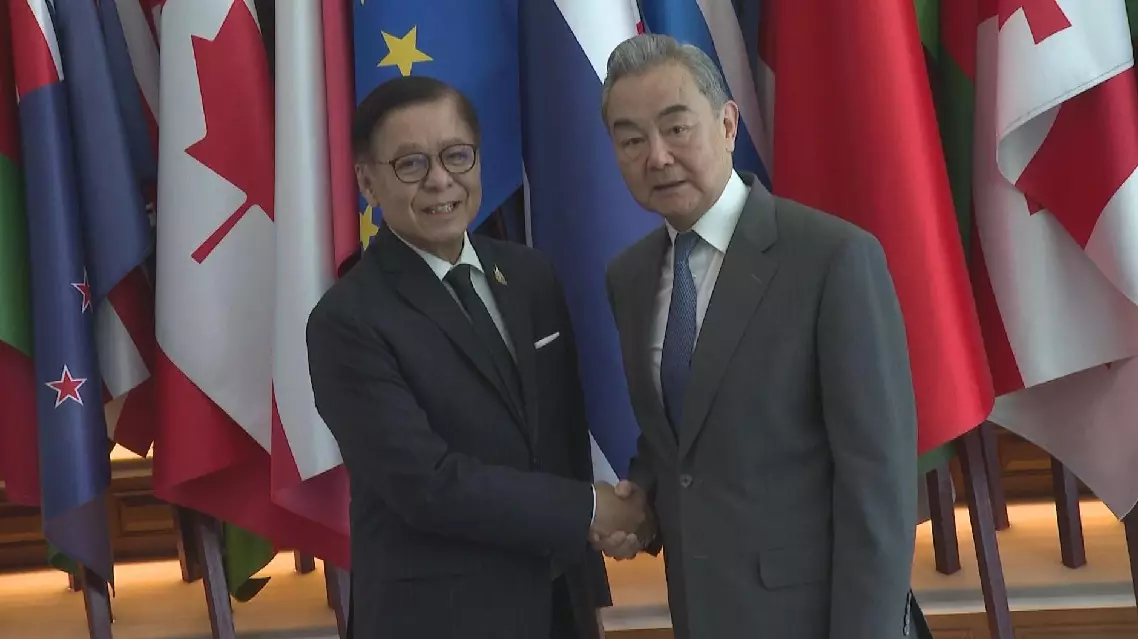
Chinese Foreign Minister Wang Yi, together with Sihasak Phuangketkeow, Thailand's deputy prime minister and foreign minister, held the third meeting of the Consultation Mechanism between the Ministers of Foreign Affairs of China and Thailand on Friday in Bangkok.
Wang, also a member of the Political Bureau of the Communist Party of China Central Committee, noted that this year marks the beginning of China's 15th Five-Year Plan and also the start of the new Thai government's governance.
Facing a volatile international situation, Wang said, China is willing to work with Thailand to give full play to the coordinating role of the foreign ministers' consultation mechanism guided by the strategic consensus reached by the two heads of state.
Both sides should join hands to advance their respective modernization processes, jointly practice genuine multilateralism, create a new golden 50 years for China-Thailand friendship, and make new contributions to promoting the solidarity and development of the Global South as well as regional peace and stability, he said.
Noting that China has always placed Thailand in an important position in its neighborhood diplomacy, Wang said China is ready to continue to be a reliable strategic partner of Thailand, support the new Thai government in leading its people to follow a development path that suits its national conditions, and promote the building of a more stable, prosperous and sustainable China-Thailand community with a shared future.
It is believed that Thailand will continue to resolutely support China's great cause of peaceful reunification, he added.
Wang also called on the two sides to maintain high-level exchanges, enhance political mutual trust, strengthen the alignment of development strategies and initiate the formulation of the new five-year action plan.
He said that both sides should intensify efforts to crack down on transnational crimes, completely eradicate gambling and fraud, strengthen multilateral collaboration and jointly implement the four major global initiatives.
China has always advocated resolving differences between countries through dialogue rather than force, Wang said, extending the hopes that Thailand and Cambodia will consolidate the ceasefire situation, resume bilateral contacts, resolve border disputes as soon as possible and maintain a peaceful and stable environment.
As a common friend of Thailand and Cambodia, China is willing to continue to build a platform for the two sides to rebuild mutual trust and improve relations, he said.
For his part, Sihasak said that Thailand will, as always, attach great importance to its relations with China, firmly pursue the one-China policy, and consolidate the political foundation of bilateral relations.
Thailand is willing to enhance high-level exchanges with China, deepen all-round cooperation in various fields such as connectivity, economy and trade, and combating online gambling and telecommunications fraud, and promote the continuous development of the Thailand-China community with a shared future.
He said that Thailand highly appreciates the four major global initiatives and is willing to strengthen multilateral coordination with China.
Sihasak expressed the appreciation for China's efforts in actively promoting peace talks and mediating the border dispute between Thailand and Cambodia, adding that he looks forward to China continuing to play a constructive role.
The two foreign ministers also exchanged views on the Lancang-Mekong Cooperation (LMC) and East Asia cooperation, and agreed to enhance coordination and cooperation to actively build an LMC 2.0, promoting the building of a Lancang-Mekong community with a shared future to a new level.
Chinese, Thai FMs hold 3rd consultation mechanism meeting