Delegations from the United States and Iran are reportedly set to arrive in the Pakistani capital for a second round of peace talks aimed at reducing tensions.
An Iranian delegation led by Foreign Minister Seyed Abbas Araghchi is expected to arrive in Pakistan late Friday, according to Pakistani government sources.
Before any potential talks with the United States, the Iranian side will first discuss key preconditions with Pakistani mediators, a Pakistani official said.
According to the official, the discussions are expected to focus on issues including the lifting of blockades and the release of seized ships and crew.
The official added that Tehran is seeking initial confidence-building gestures from the United States before moving toward direct engagement.
The White House said on Friday that U.S. President Donald Trump's special envoy Steve Witkoff and son-in-law Jared Kushner will travel to Pakistan on Saturday for more talks with Iranian officials, adding that Vice President JD Vance will be on standby in the United States.
Earlier on Friday, Pakistani Deputy Prime Minister and Foreign Minister Mohammad Ishaq Dar held a phone conversation with Araghchi, stressing the importance of sustained dialogue and engagement to address outstanding issues and advance regional peace and stability as soon as possible.
Tight security arrangements have been put in place in Islamabad for visiting foreign delegations ahead of the second round of talks, according to the interior ministry.
On April 11, Iran and the United States, under Pakistan's mediation, held the first round of intense negotiations in Islamabad, but no major breakthrough was achieved.

Iranian, U.S. delegates expected in Pakistan for peace talks
For the first time in decades, three U.S. aircraft carriers are operating simultaneously in the Middle East, U.S. Central Command said on Friday.
The three carriers — the USS Abraham Lincoln, the USS Gerald R. Ford and the USS George H.W. Bush — are carrying more than 200 aircraft and 15,000 sailors and Marines, according to the Central Command.
A day earlier, the command announced that the Bush carrier strike group had entered its area of responsibility and was currently in the Indian Ocean. The Bush, a Nimitz-class carrier, left Naval Station Norfolk in the U.S. state of Virginia in late March.
The Lincoln is conducting missions in the Arabian Sea, primarily tasked with enhancing U.S. maritime blockade operations, while the Ford is positioned in the northern Red Sea, where the U.S. claims that it is maintaining maritime security.
The Bush is expected to relieve the Ford, and during the handover period, the U.S. military is expected to maintain a three-carrier deployment posture in the region.
Meanwhile, an Iranian Defense Ministry spokesman said on Thursday that Iran has never halted production of defense equipment, and the ministry is fully committed to meeting the needs of the armed forces across all situations, including combat readiness and ceasefire conditions.
The developments come as a fragile U.S.-Iran ceasefire faces uncertainty, with Washington continuing its naval blockade and signaling possible military action.
Pakistan, meanwhile, is pushing to revive stalled U.S.-Iran talks, with Iranian Foreign Minister Seyed Abbas Araghchi expected to visit Pakistan for talks with Islamabad's mediation team and Washington saying key negotiators would also travel to Pakistan, raising speculation that a second round of U.S.-Iran talks could resume.
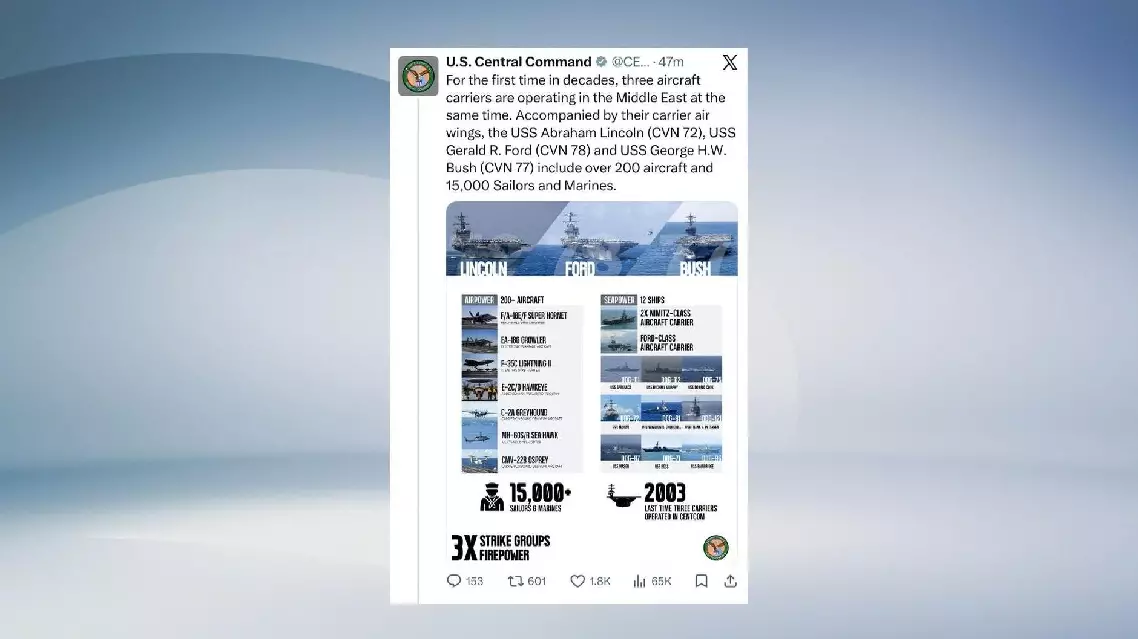
3 U.S. carriers operate simultaneously in Middle East for first time in decades: U.S. Central Command