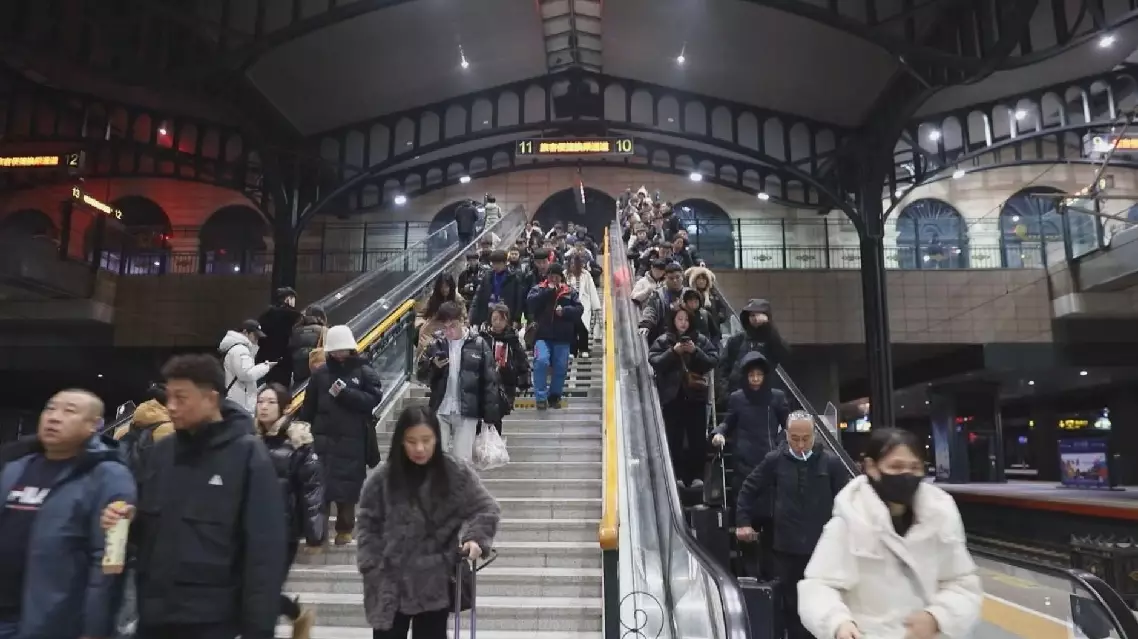
Chinese authorities expect over 170 million interregional passenger trips on Tuesday, the first day of the country's largest annual population migration -- the Spring Festival travel rush -- with transport departments nationwide offering diverse services to facilitate convenient travel for passengers.
About 10.3 million train trips are expected to be made on Tuesday, the first day of the 40-day travel rush.
Starting at 0:00 on Tuesday, the railway sector has begun using a train scheduling diagram for the travel rush based on that of the first quarter, with additional temporary trains and high-speed overnight trains being marshaled on popular routes and sections with high passenger volumes.
During the travel rush, China Railway Beijing Group will marshal a total of 220 pairs of temporary and direct electrical multiple unit (EMU) trains on peak-hour lines to destinations including Changchun in Jilin Province and Harbin in Heilongjiang Province in northeast China, and Zhangjiakou in Hebei Province in north China.
Meanwhile, several new railway lines, including the Shanghai-Suzhou-Huzhou High-speed Railway, the Jining-Datong-Yuanping High-speed Railway, and the Nanning-Yulin section of the Nanning-Zhuhai High-speed Railway, were put into operation last year, effectively improving the transport capacity for this year's Spring Festival travel rush.
"Guangxi has realized high-speed rail access for every city. The opening of the Yulin North Railway Station has significantly enhanced the convenience of our travels," said a passenger from south China's Guangxi region.
During the travel rush, it is expected that a significant increase will occur in the number of new energy vehicles (NEVs) on the roads compared to the same period in 2024.
In some highway traffic service areas, transport departments are improving high-speed charging infrastructure to ensure convenient travel for NEV owners.
In civil aviation, it is estimated that a total of 18,354 flights will be operated on Tuesday, transporting a total of 2.04 million passengers.
As the Spring Festival draws near, the tropical island province of Hainan in south China is entering its peak tourism season. Airports in the cities of Haikou and Sanya are diligently working to ensure transport services and capacity to cater to the influx of passengers.
"In efforts to serve key tourism-generating destinations such as Beijing, Shanghai, Guangzhou, Shenzhen and Chengdu, we have increased the operation of flights with wide-body aircraft. The number of parking aprons for wide-body aircraft will reach 16, marking a 33-percent increase over 2024," said Quan Xiaoyi, vice president of the Sanya Phoenix International Airport Co., Ltd.
In terms of water transport, during this year's Spring Festival travel rush, a comprehensive reservation system will be implemented for the "ro-ro" (roll-on/roll-off) transportation across the Qiongzhou Strait in Hainan.
The local maritime department will employ the smart maritime system for the first time to deliver "one-on-one" comprehensive and precise services for the "ro-ro" transportation across the strait.
Moreover, the Ministry of Public Security has required the public security authorities in sectors such as railways and civil aviation to enhance inspection against security risks to effectively maintain the public order at key transportation hubs such as railway stations and airports.
The Spring Festival, marking the start of the traditional Chinese Lunar New Year, is the country's grandest traditional festival when people across the country return to their hometowns for Chinese Lunar New Year celebrations and family reunion.
Spring Festival travel rush starts with over 170 million cross-regional trips expected