NEW YORK (AP) — They seem endless, these sapping stories of loss. A grandfather starts over in his 90s. A family loses their dream home. People who were already struggling are dealt new, brutal blows.
As California's massive wildfires burn, a barrage of GoFundMe campaigns for victims have become an outlet for onlookers transfixed by the blazes and eager to do something to help. Those appeals for help — plastered with photos of saffron flames or the charcoal aftermath or, most of all, the faces of the people at the center of the plea — are personalizing a tragedy too big to comprehend.
Click to Gallery
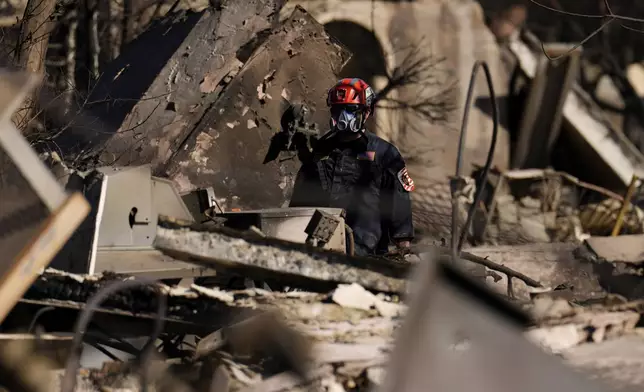
A member of a San Bernardino County Fire Department Search and Rescue crew works among the ruins of the Palisades Fire in the Pacific Palisades neighborhood of Los Angeles, Tuesday, Jan. 14, 2025. (AP Photo/Carolyn Kaster)
A car drives past homes and vehicles destroyed by the Palisades Fire at the Pacific Palisades Bowl Mobile Estates on Jan. 12, 2025, in Los Angeles. (AP Photo/Noah Berger)
The Palisades Fire ravages a neighborhood amid high winds in the Pacific Palisades neighborhood of Los Angeles, Jan. 7, 2025. (AP Photo/Ethan Swope)
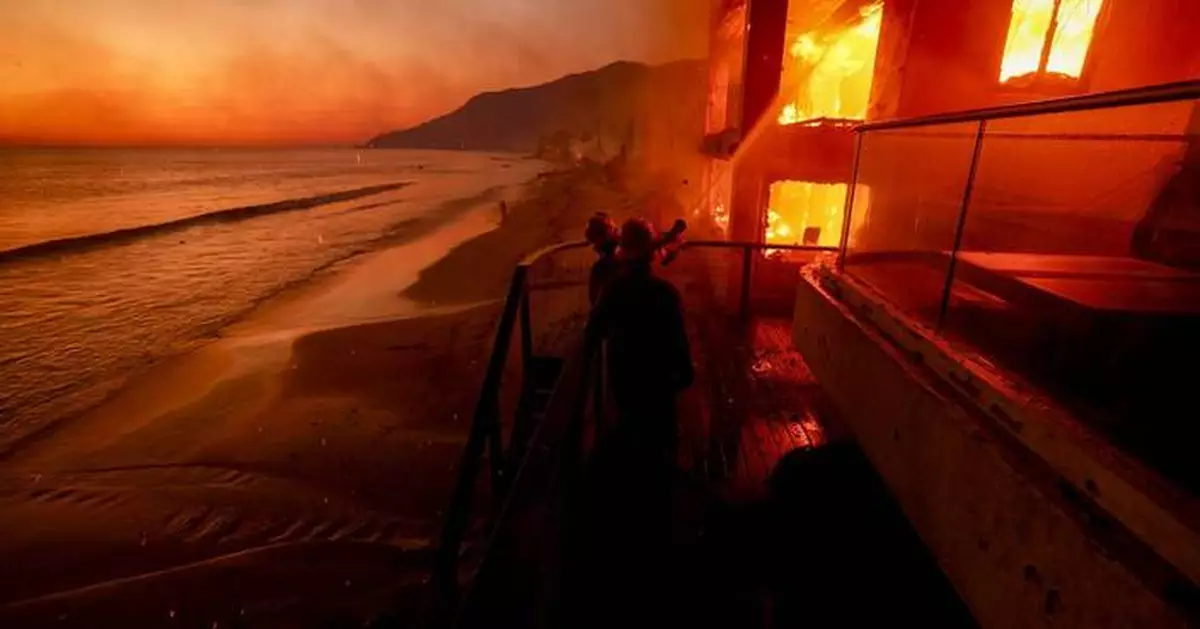
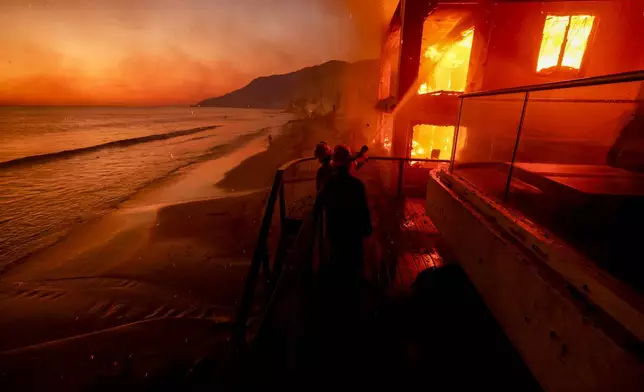
Firefighters work from a deck as the Palisades Fire burns a beachfront property Jan. 8, 2025, in Malibu, Calif. (AP Photo/Etienne Laurent)
“I feel connected in a strange way to all these people that I don’t know,” says Rachel Davies, a 27-year-old writer in New York, who went through hundreds of GoFundMe's wildfire campaigns and felt drawn in to stories of strangers, donating to fundraisers for landscapers, housekeepers and a cook.
Davies was moved by the little details of victims' stories — like the fact that someone lost their home just as they were bringing a baby home from the hospital — and compiled and circulated a list of GoFundMe sites, thinking others would feel the same and be spurred to donate.
“Those stories," Davies says, “will stick with me.”
The pages feel intimate. They serve up glimpses into the lives of a compassionate nurse or a goofy driver, and into the things they lost — be it a prized sneaker collection or the tools they counted on for work. Here, each is not some faraway, faceless victim. They're Todd or Ulli or Susan.
“People can look for someone they see as the ideal victim for them,” says Amy Pason, a professor at the University of Nevada, Reno, who has studied social movements and teaches a class on persuasion.
In an era of constant connection, on-demand expectations, pinpointed preferences and endless customization, browsability and tailoring are second nature. Why not for disaster relief, too?
Plus, Pason says, it feels to many like a “more authentic” way to give.
In a statement, GoFundMe says thousands of fundraisers have been launched in connection with the fires, including its own Wildfire Relief Fund, which has already garnered about 30,000 donations. All told, the campaigns have already raised more than $100 million for wildfire victims.
Ella Marx, a 26-year-old social worker in Ypsilanti, Michigan, is among those who chipped in. She came across an appeal from a woman who said the houses of her grandmother and three aunts were all destroyed by the Eaton Fire. She quickly donated $20.
Marx finds herself donating to GoFundMe campaigns every month or so. She likes them because she doesn’t have faith in the government to help victims and doesn’t like the constraints that nonprofits might put on recipients of aid. Plus, she likes the feeling of knowing who she’s donating to.
“I think it does personalize it a little more,” she says.
Scrolling through GoFundMe's pages, there is something to pull at nearly anyone’s heartstrings. It is a veritable catalog of grief.
Runners might be drawn to a campaign organized by the Pasadena Pacers, which posted photos of members who lost homes on happier days, on a favorite trail or sporting a race-day medal. Rabbit lovers can flock to an appeal for The Bunny Museum, which paid tribute to the fluffy-tailed animal through its collection of tens of thousands of items, now all gone. A bar, a coffee shop, a mosque, a school — all are among the places left in ashes by the fire and now the subject of campaigns to bring them back.
Matthew Wade, a sociologist at La Trobe University in Melbourne, Australia, who has researched GoFundMe, says donors are drawn to the immediate gratification of their gift and the ability to follow along as their beneficiaries recover from tragedy.
“A concrete action,” he says, “in these otherwise helpless moments.”
But while some crowdfunded fundraisers result in a massive response, Wade says many raise little or nothing. Only the most uniquely compelling stories manage to garner a fickle public’s attention, he says, reinforcing existing inequalities.
“Social crowdfunding platforms are effectively markets for sympathy, where the crowd weighs claims to moral worthiness,” Wade said in an email interview.
But John Dent, who created a GoFundMe page for his cousin’s family, who lost their home in Altadena, remains in awe of the generosity his campaign elicited. His relatives had initially rebuffed the idea of the fundraiser but were left in tears by the response of more than $22,000 so far.
“It’s just been so powerful,” says Dent, a 52-year-old teacher from Goleta, California. “These are often people that have no clue who they are.”
HOW TO HELP: In addition to individual GoFundMe efforts, here are some ways to chip in.
Matt Sedensky can be reached at msedensky@ap.org and https://x.com/sedensky.
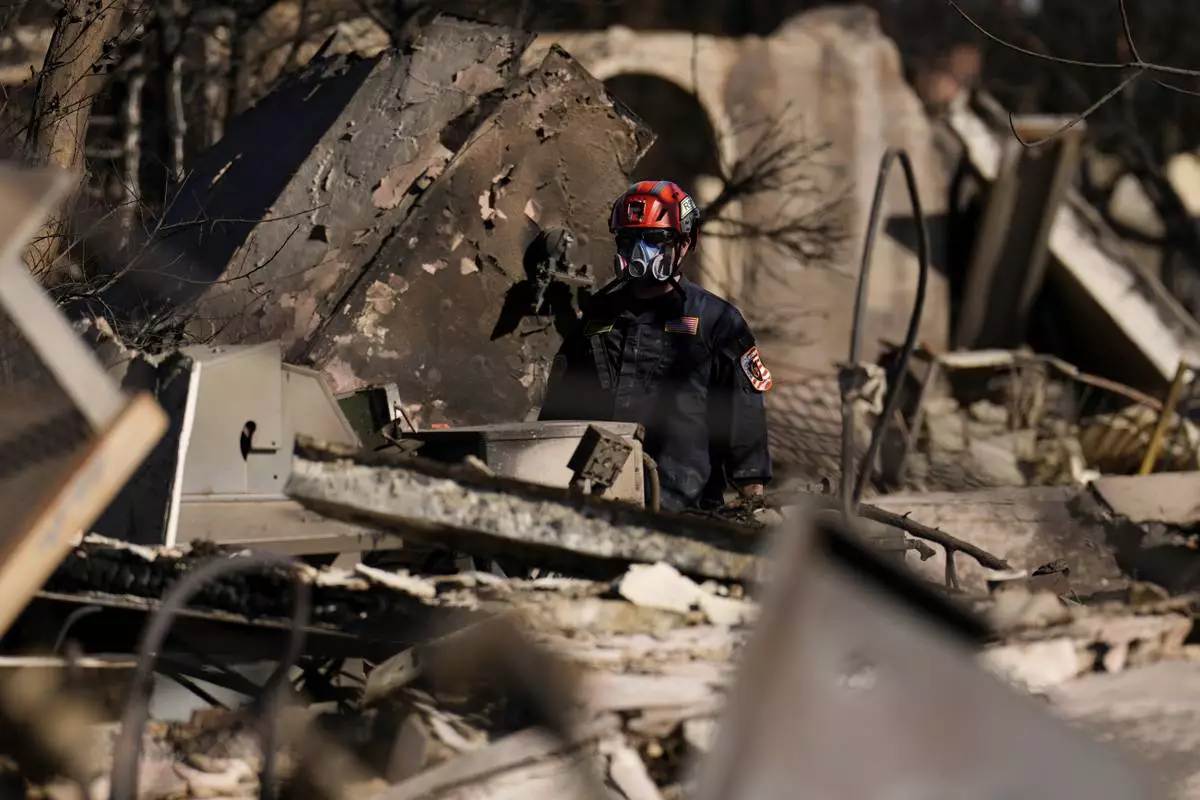
A member of a San Bernardino County Fire Department Search and Rescue crew works among the ruins of the Palisades Fire in the Pacific Palisades neighborhood of Los Angeles, Tuesday, Jan. 14, 2025. (AP Photo/Carolyn Kaster)
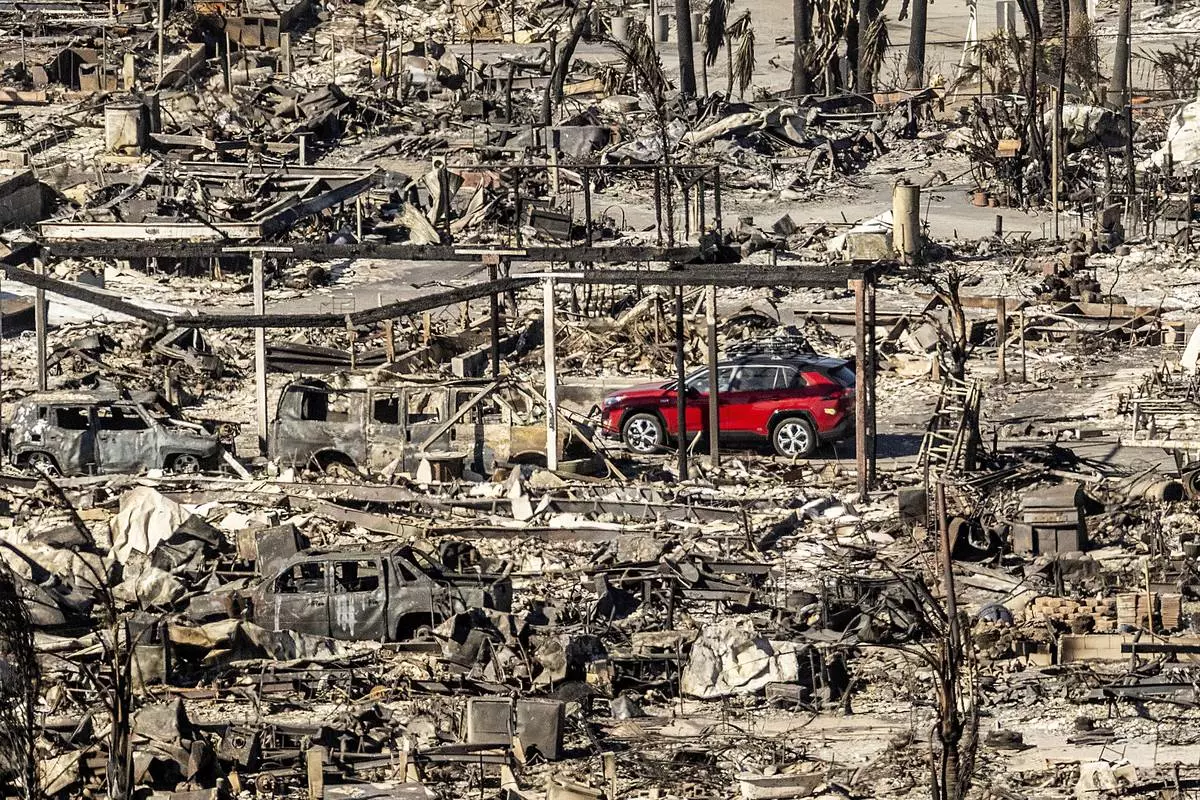
A car drives past homes and vehicles destroyed by the Palisades Fire at the Pacific Palisades Bowl Mobile Estates on Jan. 12, 2025, in Los Angeles. (AP Photo/Noah Berger)

The Palisades Fire ravages a neighborhood amid high winds in the Pacific Palisades neighborhood of Los Angeles, Jan. 7, 2025. (AP Photo/Ethan Swope)

Firefighters work from a deck as the Palisades Fire burns a beachfront property Jan. 8, 2025, in Malibu, Calif. (AP Photo/Etienne Laurent)
WASHINGTON (AP) — Becky Pepper-Jackson finished third in the discus throw in West Virginia last year though she was in just her first year of high school. Now a 15-year-old sophomore, Pepper-Jackson is aware that her upcoming season could be her last.
West Virginia has banned transgender girls like Pepper-Jackson from competing in girls and women's sports, and is among the more than two dozen states with similar laws. Though the West Virginia law has been blocked by lower courts, the outcome could be different at the conservative-dominated Supreme Court, which has allowed multiple restrictions on transgender people to be enforced in the past year.
The justices are hearing arguments Tuesday in two cases over whether the sports bans violate the Constitution or the landmark federal law known as Title IX that prohibits sex discrimination in education. The second case comes from Idaho, where college student Lindsay Hecox challenged that state's law.
Decisions are expected by early summer.
President Donald Trump's Republican administration has targeted transgender Americans from the first day of his second term, including ousting transgender people from the military and declaring that gender is immutable and determined at birth.
Pepper-Jackson has become the face of the nationwide battle over the participation of transgender girls in athletics that has played out at both the state and federal levels as Republicans have leveraged the issue as a fight for athletic fairness for women and girls.
“I think it’s something that needs to be done,” Pepper-Jackson said in an interview with The Associated Press that was conducted over Zoom. “It’s something I’m here to do because ... this is important to me. I know it’s important to other people. So, like, I’m here for it.”
She sat alongside her mother, Heather Jackson, on a sofa in their home just outside Bridgeport, a rural West Virginia community about 40 miles southwest of Morgantown, to talk about a legal fight that began when she was a middle schooler who finished near the back of the pack in cross-country races.
Pepper-Jackson has grown into a competitive discus and shot put thrower. In addition to the bronze medal in the discus, she finished eighth among shot putters.
She attributes her success to hard work, practicing at school and in her backyard, and lifting weights. Pepper-Jackson has been taking puberty-blocking medication and has publicly identified as a girl since she was in the third grade, though the Supreme Court's decision in June upholding state bans on gender-affirming medical treatment for minors has forced her to go out of state for care.
Her very improvement as an athlete has been cited as a reason she should not be allowed to compete against girls.
“There are immutable physical and biological characteristic differences between men and women that make men bigger, stronger, and faster than women. And if we allow biological males to play sports against biological females, those differences will erode the ability and the places for women in these sports which we have fought so hard for over the last 50 years,” West Virginia's attorney general, JB McCuskey, said in an AP interview. McCuskey said he is not aware of any other transgender athlete in the state who has competed or is trying to compete in girls or women’s sports.
Despite the small numbers of transgender athletes, the issue has taken on outsize importance. The NCAA and the U.S. Olympic and Paralympic Committees banned transgender women from women's sports after Trump signed an executive order aimed at barring their participation.
The public generally is supportive of the limits. An Associated Press-NORC Center for Public Affairs Research poll conducted in October 2025 found that about 6 in 10 U.S. adults “strongly” or “somewhat” favored requiring transgender children and teenagers to only compete on sports teams that match the sex they were assigned at birth, not the gender they identify with, while about 2 in 10 were “strongly” or “somewhat” opposed and about one-quarter did not have an opinion.
About 2.1 million adults, or 0.8%, and 724,000 people age 13 to 17, or 3.3%, identify as transgender in the U.S., according to the Williams Institute at the UCLA School of Law.
Those allied with the administration on the issue paint it in broader terms than just sports, pointing to state laws, Trump administration policies and court rulings against transgender people.
"I think there are cultural, political, legal headwinds all supporting this notion that it’s just a lie that a man can be a woman," said John Bursch, a lawyer with the conservative Christian law firm Alliance Defending Freedom that has led the legal campaign against transgender people. “And if we want a society that respects women and girls, then we need to come to terms with that truth. And the sooner that we do that, the better it will be for women everywhere, whether that be in high school sports teams, high school locker rooms and showers, abused women’s shelters, women’s prisons.”
But Heather Jackson offered different terms to describe the effort to keep her daughter off West Virginia's playing fields.
“Hatred. It’s nothing but hatred,” she said. "This community is the community du jour. We have a long history of isolating marginalized parts of the community.”
Pepper-Jackson has seen some of the uglier side of the debate on display, including when a competitor wore a T-shirt at the championship meet that said, “Men Don't Belong in Women's Sports.”
“I wish these people would educate themselves. Just so they would know that I’m just there to have a good time. That’s it. But it just, it hurts sometimes, like, it gets to me sometimes, but I try to brush it off,” she said.
One schoolmate, identified as A.C. in court papers, said Pepper-Jackson has herself used graphic language in sexually bullying her teammates.
Asked whether she said any of what is alleged, Pepper-Jackson said, “I did not. And the school ruled that there was no evidence to prove that it was true.”
The legal fight will turn on whether the Constitution's equal protection clause or the Title IX anti-discrimination law protects transgender people.
The court ruled in 2020 that workplace discrimination against transgender people is sex discrimination, but refused to extend the logic of that decision to the case over health care for transgender minors.
The court has been deluged by dueling legal briefs from Republican- and Democratic-led states, members of Congress, athletes, doctors, scientists and scholars.
The outcome also could influence separate legal efforts seeking to bar transgender athletes in states that have continued to allow them to compete.
If Pepper-Jackson is forced to stop competing, she said she will still be able to lift weights and continue playing trumpet in the school concert and jazz bands.
“It will hurt a lot, and I know it will, but that’s what I’ll have to do,” she said.
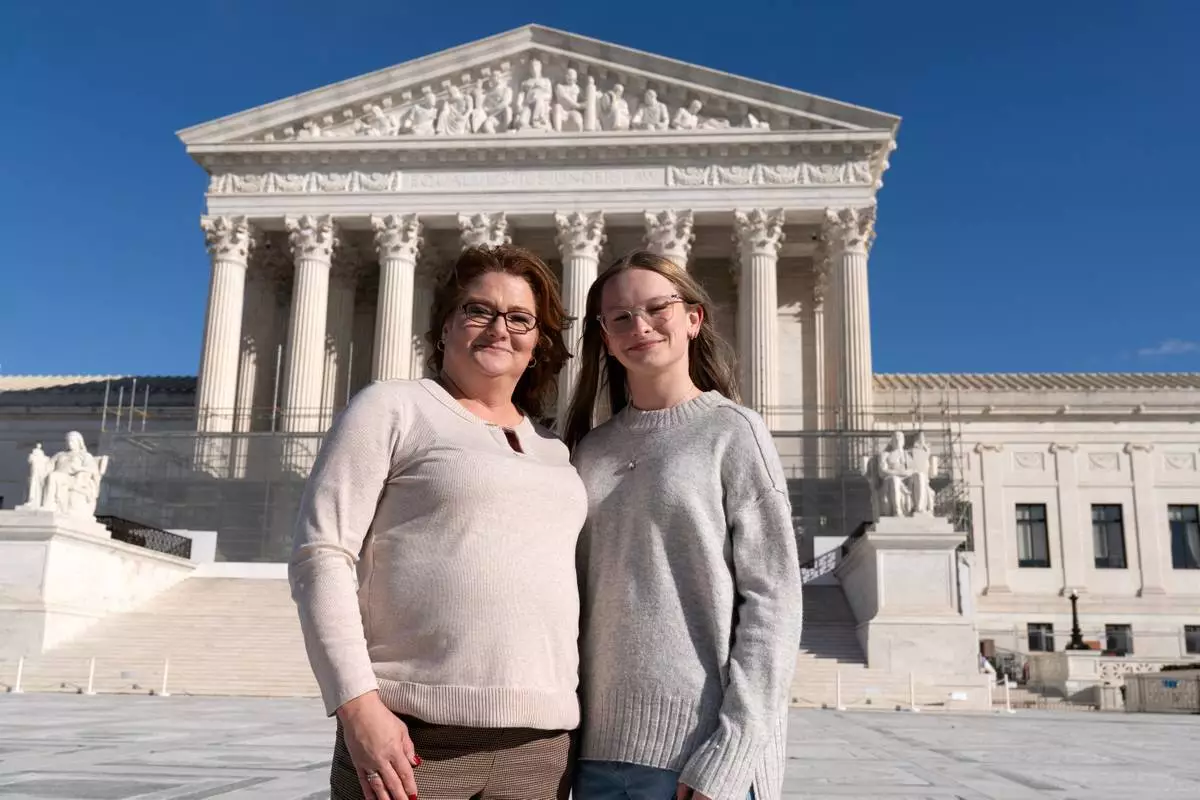
Heather Jackson, left, and Becky Pepper-Jackson pose for a photograph outside of the U.S. Supreme Court in Washington, Sunday, Jan. 11, 2026. (AP Photo/Jose Luis Magana)
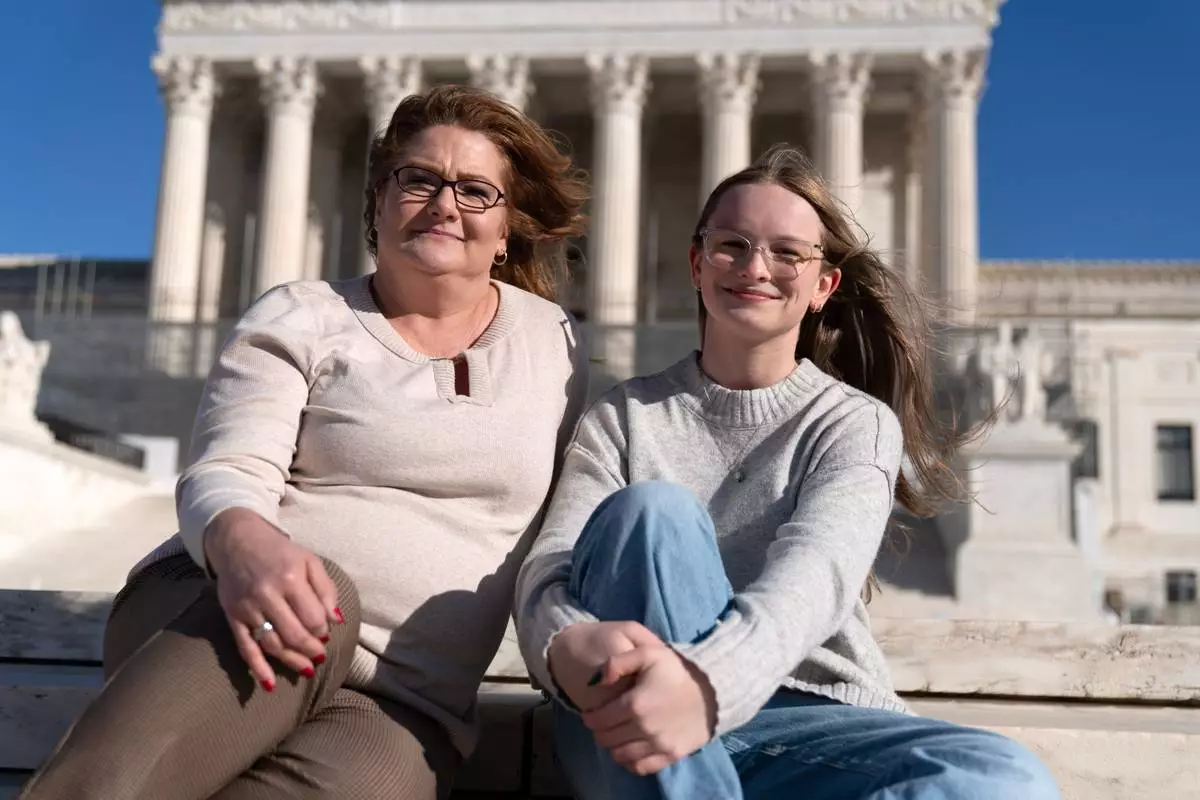
Heather Jackson, left, and Becky Pepper-Jackson pose for a photograph outside of the U.S. Supreme Court in Washington, Sunday, Jan. 11, 2026. (AP Photo/Jose Luis Magana)
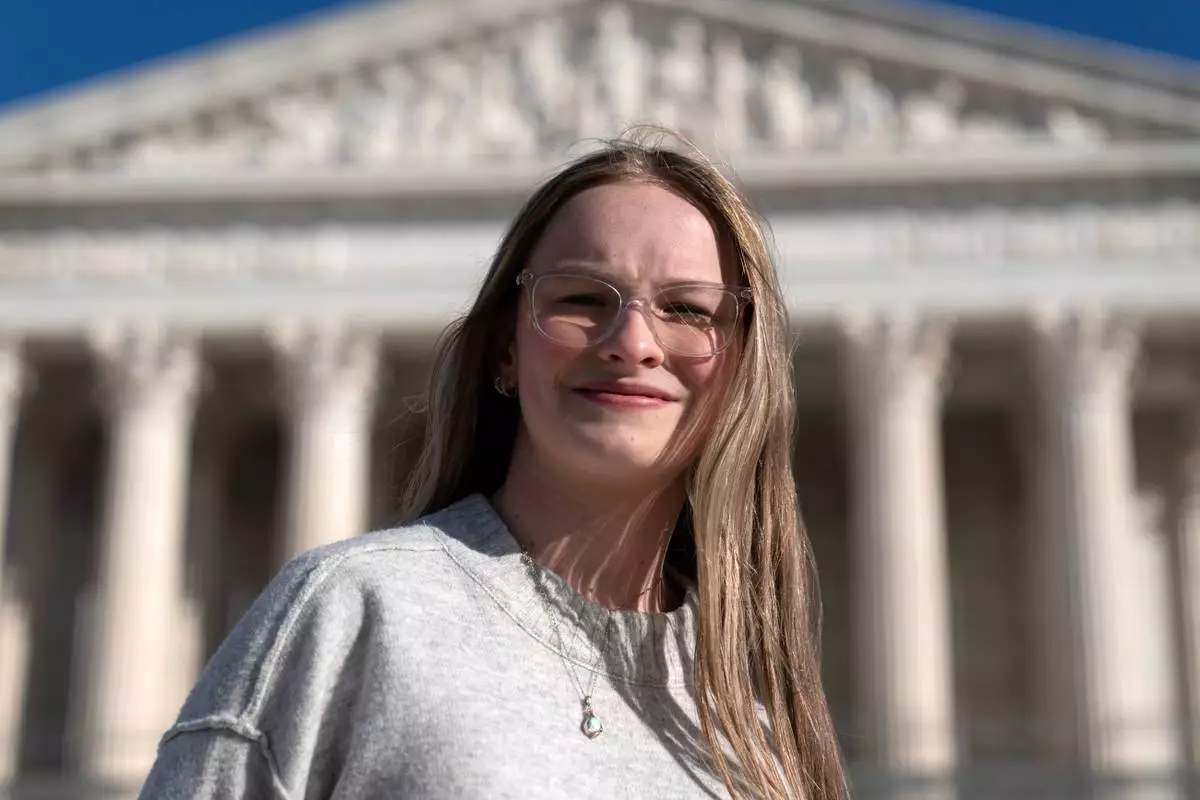
Becky Pepper-Jackson poses for a photograph outside of the U.S. Supreme Court in Washington, Sunday, Jan. 11, 2026. (AP Photo/Jose Luis Magana)
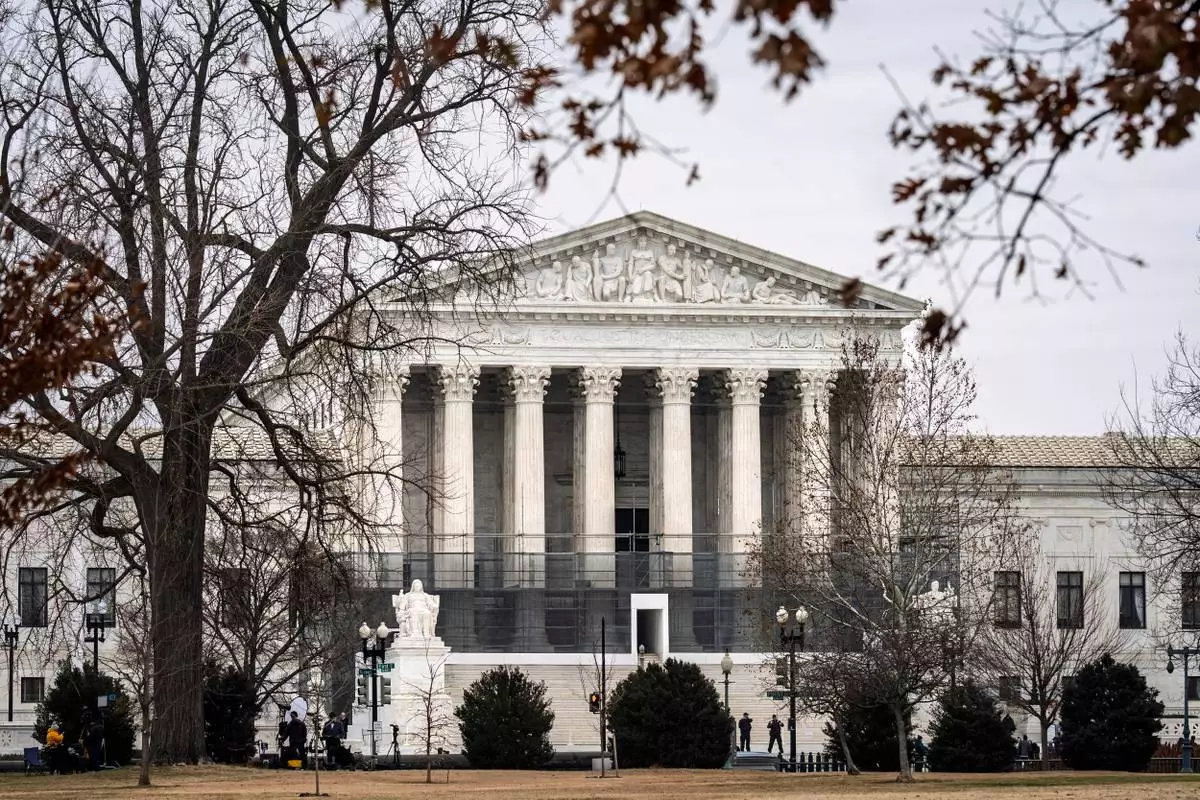
The Supreme Court stands is Washington, Friday, Jan. 9, 2026. (AP Photo/J. Scott Applewhite)
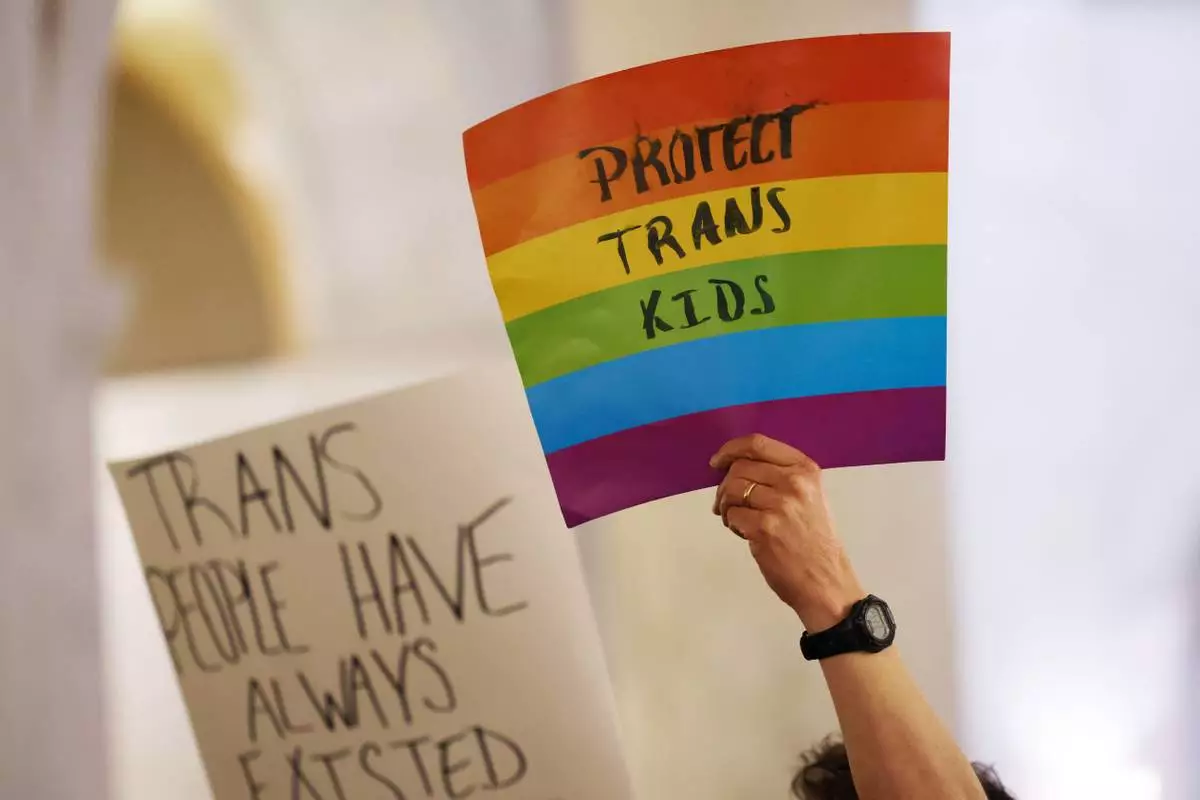
FILE - Protestors hold signs during a rally at the state capitol in Charleston, W.Va., on March 9, 2023. (AP Photo/Chris Jackson, file)