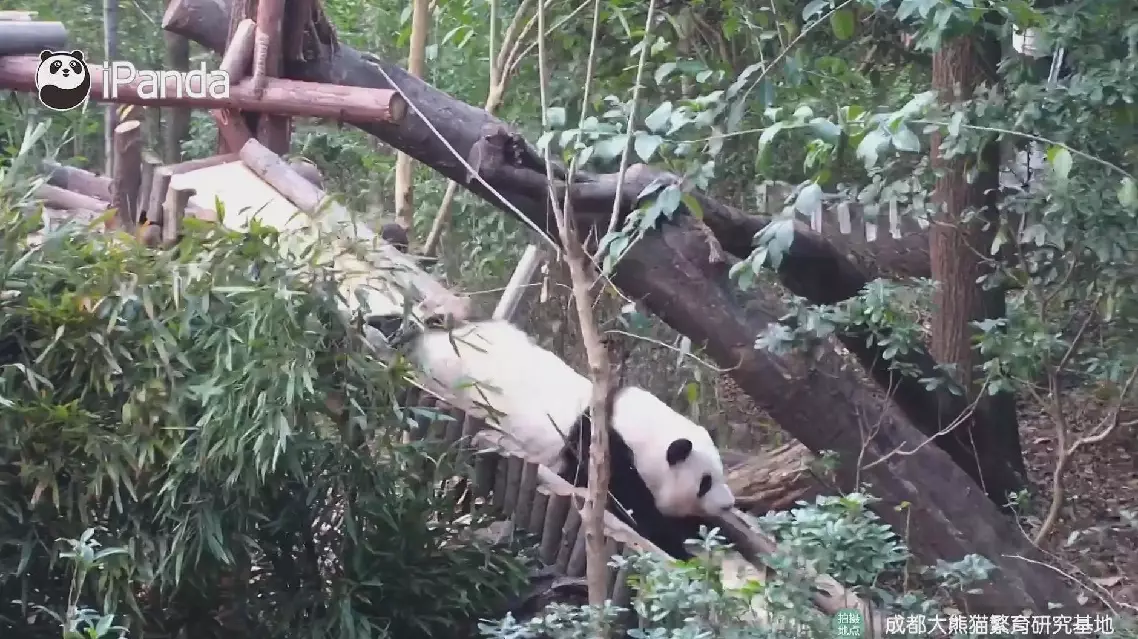
Footage of He Hua and He Ye, China's beloved twin panda sisters, joyfully sliding down a specially designed slide at the Chengdu Research Base of Giant Panda Breeding has captured hearts worldwide.
The video released on January 11 captures the joy and playfulness of the twin panda sisters as they slide and frolic on a specially designed slide created by their keepers at the Chengdu Research Base's No. 6 Giant Panda Villa.
He Hua, the more adventurous of the twin panda sisters, is captured sliding down the slope on her belly, while her younger sister He Ye lounges nearby on a rack, looking relaxed. Meanwhile, another clip shows He Ye taking a more leisurely approach, gliding sideways down the slide while grasping a nearby tree, creating a heartwarming moment.
The slide is part of a larger enrichment program aimed at fostering natural behaviors, preventing repetitive actions, and meeting the pandas' physiological and psychological needs.
Born on July 4, 2020, to mother Cheng Gong and father Mei Lan, He Hua and He Ye have quickly become international icons.
He Hua, the older sister, is famous for her "rice ball" shape when she sits and her calm, gentle nature, particularly when she shares bamboo with her companions. With over 880,000 followers on Weibo, China's leading social platform, He Hua has also won fans worldwide, with one of her YouTube videos amassing over 748,000 views.
He Ye, the younger sister, is known for her energetic spirit and athleticism, earning her a global following of devoted panda enthusiasts.
Located in Sichuan Province, southwest China, the Chengdu Research Base of Giant Panda Breeding is a globally recognized institution dedicated to the conservation of giant pandas, red pandas, and other endangered species native to China.
The base has become a major tourist destination, celebrated for its breeding programs, educational outreach, and efforts to protect these iconic animals.
Twin panda sisters in Chengdu bring smiles worldwide with slide adventure
Chinese scientists have made improvements for the porthole of the Shenzhou-23 spaceship at the launch site to avoid potential emergency situations caused by space debris.
The Shenzhou-20 spaceship's return capsule viewport window suffered a suspected impact from space debris during its mission last year. The three Shenzhou-20 astronauts returned safely aboard the Shenzhou-21 spaceship on Nov. 14, 2025, and later on Nov. 25, China launched the Shenzhou-22 spaceship to provide a return vessel for the three Shenzhou-21 astronauts, who are currently in orbit.
To avoid such a potential emergency during the Shenzhou-23 mission, the porthole improvements were implemented ahead of schedule.
According to the original plan, the porthole upgrade was scheduled for implementation on the Shenzhou-24 spacecraft. However, after the Shenzhou-20 experienced an in-orbit space debris impact that affected the astronauts’ return, the team conducted a comprehensive assessment and decided to advance the upgrade to Shenzhou-23 to ensure a smooth and safe mission.
"The previous version of the viewport window had one layer of anti-ablation glass, while we increased that to two layers for the new window for dual redundancy. In addition, we have taken an extra protective measure as a final safeguard inside the capsule. These make up a three-layer anti-ablation function, adding an extra insurance for the astronauts to work and live safely and securely in orbit, and to return safely," said He Yu, chief commander of Shenzhou spacecraft of the China Aerospace Science and Technology Corporation.
Under normal circumstances, the viewport windows are installed at the spacecraft assembly workshop in Beijing before the capsule is assembled with other ones. But, since the Shenzhou-23 had already been manufactured and placed on emergency standby at the Jiuquan Satellite Launch Center, the porthole upgrade was conducted after all three modules had already been assembled -- a process much more difficult due to the confined space inside the capsule.
"Our guiding principle is putting people first. Moreover, we must further demonstrate the strength of China as a major country with strong aerospace capabilities. We will never allow space debris to affect the smooth progress of our mission," said the chief commander.

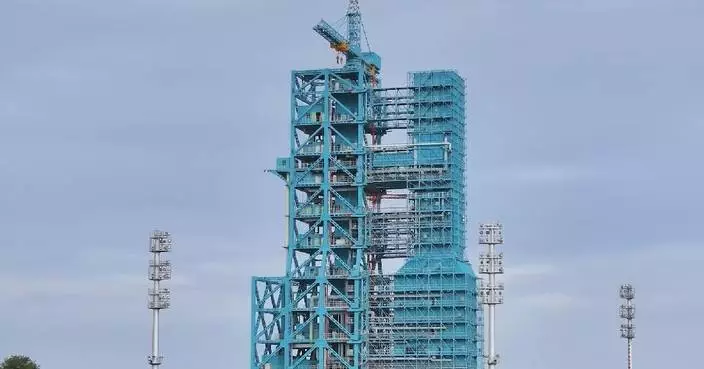
Shenzhou-23 spaceship undergoes porthole improvements at launch site