The United States' export restrictions on China's semiconductor industry have failed to curb the growth of Chinese companies and have instead driven independent innovation, reducing reliance on U.S. technology and strengthening China's competitiveness in the global market, experts say.
Earlier this week, the Biden administration announced new export restrictions on advanced chip technology, specifically targeting China. The incoming Trump administration is set to review the policy and decide whether to maintain the same course.
AI chip maker NVIDIA issued a statement saying the rules would only weaken America's global competitiveness. This sentiment was echoed by Tim Bajarin, president of Creative Strategies, a Silicon Valley-based market intelligence and strategy consulting firm.
"These restrictions will keep, I think, global competitiveness away in some sense, because it's restricting who we can partner with. And that's going to be an issue that's incredibly difficult to deal with. And then of course, the technology effectiveness, the restrictions may not effectively limit overall AI computing power, as competitors can achieve similar capabilities by using more, less powerful GPUs but cobbling them together," he said.
That's exactly what Chinese companies have managed to do. A prime example is the Chinese-developed DeepSeek AI chatbot, whose developer claims to have spent only a fraction of the development costs compared to companies like OpenAI. In some tests, it closely matched OpenAI's ChatGPT model and outperformed Meta's Llama AI model.
"You could have said that thanks to the sanction of the chips, lots of Chinese AI startups focused on developing AI applications in a more efficient way, using much fewer GPU chips than the U.S. counterparts," said Winston Ma, author of "The Digital War."
One area where Chinese tech companies have focused their efforts is humanoid robotics.
"[If you went to] the recent CES Las Vegas Exhibition, you will find Chinese manufacturers dominate the exhibition of smart robotics. It's interesting that 'Made in China' was started when China was at the low end of the global supply chain. But after two, three decades, the Chinese manufacturing ecosystem, especially relating to electronics, has become the strongest in the world," said Ma.
Rebecca Fannin, author of "Tech Titans of China," said the lack of collaboration has led to diverging paths in the personal computing space.
"We're seeing separate spheres developed of innovation. For instance, with Huawei and its own Harmony OS operating system, totally developed within China, no longer dependent upon anything from Android," she said.
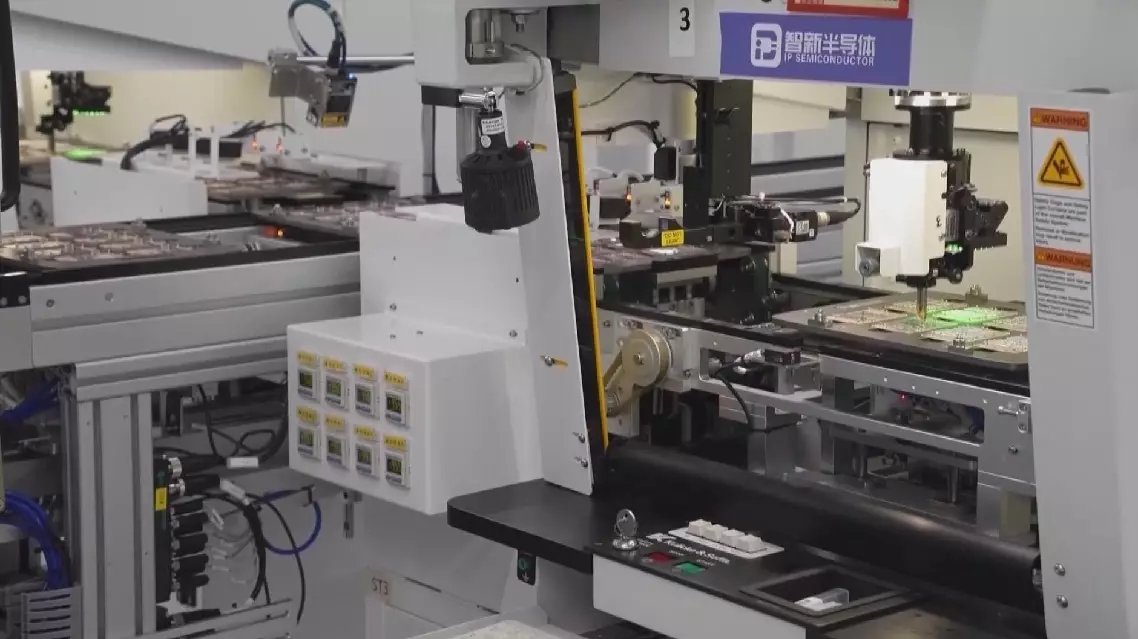
China doubles down on innovation amid US restrictions on chip exports: experts
China doubles down on innovation amid US restrictions on chip exports: experts